By Humaira Ahad
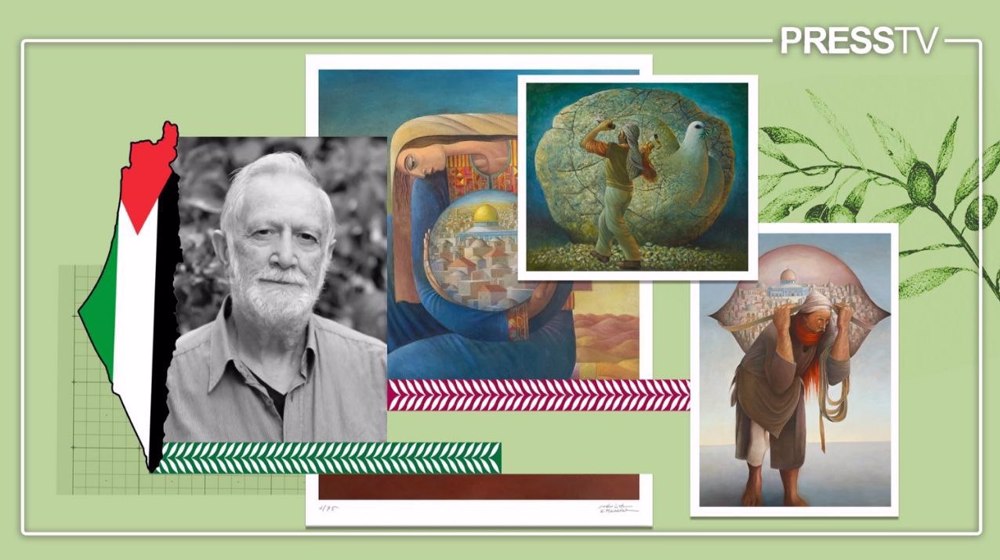
Sliman Mansour never left Palestine, even when Palestine, piece by piece, was taken from him. The distinguished painter, who died on August 24 aged 79, spent five decades turning that loss – olive trees, embroidered dresses, cracked earth – into an image Palestinians could recognize as their own.
He painted the same land for fifty years, and it kept changing under him. Mansour began exhibiting his work in the early 1970s, when Palestinian art had no institutions and no galleries of its own.
Israeli military authorities could, and often did, walk into an exhibition and shut it down. By the time he died, he had built much of that infrastructure himself and left behind hundreds of paintings that Palestinians of several generations have used to recognize themselves and their homeland.
His funeral was held at the church in Birzeit, near Ramallah in the occupied West Bank, in the presence of Palestinians from different walks of life.
In his message of condolence, Ahmed Norouzi, head of the Islamic Republic of Iran Broadcasting’s (IRIB) World Service and Press TV CEO, described his passing as a loss not only to the art world but to Palestine’s visual memory and collective consciousness.
Norouzi said Mansour had used his art to preserve what had been erased from the Palestinian landscape, bringing villages, homes, olive trees, Jerusalem and the experiences of displacement and steadfastness onto his canvases.
“He did not paint Palestine, he brought Palestine out from beneath the rubble of oblivion,” Norouzi wrote, portraying Mansour as a chronicler who transformed “displacement into memory, earth into identity and silence into a global cry.”
He added that although the artist had died, his legacy would endure in his paintings and in the generations of Palestinians who continue to remember the homeland and its hope for freedom.
Movement built from nothing
Mansour was born on July 27, 1947, in Birzeit, a town north of occupied Al Quds (Jerusalem), one year before the Nakba, or the catastrophe that befell Palestine in 1948. It resulted in the dispossession of an estimated 750,000 Palestinians from historic Palestine and the uprooting of much of Palestinian society in the process of the establishment of the Zionist regime.
The Palestinian painter grew up inside the aftermath of that displacement and came of age under the Israeli occupation that followed in 1967.
He studied at the Bezalel Academy of Arts and Design in occupied Al Quds, graduating in 1970, and from there began the work that would occupy the rest of his life: painting a homeland whose borders, ownership and very visibility were under occupation.
In the mid-1970s, Mansour and a small group of fellow artists, most of them just out of art school, founded the League of Palestinian Artists in 1973, the first official Palestinian art body to organize under the Israeli occupation.
Mansour served as its president more than once, at a place where forming an artists’ union required navigating Israel’s military administration, which treated even cultural organizing with suspicion and punishment.
Two decades later, in 1994, he co-founded the al-Wasiti Art Center, housed in a renovated old building in occupied Al Quds. Its purpose was to give Palestinian artists living under occupation a way to connect with the much larger number of Palestinian artists who had been living in exile for years, some since 1948, unable to return home.
Mansour was also a founding board member of the International Academy of Art–Palestine in Ramallah and taught for years at Palestinian institutions, including Al-Quds University, where former students remember him as generous with his time and blunt with his critiques.
Farmers, olive trees, and the language of sumud
Mansour’s paintings returned obsessively to the Palestinian countryside: men and women tilling soil, picking olives, harvesting wheat.
These were not just pastoral scenes but studies of sumud, the Arabic word for steadfastness that has become shorthand for what it means to stay on the land under occupation, where even remaining on the land can be an act of defiance.
He built a personal iconography out of that landscape and used it with the consistency of a signature.
Orange trees, in his paintings, meant the land seized by the regime in 1948. Olive trees meant the land occupied by Israel in 1967, and the groves that Israeli settlers and soldiers have uprooted or cut off from their owners in the decades since. Women in embroidered thobes stood in for the land itself and for the resistance movement built to reclaim it.
The stone terraces cut into hillsides by generations of farmers stood for a labor and a claim that predates any occupation. And Al Quds, usually rendered through the Dome of the Rock, stood for the city that many Palestinians, including those who live only an hour’s drive away, are barred by the Israeli occupation from entering.
His most widely reproduced painting, “Jamal al-Mahamel” (Camel of Hardships or Camel of Burdens), shows a porter bent under the weight of Al Quds itself, carried on his back like cargo.
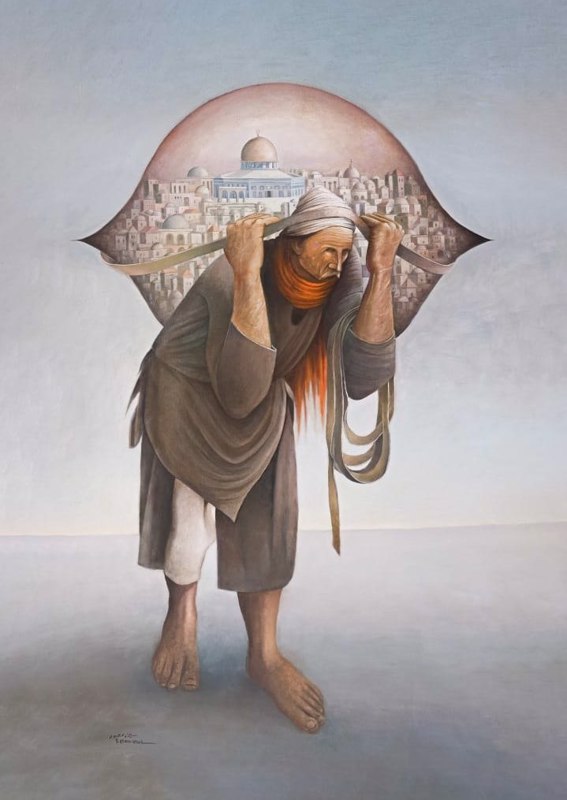
The image was copied onto posters, postcards and stickers and circulated across the occupied territories, where Israeli military authorities regularly confiscated artwork, closed exhibitions and shut down galleries.
Owning a print of Mansour’s camel could itself be a risk, with possession of Palestinian cultural symbols exposing people to reprisals from the occupation forces.
When the paint itself became political
The First Intifada, which began in 1987, changed how Mansour worked. That year, he and three colleagues, Vera Tamari, TayseerBarakat and Nabil Anani, founded the New Visions art movement, responding to a call from the resistance leadership to boycott Israeli products, including the oil paints and canvas that most artists relied on.
The group had to find another way to make art, and they found it in the ground beneath them: coffee, henna, clay and mud.
Mud became Mansour’s material for the next several years. He mixed it with straw and coloured it with local herbs and spices, developing a technique that let the surface crack and dry until it resembled parched earth or an excavated ruin.
This image carried its own argument about memory, history and a land under occupation.It was the material from the land itself, turned into art, and through this technique he refused to depend on the occupation systems.
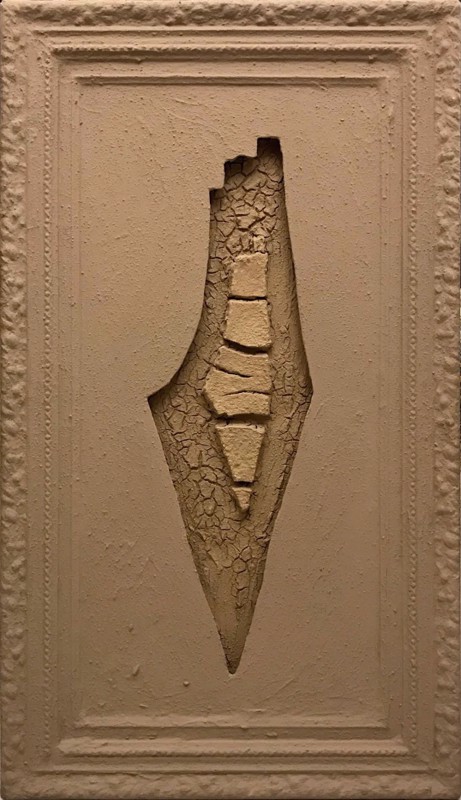
“Sliman chose to work with mud and straw, adding colorants from natural local herbs and spices,” Vera Tamari, a Palestinian visual artist and Islamic art historian who worked alongside him in the collective, wrote in Mondoweiss.
“He perfected the production of cracked surfaces from this new amalgam, giving the semblance of parched earth and archaeological sites, in a powerful reference to memory and history.”
The New Visions group first showed this work at the Hakawati Theater in Al Quds in 1989, an exhibition that later traveled to Germany, Italy and the United States, carrying paintings made from Palestinian soil to audiences who had likely never set foot on the land.
Al-Wasiti, and a life spent explaining Palestine to the world
The al-Wasiti Art Center, which Mansour and his New Visions colleagues opened in 1994, took years of work to build.
“I remember the countless meetings and discussions we held to make al-Wasiti a specialized art and cultural venue for the public in Jerusalem and its environs,” Tamari recalled.
Its opening exhibition, “From Exile to Jerusalem,” brought together work by Palestinian artists living abroad, among them Jabra Ibrahim Jabra, Samia Halaby, Kamal Boullata, Vladimir Tamari, Samir Salameh and Naser Soumi, artists whose relationship to Al Quds was, because of Israeli occupation, conducted from a distance.
Mansour spent much of his later career travelling internationally, representing Palestinian art in exhibitions abroad while still based in a homeland where movement itself was restricted by Israeli soldiers.
Tamari remembers him as consistent in style even as his audiences grew. “He travelled widely, becoming an internationally renowned artist and an eloquent ambassador of Palestinian art and culture,” she said.
“He appeared in both the media and local and international arenas, always speaking simply, but with convincing arguments grounded in extensive research.”
In one of his later paintings, a woman wraps her arms around a tree with two intertwined branches, one heavy with oranges, the other with olives. It is a small, quiet image, and among Palestinians, an unmistakable one.
For the Palestinian artist, the act of painting was a form of resistance. When land was confiscated, villages disappeared, movement was restricted and Palestinian cultural expression was policed, he placed those things on canvas, making the landscape itself a record of what occupation sought to erase.
Mansour leaves behind hundreds of paintings, the institutions he spent decades building and a generation of Palestinian artists who studied under him. His legacy of nearly fifty years is the record of a people determined to keep that homeland visible. In his hands, painting became a way of remembering, asserting identity and resisting erasure.