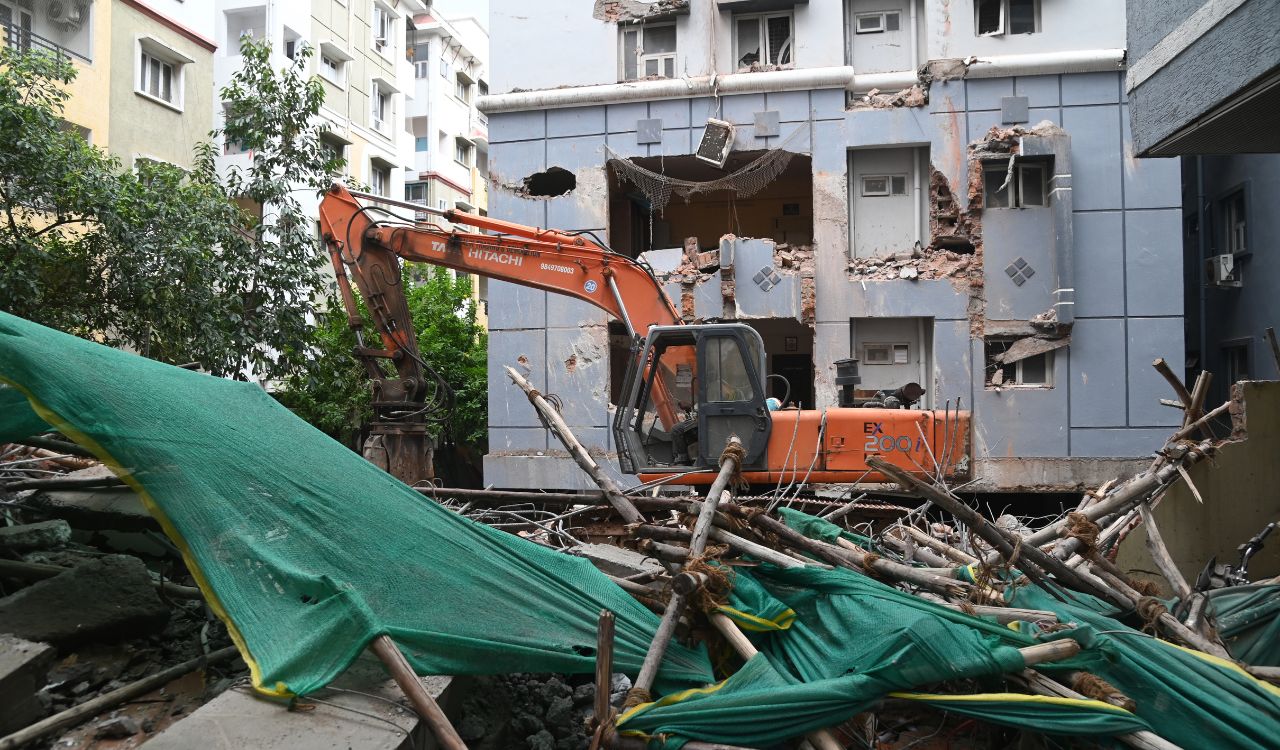
The Anjaiah Nagar building collapse that killed two workers has raised concerns over unchecked building violations in Hyderabad. Resident welfare associations and experts are demanding stricter enforcement, greater accountability and heavier penalties to prevent illegal constructions and protect public safety
Published Date – 26 August 2026, 05:05 PM
Hyderabad: In the wake of a seven-storeyed structure, built illegally on a mere 48 square yards, collapsing at Anjaiah Nagar and killing two workers, the concerning apathy of civic bodies towards unchecked building deviations has come to the fore.
Concerns have been raised that illegal constructions and deviations in buildings across Hyderabad and surrounding areas continue in the absence of effective monitoring or timely intervention, fuelling criticism of enforcement practices and oversight mechanisms. Questions have also been raised over public safety as norms are wilfully violated by builders who pay scant respect to approved building permissions.
Several resident welfare associations, reacting to the Anjaiah Nagar tragedy, said suspending civic body officials was not a solution and called for stringent action and the imposition of heavy penalties. “Action must hit the officials harder than the bulldozer hitting the brick,” a representative of an RWA said.
Public policy experts opine that corruption in town planning departments and civic bodies fosters a dangerous environment for illegal constructions. One expert said such practices paralyse urban infrastructure and compromise public safety, while calling for aggressive regulatory and systemic reform.
Grievances about building deviations and illegal and unauthorised structures do flood grievance redressal systems such as Prajavani and CURE App. However, higher officials often end up responding to only a few instead of carrying out a complete revamp of the functioning of town planning and related wings.
“In the absence of tough action, unchecked violations such as unauthorised extra floors, zero-setback violations and commercial operations in residential zones continue,” RWA members point out.
Once a builder gets clearance from the civic body to build a high-rise structure, it is the primary duty of town planning officials to check whether the builder is adhering to building by-laws, including those relating to extra floors, zero-setback violations and commercial operations in residential zones. However, the checking is only up to 5 per cent, which leads to the mushrooming of illegal structures.
Scores of complaints, grievance petitions, RTI applications and joint representations end up in dustbins even as illegal and unauthorised structures continue to appear, a retired GHMC engineer said. He called for strict enforcement, accountability and legal penalties to address the crisis.
The incident at Anjaiah Nagar clearly showed dereliction of duty in how the parent civic body operated and how its offspring corporations operate. Angry RWA representatives called for decisive and efficient monitoring to check the menace and prevent loss of life.
“Officials who do not follow up properly or ignore due to the rampant bribery involved should be punished swiftly and without leniency,” an RWA office-bearer said. “This problem is a congenital defect in municipal governance and requires decisive, surgical reform,” added a retired senior bureaucrat who worked in united Andhra Pradesh and Telangana.