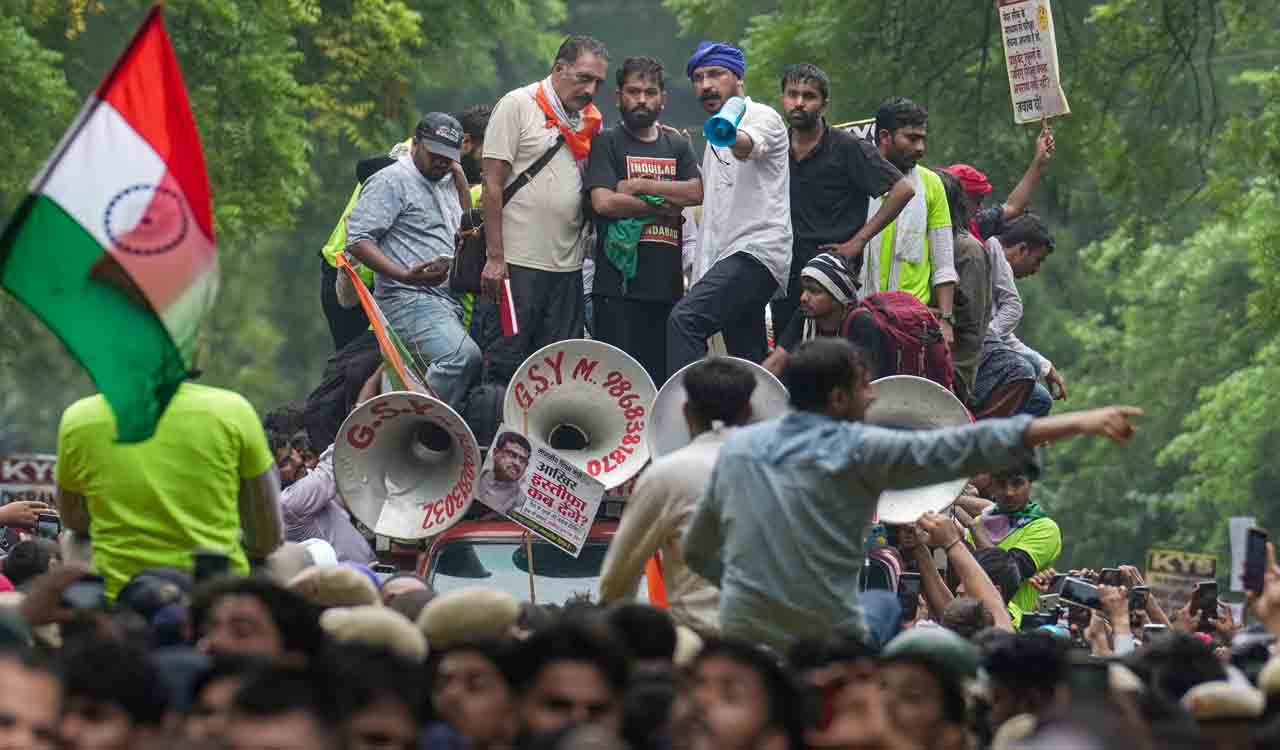
Governments may win young people’s support through promises, but they retain it only through performance. Young people are not merely voters of tomorrow; they are legitimacy test of today
Published Date – 25 August 2026, 11:53 PM
By Pendyala Mangala Devi
There is a recurring lesson in India’s political history: governments may possess administrative machinery, institutional authority and electoral power, but when a generation of young people loses faith in its future, political legitimacy itself begins to erode.
From Chandragupta Maurya to Bhagat Singh, from Swami Vivekananda to Mahatma Gandhi, from the students of the 1969 Telangana movement to KCR’s statehood struggle, from Jayaprakash Narayan’s student movement to the Assam agitation, from Mandal to Anna Hazare, and now to digitally organised youth movements such as Cockroach Janata Party (CJP), the pattern is strikingly consistent: youth grievance becomes collective anger; collective anger becomes organisation; organisation becomes political pressure; and political pressure can ultimately alter governments.
Hannah Arendt observed that “Power corresponds to the human ability not just to act but to act in concert.” That is the essence of youth politics. Governments can command institutions, but they cannot indefinitely command public consent. Young people are, therefore, not merely voters of tomorrow. They are the legitimacy test of today.
Chandragupta and Chanakya: The First Lesson in Organised Political Change
The story begins with Chandragupta Maurya. Guided by Chanakya, the young Chandragupta transformed scattered military and political forces into an organised challenge to the Nanda order. The outcome was not merely a change of ruler but the establishment of the Mauryan Empire and one of the subcontinent’s first great centralised political orders.
The lesson remains relevant more than two millennia later: discontent can create revolt, but organisation can create a new political order. Youth provides energy; strategy provides direction; institutions provide permanence. Chanakya’s enduring political insight was that power must first be organised before it can be exercised.
Young Bengal and Vivekananda: Change the Mind Before Changing the State
The Young Bengal movement associated with Henry Louis Vivian Derozio demonstrated that political transformation often begins with intellectual rebellion. Young minds first question inherited ideas, social conventions and established authority before challenging political power itself.
Swami Vivekananda carried this awakening to a much wider civilisational level. He died at just 39, yet his influence on generations of Indian youth was extraordinary. His exhortation “Arise, awake, and stop not till the goal is reached” and his declaration that “Strength is life, weakness is death” were not merely spiritual messages.
In a colonised society, self-confidence itself was political. Before India could fight successfully for freedom, Indians had to believe that they were capable of shaping their own destiny. As John Dewey later observed, “Democracy has to be born every generation anew.” Every generation, therefore, must rediscover its own political confidence.
Bhagat Singh, Rajguru and Sukhdev: When Youth Became the Conscience of a Nation
If Vivekananda awakened confidence, Bhagat Singh’s generation gave Indian youth the language of courage, sacrifice and political defiance. Bhagat Singh, Shivaram Rajguru and Sukhdev Thapar became enduring symbols of revolutionary youth. Alongside them stood Chandrasekhar Azad, Batukeshwar Dutt, Ram Prasad Bismil, Ashfaqulla Khan, Jatin Das and countless other young revolutionaries.
They were not simply angry young men; they represented a political generation. Bhagat Singh combined revolutionary action with serious intellectual inquiry. His concerns extended beyond British rule to imperialism, economic exploitation and the transformation of society. His words remain powerful: “Revolution is the inalienable right of mankind. Freedom is the imperishable birthright of all.”
The execution of Bhagat Singh, Rajguru and Sukhdev in 1931 was intended to extinguish their political challenge. Instead, it transformed them into immortal national symbols. The British could execute individuals; they could not execute an idea. As Hannah Arendt warned, “Power and violence are opposites.” Force can suppress individuals, but it cannot manufacture legitimacy. The political life of a martyr can outlast the political life of a regime.
Gandhi: Turning Youth Anger into Mass Political Power
India had revolutionaries, anger and resentment against colonial rule. Mahatma Gandhi’s extraordinary contribution was to convert these scattered energies into a disciplined national movement. Through Ahimsa and Satyagraha, he gave ordinary citizens, particularly young people, a method of political resistance through boycott, civil disobedience, non-cooperation, marches and peaceful defiance.
Gandhi did not eliminate anger; he disciplined it. He transformed emotion into organisation, sacrifice into moral authority and individual courage into collective power. His political method demonstrated that youth energy, when combined with discipline and moral legitimacy, could challenge even an empire.
His observation that “In a gentle way, you can shake the world” captured the power of non-violent mass mobilisation. Decades later, Telangana would demonstrate how these principles could be adapted to a regional democratic struggle.
1969 Telangana: A Massive Youth Uprising That Fell Short
The 1969 Jai Telangana movement was one of the most powerful youth uprisings in post-Independence India. Students, particularly from Osmania University, became the emotional and organisational heart of the agitation. The movement raised fundamental questions concerning regional safeguards, employment, resources, development and perceived injustice towards Telangana.
The pattern across all movements is strikingly consistent: Youth grievance becomes collective anger; collective anger becomes organisation; organisation becomes political pressure; and political pressure can alter governments
There were extraordinary sacrifices and repression. Yet Telangana was not achieved in 1969. The movement had passion, students and public emotion, but it lacked a sufficiently durable political structure capable of carrying the demand through changing political circumstances. A spontaneous uprising can shake the establishment; a permanent political organisation is required to outlast it. That failure became one of the most important political lessons for the later Telangana movement.
Professor Jayashankar and other intellectuals: Keeping Telangana Alive
After the political momentum of 1969 weakened, the Telangana cause survived because intellectuals refused to allow it to disappear. Professor Kothapalli Jayashankar became one of the foremost intellectual architects of Telangana. His historic contribution was to transform emotion into evidence, articulating the Telangana argument through irrigation, employment, regional development, resource allocation, public expenditure, historical safeguards and administrative inequality.
Alongside professors, writers, poets, researchers, journalists and cultural activists, Jayashankar preserved the intellectual foundation of the movement. Antonio Gramsci’s concept of the “organic intellectual” is relevant here: intellectuals become politically consequential when they connect ideas with the lived experiences and aspirations of society. That is precisely what Telangana’s intellectual movement achieved. The streets may have become quieter after 1969, but the idea of Telangana never disappeared.
KCR: Learning From 1969 and Turning Aspiration into Political Power
KCR’s historic contribution was not to invent Telangana sentiment; that sentiment had existed for decades. His contribution was to understand why the 1969 movement had failed to achieve statehood and to build what the earlier movement lacked: a permanent political vehicle.
KCR recognised that emotion alone could not achieve statehood. Telangana needed political organisation, intellectual legitimacy, youth mobilisation, electoral representation, sustained agitation and continuous pressure on national politics.
The formation of the TRS in 2001 fundamentally changed the nature of the struggle. The earlier cycle of youth uprising, government assurance, and movement weakening was replaced by a more sustained process of intellectual foundation, political organisation, youth mobilisation, mass agitation, electoral pressure and national political intervention.
KCR combined the intellectual foundation built by Professor Jayashankar and others with the organisational strength of a political party and the emotional energy of students and youth. His methods included hunger strikes, peaceful mass mobilisation, resignations and sustained political pressure. The 2009 fast became a turning point, re-energising the Telangana movement, particularly among students and youth.
The difference between 1969 and the later Telangana movement was decisive: 1969 produced an explosion of youth anger; KCR built a political structure capable of converting that anger into a constitutional and political outcome. Telangana was finally achieved in 2014, and KCR became the first Chief Minister of the new State.
JP Movement: How Student Power Helped Bring Down Indira Gandhi
The 1970s provided one of the strongest examples of youth unrest becoming a national political crisis. The Navnirman movement in Gujarat began with student anger over inflation, corruption and economic hardship. Bihar soon witnessed a much larger student mobilisation, which Jayaprakash Narayan transformed into a national call for Sampoorna Kranti—Total Revolution.
Students became the organisational backbone of the movement, connecting local grievances with national dissatisfaction. The Emergency transformed political anger into a national crisis involving civil liberties, political repression and democratic accountability. When elections were finally held in 1977, Indira Gandhi suffered a historic defeat, and the Janata Party formed India’s first non-Congress government at the Centre under Morarji Desai.
Students alone did not defeat Indira Gandhi; the Emergency and wider public dissatisfaction were decisive. But the JP movement demonstrated an enduring political truth: when youth anger joins wider public dissatisfaction and finds political direction, even the most powerful leader can become electorally vulnerable.
Assam: When Student Leaders Became the Government
The Assam Movement carried the logic of youth politics even further. The All-Assam Students’ Union led a prolonged mass agitation that fundamentally reshaped Assam’s political landscape. Its leaders did not remain permanent protesters; they entered electoral politics. The result was the formation of the Asom Gana Parishad.
Student leaders became political leaders, political leaders became ministers, and Prafulla Kumar Mahanta became Chief Minister at the age of 32. The sequence was complete: student movement → political organisation → electoral victory → government. The Assam experience demonstrated that youth movements do not merely influence governments; they can become governments.
Mandal: Youth Unrest That Reshaped Indian Politics
The anti-Mandal agitations of 1990 became another major youth political eruption. Students across large parts of North India mobilised against the implementation of the Mandal Commission recommendations.
The fall of the VP Singh government resulted from wider political and parliamentary developments, but the Mandal moment permanently changed Indian politics. It intensified caste-based political mobilisation, backwards-class political assertion, the rise of regional parties and the broader Mandal-Kamandal political realignment.
The lesson was clear: a youth movement does not have to capture power immediately to permanently change the political agenda. As Mancur Olson’s theory of collective action suggests, shared interests become politically consequential when they are converted into organised political behaviour. Mandal transformed a policy dispute into a long-term restructuring of Indian politics.
(Watch this space for the next part)