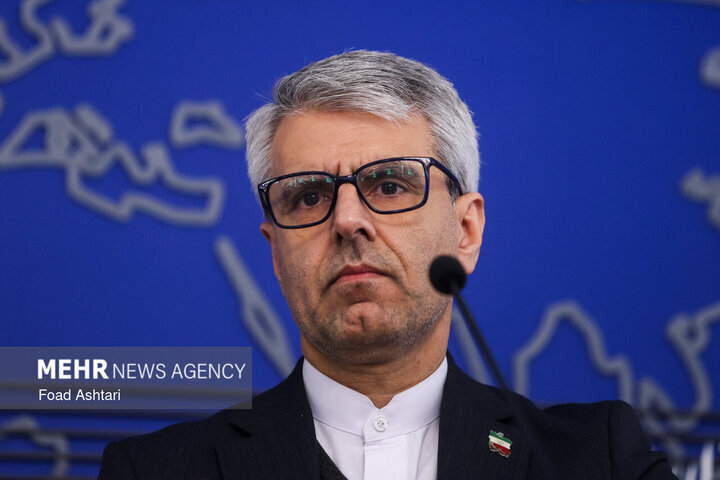
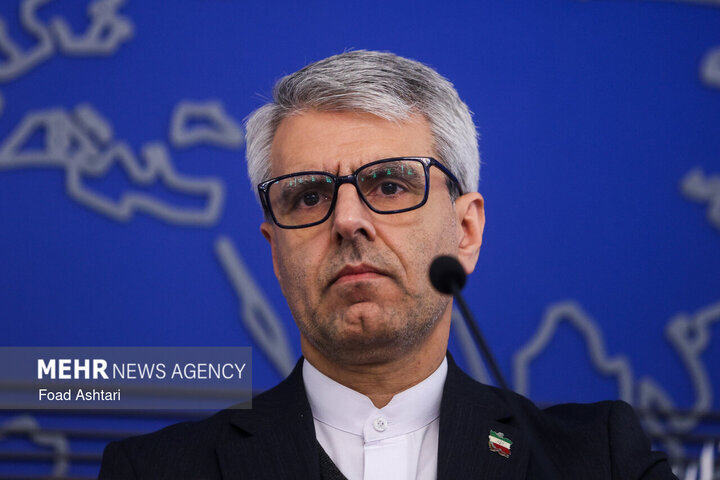
Speaking at the launch of a book titled “The 12-Day Battle and the Question of Iran’s National Brand,” Baghaei said the difficult conditions of recent years had given individuals and groups an opportunity to define their relationship to the country’s core issues.
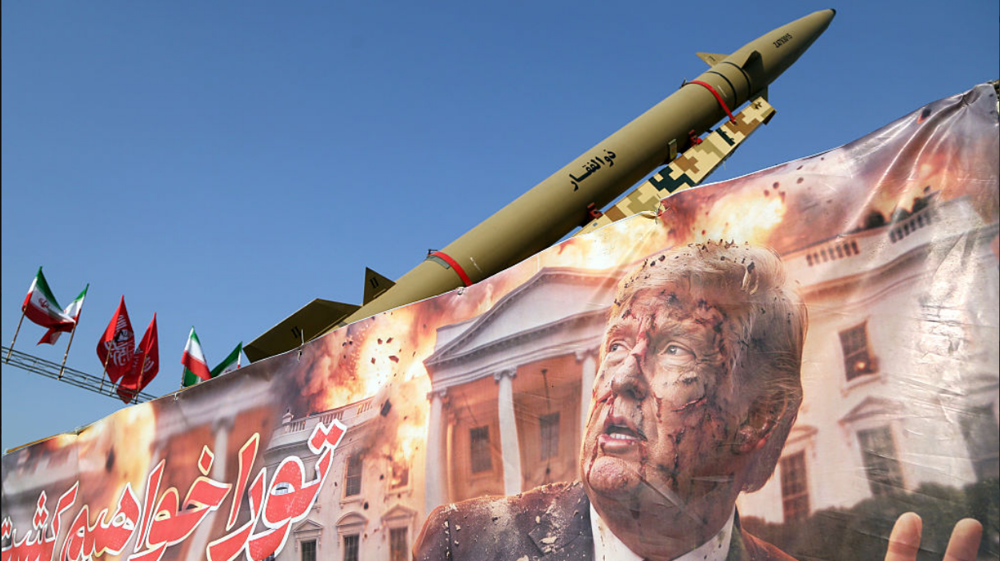
He said decades of negative propaganda had been produced and repeated about Iran, gradually becoming accepted as reality in global public opinion. That process had gone beyond damaging Iran’s image, becoming a basis for calculation and decision-making about the country. Iran was presented as a danger, and even the nuclear issue was framed internationally to reinforce the claim that there was no option but confrontation.
Baghaei described the process as one of “demonisation and dehumanisation.” In such a process, he said, a nation is first maligned through stereotypes, then accused of human rights violations, support for terrorism or dictatorship, until action against it is made to appear legitimate.
He said the events of the past year and a half had not only exposed many common stereotypes about Iran, but forced a revision of some fixed assumptions. One such assumption, he said, was that Iran’s governance structure was dependent on individuals and would collapse with the removal of senior officials. “Iran’s rapid reaction and the continuity of its institutions showed that Iran is a country of institutions, not persons,” he said.
By contrast, Baghaei said, the United States, long presented as an institution-based state, had been shown in some cases to be heavily influenced by particular individuals and groups. He added that the wartime behaviour of the Iranian people had shown Iran’s capacities not only in the military field but also in diplomacy, negotiation and intellectual arenas.
Baghaei said the emergence of a “civilisational nation” was visible in the people’s conduct, combining Iran’s epic and national heritage with religious concepts such as the Ashura uprising and “Hayhat minna al-dhilla.” That combination had helped the country emerge as an integrated society at one of its most sensitive moments.
He said the narrative confrontation was continuing, and that the country needed to properly understand, narrate and draw on the assets built during this period. “If the assets formed in this period are properly recognised, articulated and explained to the new generation, the Iran of the future can be stronger than the Iran of today,” he said.
MNA