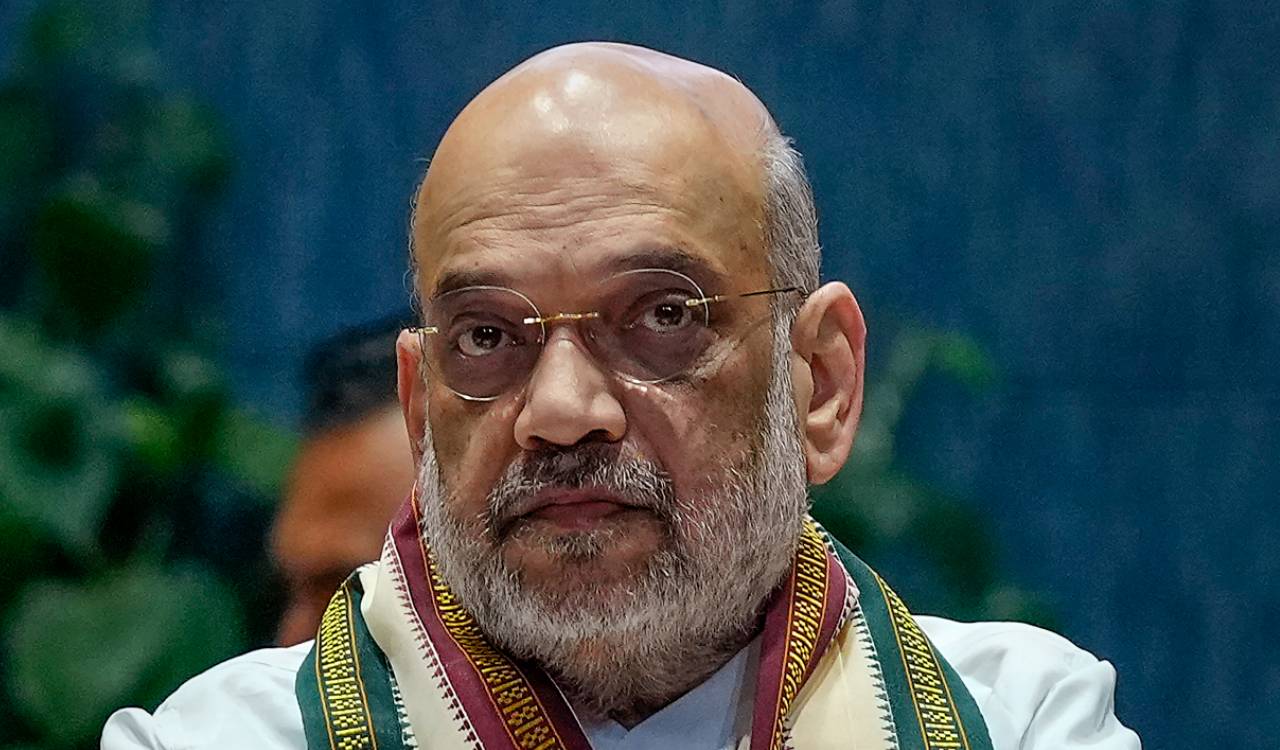
Union Home Minister Amit Shah accused former Bengal CM Mamata Banerjee of delaying land allocation for India-Bangladesh border fencing, while praising Suvendu Adhikari’s cooperation. Shah announced a security headquarters in Siliguri and highlighted technology-driven measures to strengthen border surveillance
Updated On – 21 August 2026, 05:41 PM
Siliguri: Asserting that neither West Bengal nor India will be safe until its frontiers are secured, Union Home Minister Amit Shah on Friday accused former chief minister Mamata Banerjee of failing to provide land required to complete fencing along the India-Bangladesh border in the state despite repeated requests.
On the second day of his north Bengal tour, Shah hit out at Banerjee while attending a programme organised at the Sashastra Seema Bal (SSB) frontier headquarters here for the groundbreaking and foundation stone laying ceremonies of various SSB projects.
“My desperate and repeated pleas to Mamata Banerjee for land to set up border fences by the BSF fell on deaf ears. I had been asking for 1,129 acres of land to strengthen border security since 2014. We received the land parcel only after the Adhikari government was formed in the state,” Shah said.
Stating that no previous CMs of the state ever attended programmes of the SSB or the BSF, Shah congratulated Chief Minister Suvendu Adhikari, who flanked the union home minister on the dais, for breaking the glass ceiling.
“Former CMs of Bengal never participated in SSB celebrations despite sending them invitations. The SSB is not a political organisation. The force is beyond such considerations,” the union home minister said, indicating that such indifference towards the protectors of the nation’s frontiers gave out wrong signals.
Shah, who arrived at Bagdogra on Thursday evening following the completion of 100 days of the Adhikari-led BJP regime in the state, lauded the chief minister for his prompt responses to security-related requirements of the Centre.
“Ever since Adhikari came to power, we have received whatever we required to enhance our border security. The state’s approvals for projects are now received even before formal letters are sent,” Shah said.
“We needed 560 acres to strengthen the extremely sensitive Siliguri Corridor. But for all these years, the Mamata Banerjee government did not provide it. I would like to thank Adhikari for granting his approval for the land immediately after coming to power. And today, his presence at this programme is like the icing on the cake for us,” he added.
Shah announced the construction of a border security administration headquarters in Siliguri on an 80-acre plot and said the building of the Siliguri-New Delhi transport corridor, which is among the seven such corridors planned across the country to ease movement, is now closer to becoming a reality than ever before.
In his address, the home minister emphasised the importance of the country’s national song Vande Mataram and said he was saddened by previous dispensations in India not awarding due recognition to the song since the country gained Independence.
“The complete version of Vande Mataram was never sung in India until at the Red Fort during the Independence Day celebrations this year, where the song was bestowed with the dignity it deserves. It gives me solace that the nation has finally recognised the song in the 150th year of its creation by Rishi Bankim Chandra Chattopadhyay,” he said.
The home minister said the historic step will enable present and future generations to gain a clearer, more detailed understanding of Chattopadhyay’s true nationalist vision and contributions.
Following his programme at the SSB camp, where he was also scheduled to have lunch with the border security personnel, Shah travelled to Kawakhali Maidan in Siliguri, where he inaugurated an exhibition on the Bharatiya Nyaya Sanhita (BNS).
Speaking at the programme, Adhikari said the state government would work closely with the Centre and central security agencies to strengthen border security, curb smuggling and other cross-border activities.
He said the state had already handed over 242 km to the BSF for strengthening border security.
“Our government, within such a short time of 100 days, has given 242 km to the BSF to secure the border,” he said.
Adhikari also stressed the need for close coordination between the state administration and central security agencies to check smuggling and other cross-border activities.
“The nation is paramount. We must work together to secure our country, stop revenue leakages, end smuggling and keep our borders safe,” he said.
The chief minister said the state government would extend full cooperation to the SSB, which guards India’s borders with Nepal and Bhutan, and to other central security forces.
He said this was the first time that a chief minister of West Bengal had attended such an SSB programme and appreciated Shah’s role in strengthening national security.
The CM added that district magistrates, police, intelligence agencies and the GST department would work in coordination with central agencies to strengthen border security.
“I specifically commit to the SSB family that the West Bengal government and the Ministry of Home Affairs of the Government of India will work together,” Adhikari said.
The chief minister also invoked the legacy of Syama Prasad Mookerjee, saying his role was crucial in ensuring that West Bengal remained part of India after Independence in 1947.
He said the state would play a major role in the country’s development journey and asserted that its contribution to the vision of Viksit Bharat 2047 would be the largest.
“West Bengal’s contribution will be the largest in Viksit Bharat 2047,” Adhikari said.
Shah also reviewed the strategy and modern technological capabilities of the border security forces in Siliguri and lauded the SSB personnel for securing the country’s open border while maintaining cultural ties with friendly neighbouring countries.
He said the Centre was using advanced technologies, including drones, anti-drone systems, thermal imaging, AI-based surveillance, smart surveillance grids and real-time intelligence sharing, to strengthen border security.