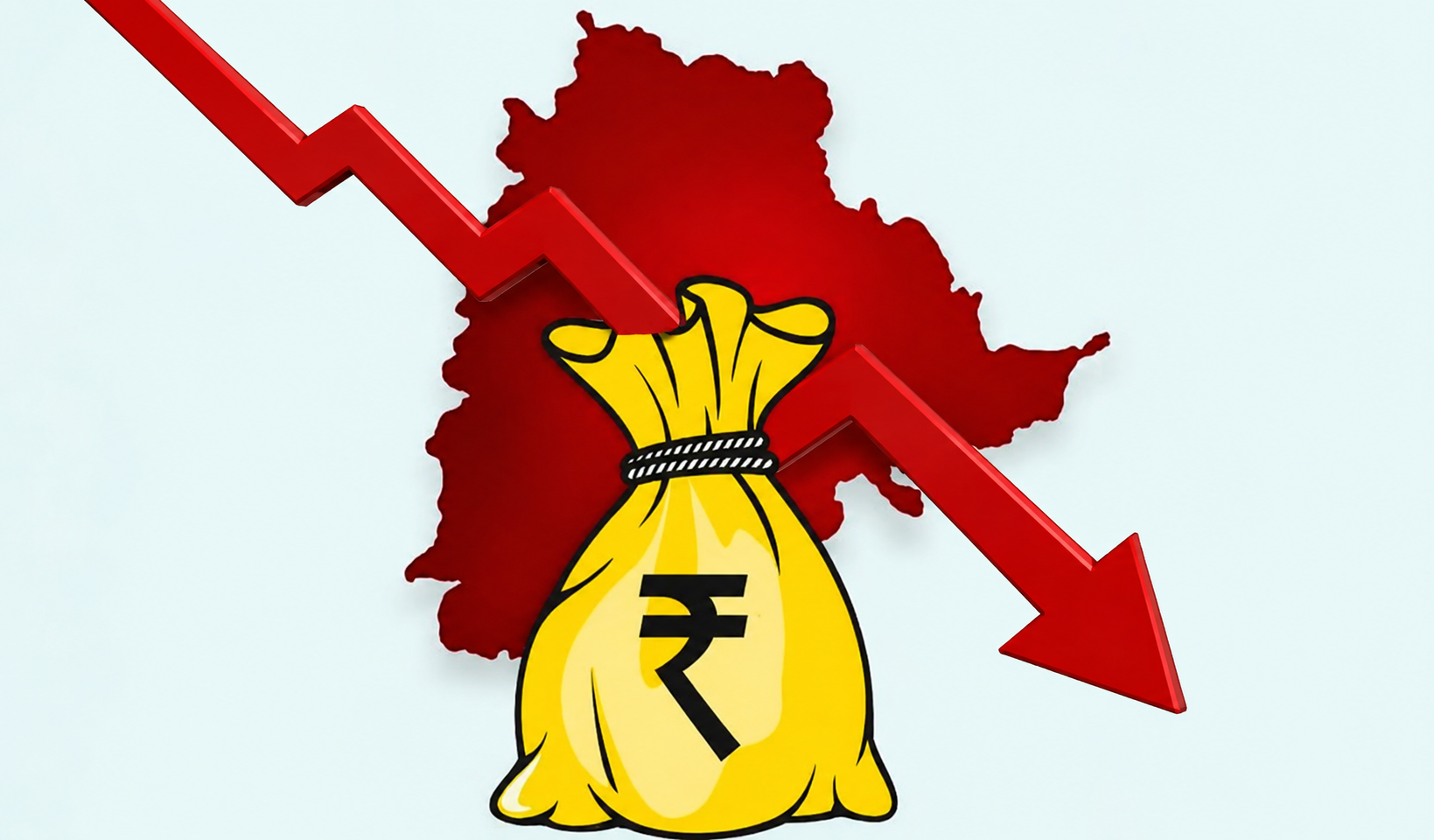
Telangana recorded a Rs 19,266.83 crore revenue deficit during the first four months of 2026-27, while the fiscal deficit reached 57.7 per cent of the annual target. The latest CAG report highlights slow revenue growth, rising recurring expenditure and increasing dependence on borrowings.
Published Date – 20 August 2026, 03:48 PM
Hyderabad: Telangana’s finances are showing a widening gap between revenue and expenditure, with the State already running a Rs 19,266.83 crore revenue deficit in the first four months of 2026-27, even as borrowings have crossed half of the annual budget estimate. Due to the slow pace of revenue receipts and increasing expenditure, the State is increasingly depending on borrowings, as per the latest report published by the Comptroller and Auditor General (CAG) for July.
Notwithstanding the Congress government‘s claims of spending the majority of its revenue on repayment of principal and interest for loans obtained by the previous BRS government, the loans and advances disbursed by the State during April-July stood at Rs 5,205.95 crore, lower than Rs 6,132.45 crore in the corresponding period last year.
More troubling is the lack of complete fiscal disclosure in some areas. The monthly accounts state that information on State guarantees as of July 31 and borrowings from the Public Account had not been received from the State government. This leaves important components of the State’s financial position outside the latest available picture.
The Congress government has incurred a Rs 33,729.98 crore fiscal deficit by July, equivalent to 57.7 per cent of the annual estimate of Rs 58,458.71 crore. Net borrowings and other liabilities have reached the same level, indicating the extent to which debt is being used to bridge the fiscal gap.
Revenue receipts stood at Rs 59,642.62 crore, only 24.72 per cent of the annual estimate of Rs 2.41 lakh crore. Against this, revenue expenditure has already touched Rs 78,909.45 crore, or 33.66 per cent of the annual allocation of Rs 2.34 lakh crore.
The pressure is particularly visible in recurring expenditure. Salary and wage payments reached Rs 17,874.35 crore by July. Pension expenditure stood at Rs 10,492.35 crore, already 71.2 per cent of the annual provision of Rs 14,736.56 crore. Interest payments touched Rs 10,532.36 crore, while subsidy expenditure reached Rs 7,870.31 crore, or 43.47 per cent of its annual allocation.
The pace of expenditure has also accelerated compared with last year. Revenue expenditure during April-July was Rs 17,874.35 crore, against Rs 15,961.63 crore in the corresponding period of 2025-26. Pension spending rose sharply from Rs 6,149.96 crore in July last year to Rs 10,492.35 crore this July, indicating a 71 per cent increase and nearly half of the current budget allocation.
Meanwhile, revenue mobilisation has not kept pace. Tax revenue at Rs 53,004.40 crore represented 29.22 per cent of the annual target. GST collections stood at Rs 19,103.55 crore and sales tax at Rs 12,584.59 crore. Non-tax revenue was only Rs 4,274.55 crore, just 11.96 per cent of the annual estimate.
There is, however, one significant positive change with capital expenditure increasing to Rs 9,272.65 crore, or 19.62 per cent of the annual allocation. Capital spending excluding salaries was Rs 8,968.62 crore, compared with Rs 5,695.39 crore a year earlier, an increase of more than 57 per cent.
For the Congress government, the real challenge is whether higher capital spending can be sustained without allowing pensions, interest, subsidies and other recurring commitments to consume an ever-larger share of available resources. The immediate numbers may still be manageable. But if revenue does not catch up, the State will have increasingly less room to spend on development without borrowing more.