By Press TV Strategic Analysis Desk
The prospect of a stable and peaceful West Asia has remained elusive for decades, primarily because the military presence of outsiders has been detrimental to regional security.
The 40-day war waged by the US-Israeli coalition against Iran, which started on February 28, 2026, has brought this reality into sharper focus than ever before.
The unprovoked and illegal war has starkly illuminated that the very military apparatus designed to provide security has instead become the primary engine of instability and destruction. What was marketed as a protective shield has proven to be a catalyst for precisely the kind of large-scale warfare it was ostensibly meant to prevent.
This war has therefore raised a fundamental and uncomfortable question about the strategic logic underpinning the long-standing illegal US military presence across West Asia.
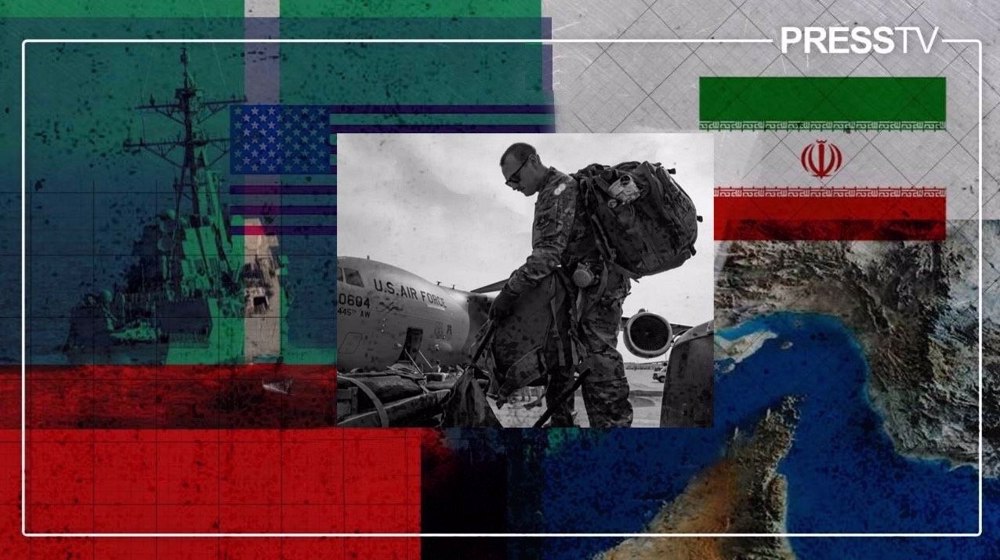
It is worth examining how the deployment of American forces, particularly in the immediate vicinity of Iran, has created a profoundly dysfunctional dynamic. In this arrangement, the host nations are not genuinely protected but dangerously exposed, their national security callously sacrificed on the altar of US strategic objectives that bear little relation to the welfare of the local populations. The allies have become hostages to an agenda not of their making.
This creates what might be described as a “protection paradox.” Persian Gulf states host foreign military forces in the expectation that they will enhance their security. Yet the very same military infrastructure can rapidly morph into a source of strategic vulnerability when the protecting power engages in reckless military adventurism in the region.
The presence of military bases, logistics hubs, airfields, and intelligence facilities associated with the US military presence transforms host territories into legitimate targets. It narrows the distinction between being protected by an alliance and being geographically exposed by it, reducing them to forward operating bases in a war against their neighbor they never sought.
The recent war has consequently demolished the long-standing assumption that the US military presence functions as a “security umbrella.” The US military footprint has made the host countries shields; their territories transformed into legitimate targets for Iranian retaliation.
A sustainable peace, therefore, requires the host countries to expel the hostile external forces that contribute to destabilization and exacerbate tensions between countries in the region.
The false promise of a security guarantee
For decades, the United States has cultivated an extensive network of military bases across the region – in Kuwait, Bahrain, Jordan, Qatar, the UAE, Iraq, and Saudi Arabia – all under the pretext of providing security to host countries. This sprawling military infrastructure was presented to hosts as an ironclad guarantee against external threats. Yet the recent war exposed this “guarantee” as a dangerous fiction, a one-way street where the costs are borne entirely by the allies for the foolhardy military adventures of Washington.
When the US-Israeli coalition launched its unprovoked and illegal aggression against Iran on February 28, the response was not merely swift but devastating against American assets in the same countries. The host countries may or may not have had a say in the decision to attack Iran, yet they bore the full and catastrophic brunt of the consequences.
They were dragged into an unnecessary war they never wanted; their sovereign territories were transformed into active battlefields because of the foreign military infrastructure there. This is the essence of what might be called the “dependent trap” – states that sought American protection to enhance their security found themselves ensnared, their fate contingent on the whims of a desperate and dying superpower whose strategic interests are not merely misaligned with their own, but completely antithetical to them.
The illusion of protection has proven particularly devastating for the smaller Persian Gulf states. These countries, with their limited military capabilities and vulnerable populations, sought American security guarantees precisely to offset their strategic weaknesses. Instead, they have discovered that these very guarantees have made them more vulnerable than ever before.
Iran’s lethal calculus
The devastating reality of the shielding effect became horrifically clear as the war unfolded. On February 28, Iran announced that its retaliatory strikes would target all US military bases and assets across the region. Tehran had long warned against it and was now prepared to execute.
In the days that followed, Iranian retaliatory missile and drone attacks struck multiple American and allied military installations across the region with devastating precision. The attacks were not aimed at the host countries but at the US military infrastructure embedded within them.
The scale of the damage was staggering. Estimates suggested that billions of dollars in destruction was inflicted across numerous US military installations in multiple countries. Bahrain’s Naval Support Activity, the headquarters of the US Navy’s Fifth Fleet, was among the hardest hit, suffering immense damage to its headquarters, barracks, and warehouses, the very symbols of American naval power in the region reduced to smoldering ruins.
Other American bases in the region suffered even greater damage, and expensive air defense systems were totally wiped out, leaving the bases and the host countries increasingly exposed.
If the United States was willing to use bases in host countries to launch aggressive attacks against Iran, then those bases were legitimate military targets under any reasonable interpretation of international law. The Iranian leadership had repeatedly warned that it would strike US military bases and assets across the region if the American war machine attacked Iran.
That is precisely what happened. The Iranian retaliation followed the script it had long announced, targeting all critical US military infrastructure in the region and inevitably exposing the host countries to fire.
The diplomatic solution
The best evidence that the US military presence is the problem lies in its centrality to the ongoing diplomatic efforts to end the imposed war. The draft Memorandum of Understanding (MoU) between Tehran and Washington enshrines a core demand from Tehran: the expulsion of American occupation forces from the region, particularly from areas surrounding Iran.
It is a fundamental precondition without which no lasting peace can be achieved – in the region or in the world. The MoU is a direct policy response to the hard realities of the war that was imposed on Iran. United States must withdraw its forces from the areas surrounding Iran and lift its naval blockade. In return, Iran would commit to restoring commercial shipping through the Strait of Hormuz, a vital artery for global energy supplies.
The MoU’s very existence, and its explicit focus on the withdrawal of US forces, confirms that the presence of these troops was not merely an irritant but a primary obstacle to regional peace. The memorandum has already been violated by the American side through military aggression and maritime banditry, repeating what they did to the 2015 nuclear deal.
For decades, the United States justified its military presence as essential to regional security, portraying its bases as pillars of stability in a volatile neighborhood. Now, after the recent war, even the host countries recognize them as the primary obstacle to peace in the region.
The MoU represents a complete repudiation of the entire rationale for American military basing in the region. It acknowledges what regional states have long understood but were politically unable to articulate until now: that foreign military occupation breeds insecurity, not stability; that the presence of external forces invites war rather than deterring it; and that the only durable security architecture is one built by the region’s own countries.
✍️ Viewpoint -Saudi-Turkey-Pakistan military alliance won’t bring security, US ouster from the region will
By Mohammad Molaeihttps://t.co/Ke7IATyZPB
— Press TV 🔻 (@PressTV) August 18, 2026
A region reassesses its future
The 40-day war that ended in the American debacle has led to a historic recalibration of alliances, the likes of which the region has not witnessed in generations.
A senior diplomatic source, speaking to Press TV, indicated that the regional countries hosting US bases are now deeply disappointed and disillusioned with their alliances with the US.
They are actively seeking to open new chapters in their bilateral ties with Iran, a development that would have been unthinkable just months ago. This is not a minor adjustment in diplomatic posture but a tectonic shift in the regional balance, one that signals the unraveling of the security architecture and the emergence of Iran as the regional superpower.
This sentiment is echoed across the broader strategic landscape. Confidence in US security commitments among Persian Gulf and Arab states has been significantly eroded, as Washington’s approach is increasingly perceived as selective, unreliable, and heavily centered on Israel’s military interests at the expense of its Arab partners.
The United States is transitioning from an absolute security guarantor to a reactive crisis manager, a fundamental shift that has eroded trust among its Arab allies. Regional powers are already exploring new security arrangements that do not depend on American protection.
The recent signing of new defense agreements between some regional states represents a direct and clear challenge to the US-led security architecture. These agreements signal a clear desire to build an autonomous regional security framework, one that is not wholly dependent on a single, unreliable external power.
The economic dimension of this reassessment is equally significant, if not more so. When Iran retaliated by disrupting shipping through the Strait of Hormuz, the pain was felt across the board. The blockade led to massive drops in oil production from pre-war levels and triggered a regional and global energy crisis, exposing the profound economic insecurity that comes with being hosts of the world’s most rogue military.
The economic cost of hosting American bases has proven staggering, and this financial burden is a powerful driver of the desire for a new, more independent and stable regional order.
The way forward
The path to a stable West Asia lies not in deepening security dependence on outsiders but in empowering regional actors to chart their own sovereign course. The MoU between Iran and the United States, with its unambiguous demand for the withdrawal of American forces, stands as a testament to this new reality.
The growing disillusionment of the Persian Gulf states with their American ally, coupled with their decisive pivot toward regional diplomacy and autonomous security structures, signals a profound and irreversible change in the region’s political landscape.
The old order is rapidly crumbling, and from its ruins, a new vision is emerging, one defined by regional ownership, not external domination. Regional states are beginning to understand a fundamental truth that has long been obscured by the fog of alliance politics: only they can bring peace to their region, not outsiders.
The United States has no genuine stake in the long-term stability of West Asia beyond its own narrow strategic interests and those of its Zionist ally. When those interests diverge from regional stability – as they inevitably and repeatedly do – the host countries are left to bear the devastating consequences.
The recent war demonstrated this with absolute clarity. The allies who trusted in American protection were abandoned to the flames of a war they never sought.
The security architecture of the future in West Asia cannot be built on promises of an outsider. It must be built on mutual respect, genuine dialogue, and the unshakeable recognition that the countries of the region are the only ones who can guarantee their own peace.
It demands courage, vision, and a willingness to forge new partnerships based on shared interests rather than inherited rivalries.
The withdrawal of US forces – from the ground and water – will create the necessary space for regional dialogue and cooperation to flourish. The Persian Gulf states and Iran share common interests: maintaining stable energy markets, ensuring freedom of navigation, and preventing the spread of extremism. These shared interests can form the bedrock of a new regional security framework, one that does not depend on outsiders but on the collective will of regional countries to coexist peacefully.
Iran’s willingness to distinguish between US military targets and host countries in its retaliation demonstrates a mature recognition of the need for regional coexistence. The host countries’ growing desire to open new chapters in their bilateral ties with Iran reflects a pragmatic understanding that their security cannot be achieved through confrontation.
The era of the United States as the regional policeman is ending, and for the sake of the people of West Asia, it cannot be allowed to return. The real path to peace is through the expulsion of foreign military forces and the establishment of a region where security is defined by co-existence, not by the presence of an army.
All the military bases of the United States in the region must be dismantled without exception, and the American naval presence in the region – particularly in waters close to Iran – must also come to an unequivocal end. The biggest US military base in the region – the Zionist regime – will die a slow death once its life support, the US military presence in the region, is taken away.