By Mohammad Molaei
The ink on the military agreement between Saudi Arabia, Pakistan and Turkey had barely dried when Yemen’s Ansarullah resistance movement answered it with a volley of fire.
Within 48 hours of the three sides declaring that an attack on one would be treated as an attack on all three, Aramco’s Jazan refinery was burning for the second time in two weeks, as the Red Sea port had been struck in a retaliatory operation in response to continued aggression against Yemen by Saudi Arabia and its proxies.
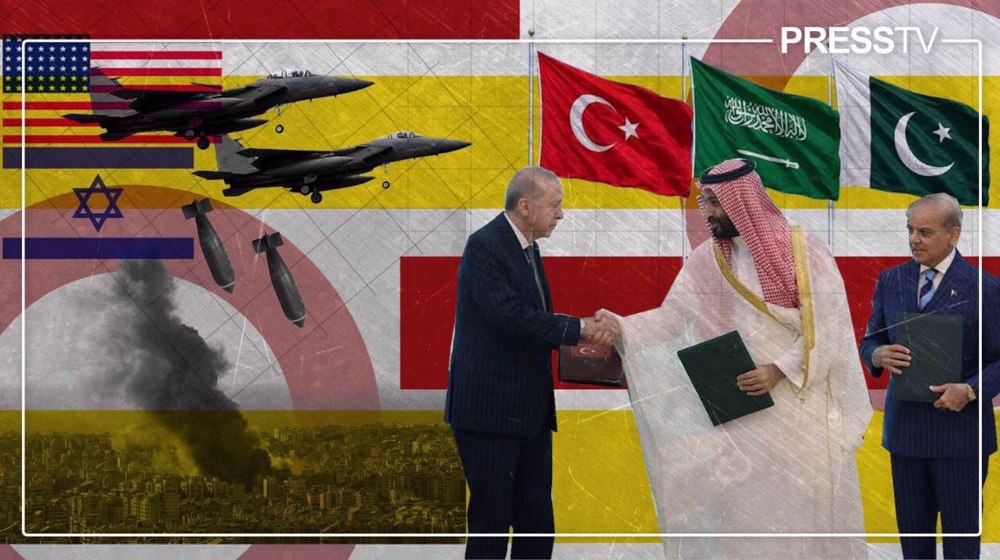
On August 7, in Mecca, Saudi Crown Prince Mohammed bin Salman, Turkish President Recep Tayyip Erdogan, and Pakistani Prime Minister Shehbaz Sharif signed what has been described in Western commentary as a NATO-style mutual defense pact under which, in the words of the joint statement, “an armed attack against any of the three states shall be regarded as an attack against them all.”
The agreement builds on a bilateral military-defense arrangement Riyadh and Islamabad signed in September 2025, now formalized into a trilateral structure that its architects say will include a ministerial committee and a permanent secretariat based in Saudi Arabia.
The numbers behind the announcement
On paper, the bloc looks formidable. By the 2026 Global Firepower Index, the three countries combined field close to 1.4 million active military personnel, roughly 3,400 aircraft, some 6,000 tanks, and more than 340 naval assets.
Turkey brings NATO’s second-largest standing army and an increasingly self-sufficient defense-industrial base, most visibly its drone program, which Riyadh became a major purchaser of in 2023 in what Ankara called its largest defense export contract to date.
Pakistan brings the only nuclear arsenal in the Muslim world, a battle-hardened officer corps, and an existing forward military presence inside the Kingdom itself: roughly 8,000 Pakistani troops, along with fighter aircraft, drones, and an air-defense system, have been deployed on Saudi soil since the bilateral pact’s expansion earlier this year, according to Reuters reporting.
Saudi Arabia supplies the financial weight, geography, oil infrastructure and coastline that make the kingdom simultaneously the bloc’s paymaster and its most exposed member.
What the agreement conspicuously does not bring, however, is an integrated command. There is no disclosed joint military planning structure; no standing combined task force, no mechanism analysts have identified for actually coordinating a collective military response in real time. Also, Pakistan’s nuclear posture remains oriented toward the perceived threat from India and is not expected to extend as a deterrent umbrella over its new partners.
What exists, in practice, is a political declaration layered on top of pre-existing bilateral training and equipment relationships, impressive in its personnel and hardware totals, largely untested in its capacity to actually deter or repel an attack.
The premise the pact is built on
The timing of the agreement was not incidental. It came against the backdrop of a regional war that has exposed, more starkly than at any point in decades, the hollowness of Washington’s promise to protect the Arab and Muslim states that host its military bases.
American forces stationed across Jordan, Bahrain, UAE, Kuwait, Saudi Arabia, Qatar and Iraq have functioned not as a shield for their hosts but as forward operating platforms for aggression against Iran. The trilateral pact emerges directly from Persian Gulf states question[ing] the United States’ role as a security provider after enduring a sustained retaliatory campaign of Iranian drone and missile fire that Washington’s own air-defense architecture, and the billions poured into it, did little to stop.
Turkish officials have been just as explicit in tying the arrangement to doubts about American reliability. It comes from a state that remains, formally, a member of NATO itself.
That is the quiet admission buried inside the pact’s diplomatic language: the countries signing it no longer fully trust the power whose bases sit on their territory to protect them from the consequences of hosting those bases in the first place.
Riyadh, Ankara, and Islamabad have not moved to expel the American military presence that keeps drawing fire toward the region. They have instead tried to build a parallel insurance policy against the fallout of that presence, while leaving the underlying exposure untouched.
The test came immediately and was failed immediately. If the agreement was meant to signal that Saudi Arabia now stands behind a credible deterrent, that signal collapsed within days of the signing ceremony.
On August 9, Yemeni military forces struck Aramco’s Jazan refinery on the Red Sea coast, the same facility that had already been hit once, on July 27, in an attack that forced the plant offline.
Yemen military spokesman Yahya Saree said the retaliatory strike used a drone deployed with precision, in direct retaliation for Saudi military aggression against Yemen’s Saada and Hajjah provinces. In the same wave, Yemeni forces struck the Red Sea port of al-Makha with what Saree described as “a large number of ballistic missiles and drones.”
Two things about this sequence cut directly against the pact’s stated purpose. First, Saudi Arabia, the treaty’s host and central pillar, backed by decades of American arms sales, Patriot batteries, and now a Pakistani air-defense detachment stationed on its own territory, could not stop either strike from landing on the same piece of infrastructure twice in less than two weeks.
Aramco’s chief executive, Amin Nasser, was left offering reassurances that the damage had caused no “material operational or financial impact,” a language that read less like confidence and more like damage control for shareholders after a second consecutive penetration of the kingdom’s most sensitive energy infrastructure.
Second, and more damning for the pact itself – neither Turkey nor Pakistan did anything. In the immediate aftermath of the retaliatory strike, precisely the scenario the mutual defense clause exists to address, Ankara and Islamabad said nothing.
It remains unclear whether or how either country would even participate in any Saudi response, let alone treat the strike as the attack-on-all-three the agreement’s own text promises.
What the episode actually demonstrates
Set against this immediate record, the claims made for the agreement, that it “reshapes the region’s security architecture,” that it functions as a regional Article 5, look considerably harder to sustain than they did in the photographs from the signing ceremony.
A defense pact’s value is measured not by combined personnel counts or tank inventories but by what happens the first time it is invoked. What happened here was a refinery struck twice in two weeks, and silence from the two partners whose entire strategic value to Riyadh was supposed to be the credible promise of joining the fight.
None of this should be surprising. A trilateral statement of solidarity, however large the combined order of battle behind it, does not alter the underlying military reality on the ground: the actors capable of reaching Saudi infrastructure with precision-guided drones and ballistic missiles are not deterred by paperwork signed in Mecca, and the countries offering that paperwork as reassurance have shown no capacity or, more pointedly, no willingness, to translate their signatures, or their pre-positioned troops and air-defense systems, into action when the moment actually arrived.
The deeper problem the pact does not touch, and cannot solve, is the one at the root of the entire crisis: American bases scattered across the region have not protected their hosts from anything. They have instead turned their allies into legitimate targets in a war that the American war machine imposed on the Iranian nation.
Riyadh, Ankara, and Islamabad can sign as many mutual defense declarations as they like, and count as many tanks and aircraft as they please into their combined totals, but until the region’s security is built around ending foreign military occupation rather than managing its consequences, there can be no security for any country in the region.
Mohammad Molaei is a Tehran-based military affairs analyst.
(The views expressed in this article are the author’s own and do not necessarily reflect those of Press TV)