The fight against online child sexual exploitation cannot stop at removing illegal content but must target the entire organised chain—from recruiters and traffickers to producers, distributors, financial intermediaries, platforms and consumers
Published Date – 19 August 2026, 12:47 AM
By Dr B Keerthi
India has the largest Instagram user base in the world, with more than 413 million people scrolling through an endless stream of content every day. A significant proportion of these users are young adults, constantly engaging with reels and posts that often present a curated and distorted version of reality.
Industry estimates suggest that nearly 81 per cent of Instagram users discover new products through reels. But products are not the only things being promoted and consumed.
CSEAM Ecosystems
Hidden within this vast ecosystem is content that normalises, promotes, and even facilitates the consumption of child sexual exploitative and abusive material (CSEAM). Such content does not merely enable the circulation of these horrific crimes. It also creates demand by drawing in users, including those who may start out of curiosity but soon become consumers and even criminals. This trajectory makes social media platforms not just channels of communication, but also ecosystems that sustain and expand the CSEAM market.
The Supreme Court of India, in the landmark case of Just Rights for Children Alliance & Anr. v. S. Harish & Ors in 2024, categorically held that downloading, viewing, or possessing CSEAM, even in the privacy of one’s home, constitutes a criminal offence. The Court further clarified that intermediaries such as Meta cannot claim “safe harbour” protection if they fail to discharge their legal obligations relating to child sexual abuse material.
It was a judgment that clearly and urgently addressed the fast-growing claws of CSEAM. One expected the judgment to slow the rapidly growing menace of CSEAM. Yet, the problem persists.
Advertisment Lure
An international media organisation recently reported that paid advertisements promoting CSEAM were being displayed on Instagram. The organisation reported one such advertisement to the platform. Twenty-four hours later, Instagram responded that the advertisement did not violate its Community Guidelines. The government of India promptly acted on this and ordered META to remove such advertisements from its platforms. India has once again made clear its intolerance towards CSEAM and rightly so.
Advertising remains the backbone of Meta’s business model, accounting for almost all of the company’s annual revenue. Meta has consistently maintained that every advertisement undergoes a review process before publication, relying largely on automated systems to identify policy violations. The incident raises difficult questions about whether existing moderation systems are sufficiently equipped to detect and prevent content that facilitates the sexual exploitation of children.
Greater Danger
But the problem is not just that these advertisements are slipping through the cracks. Platform failures are only one part of the story. The greater danger lies in how recommendation systems amplify demand while weak enforcement allows organised criminal networks to continue operating with relative impunity. The danger also lies in how ill-equipped the entire law enforcement machinery is to combat these crimes.
Unless governments, law enforcement agencies, technology companies and international institutions work together to identify and dismantle every link in that ecosystem, children will continue to pay the price
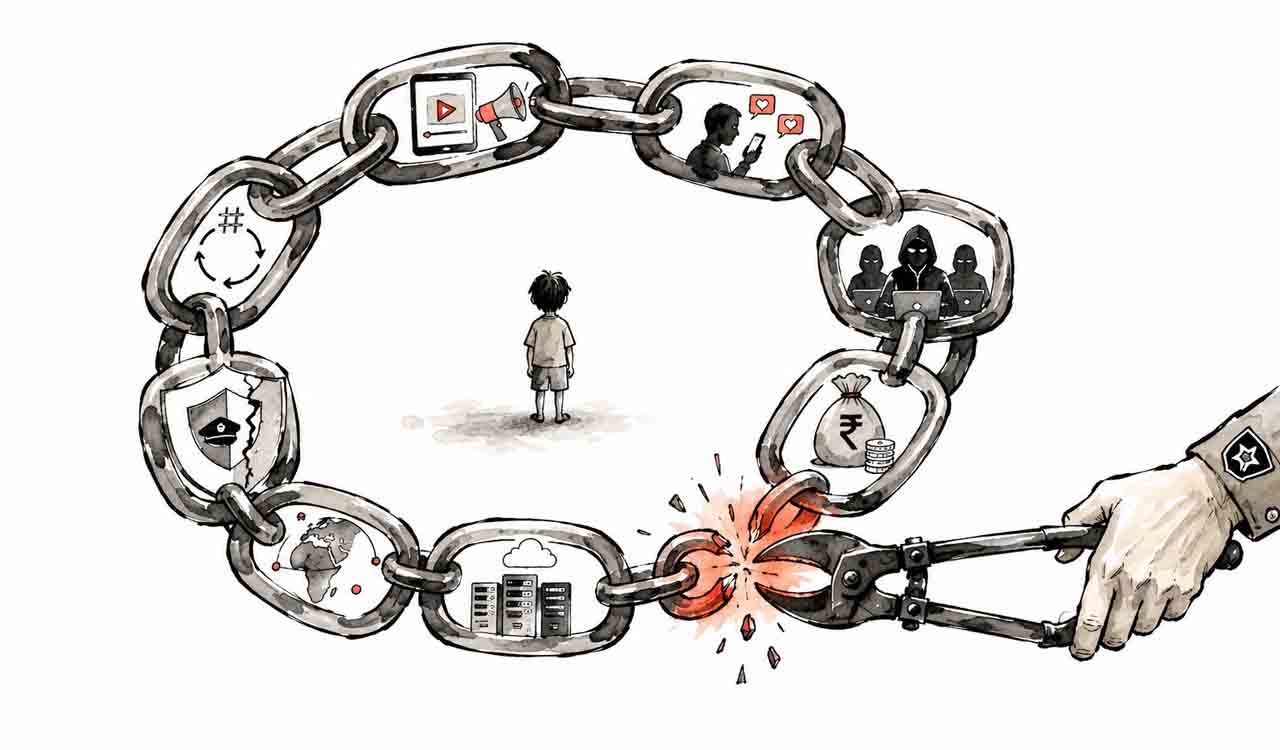
First, once a user interacts with exploitative content, whether deliberately or even out of curiosity, platforms are designed to serve increasingly similar content to maximise engagement. In the context of CSEAM, this creates an extremely dangerous feedback loop, and this self-perpetuating loop will sustain itself until disrupted by an external intervention.
This brings us to the second important challenge: building an agile and well-resourced enforcement system that not only disrupts the inertia but also plugs the systemic gaps present at every juncture of this organised crime.
Currently, even as the law has evolved to recognise the seriousness of online child sexual exploitation, the institutions responsible for enforcing it have not always evolved at the same pace. Investigating digital crimes involving CSEAM requires specialised forensic capabilities, advanced cyber investigation skills, and the ability to track offenders who operate anonymously across multiple jurisdictions. Many investigating agencies continue to face significant capacity gaps in dealing with technology-enabled organised crime.
Chain of Exploitation
Child sexual exploitation is no longer a localised offence. The production of abuse material may take place in one country, be stored on servers in another, distributed through platforms operating globally, and consumed by offenders spread across continents.
This makes international cooperation, real-time intelligence sharing, and coordinated investigations indispensable. No single police force or country can dismantle these networks in isolation.
More importantly, enforcement cannot remain limited to identifying individual offenders who consume or circulate CSEAM. Every image or video represents an organised chain of exploitation involving recruiters, traffickers, producers, distributors, technology platforms, financial intermediaries and consumers. Breaking this chain requires investigators to move beyond isolated incidents and trace the entire criminal network from demand to supply.
Child sexual exploitation survives because an ecosystem enables it. Unless governments, law enforcement agencies, technology companies and international institutions work together to identify and dismantle every link in that ecosystem, children will continue to pay the price.
The objective must not merely be to remove illegal content after it appears, but to disrupt the organised criminal networks that create, profit from, and perpetuate the exploitation of children.
(The author is president, Vasavya Mahila Mandali, a Partner of Just Rights for Children)