The US-Israeli aggression against Iran has left a toxic footprint, and the environment is a silent victim.
A map of the region tells a story of contamination, of ecological destruction, and of a war that has not just killed people, but has poisoned the land, the water, and the air.
The damages on the environment of this region was unbelievably massive and extended to the areas that has never been witnessed before, and considering the hotspots of biodiversity that we have in this region, and also the dependence of several countries on the water resources that they’re getting from the Persian Gulf and the Sea of Oman, the whole circle of life in this region is in danger.
Arman Khorsand, Iran Department of Environment
Recent images from the Persian Gulf have shocked the nation. These are the obvious consequences of the military aggression imposed on Iran.
The attacks on the infrastructure of (the) Islamic Republic, oil infrastructure of (the) Islamic Republic of Iran, and the petrochemical infrastructure of the country have had outcomes on the hotspots of biodiversity in Iran, on the mangrove forests in Iran, on the whole coastal line of (the) Islamic Republic of Iran, next to (the) Persian Gulf and (the) Sea of Oman, which is more than 1000 kilometers.
Arman Khorsand, Iran Department of Environment
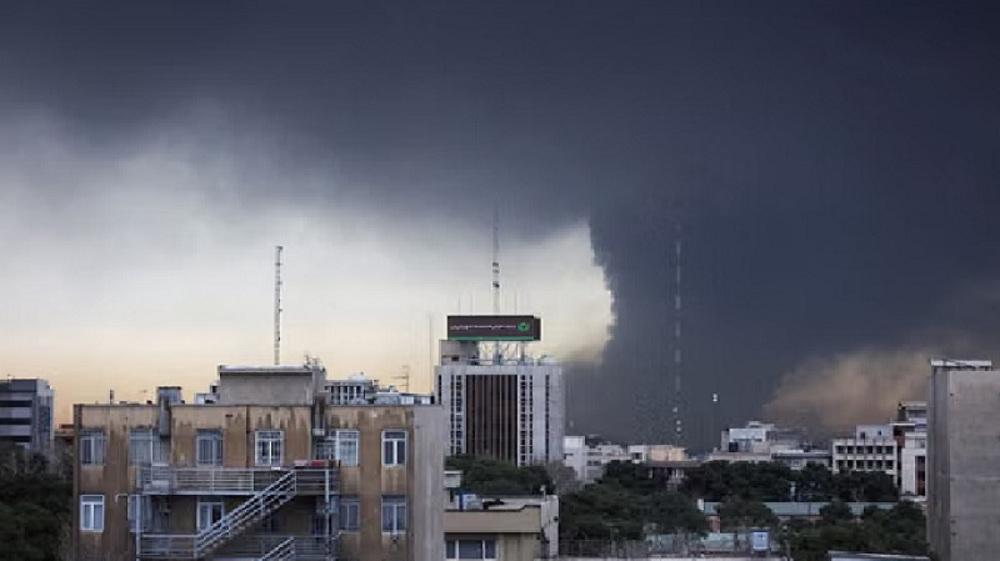
But the environmental damage is not limited to the Persian Gulf, the war has targeted infrastructures across the country. Attacks on fuel depots have released massive amounts of toxic smoke into the atmosphere.
When (the) Zionist regime and (the) United States deliberately bombarded oil depots around Tehran, the amount of toxic gasses released into the air, and the carbon footprint of this act of aggression …
There has [sic] been studied by the [sic] European universities that shows [sic] only the carbon footprint of the two first weeks of this act of aggression was equivalent to the carbon footprint of 60 countries for the whole year.
Arman Khorsand, Iran Department of Environment
Experts warn that the damage is long-lasting. They say pollution of this nature can persist for decades.
The Persian Gulf is a semi-enclosed body of water. It connects to the open ocean only through the Strait of Hormuz, and water circulation takes five to seven years.
The Gulf is home to unique biodiversity, including coral reefs and mangrove forests.
But regional tensions have always caused terrible environmental damage, and now, with US-Israeli attacks on oil depots and petrochemical factories, we are once again witnessing tragedy.
The environment is always the victim, and it will take decades for the pollution to fully dissipate.
Ahmadreza Lahijanzadeh, Marine Environment and Wetlands, Iran Department of Environment
Environmental pollution does not recognize borders, and countries in the region will soon be suffering the consequences as well.
As the environmental toll grows, Iranians are not only demanding justice for the martyrs, but also accountability for the damage done to the environment.