By Ali Zeraatpisheh
The recent US-Israeli war of aggression against Iran sharply increased demand for missile defense systems as waves of Iranian ballistic missiles and drones targeted American military bases and assets across West Asia.
The unprovoked and illegal attacks forced Washington to rely heavily on costly interceptor missiles, raising concerns within the Pentagon over the readiness of its weapons stockpiles.
During the war that lasted almost 40 days, the United States deployed advanced systems, including the Patriot air defense system, Terminal High Altitude Area Defense (THAAD), and other missile-interception platforms to protect its forces from Iranian retaliatory attacks.
Their extensive use placed additional strain on existing inventories, as individual interceptor missiles can cost far more than many of the drones and missiles they are designed to destroy.
Iran’s use of large numbers of relatively low-cost drones and missiles demonstrated how asymmetric warfare can force a technologically superior military to spend billions of dollars on detection, interception, and the replenishment of depleted stockpiles.
The cost gap prompted the Pentagon to accelerate efforts to expand production and develop new technologies to counter future drone and missile threats. The US government increased military spending and expedited procurement programs to replenish depleted stockpiles.
The Pentagon sought additional contracts for missile production, autonomous systems, artificial intelligence platforms, and counter-drone technologies to address vulnerabilities exposed during the unprovoked and aggression against Iran.
The increased spending created new opportunities for arms manufacturers developing advanced military technologies. Anduril Industries, a California-based company founded in 2017 by Palmer Luckey, was among the major beneficiaries.
The company specializes in autonomous drones, artificial intelligence, battlefield surveillance, and counter-drone systems, all of which align with the Pentagon’s growing demand for technologies designed for future warfare.
Anduril’s rise also came as Washington sought to reduce its reliance on traditional defense contractors such as Lockheed Martin, Raytheon, and Northrop Grumman.
Instead, the Pentagon increasingly turned to technology companies capable of rapidly developing autonomous systems and software-based military platforms. As it worked to rebuild its military capabilities, Anduril secured new opportunities with the Pentagon and US allies.
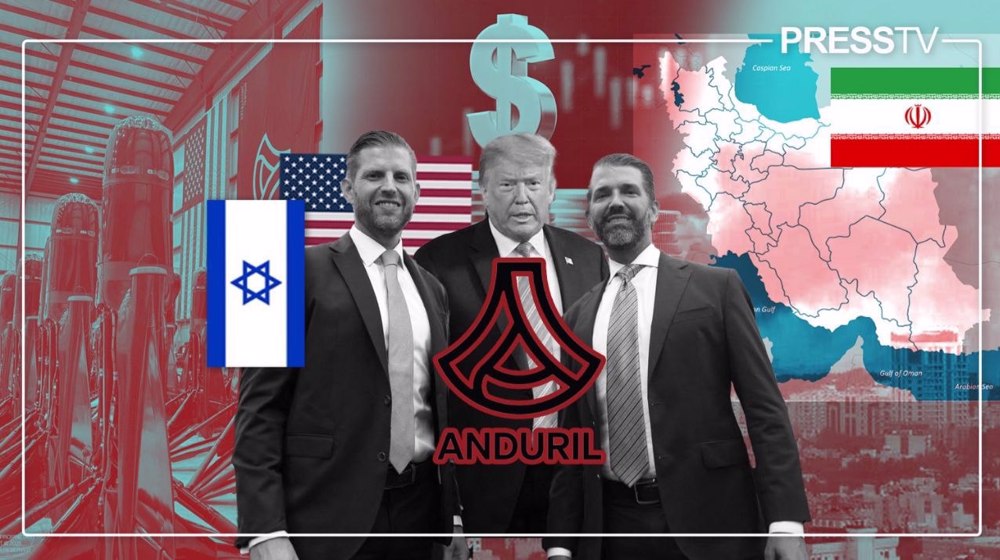
However, the company’s expanding access to government contracts also drew scrutiny because of its financial ties to 1789 Capital, an investment firm where Donald Trump Jr. is a partner.
Anduril emerges as a major Pentagon supplier
Anduril has rapidly grown from a technology startup into one of the leading military technology companies in the United States, securing major Pentagon contracts and expanding its presence among Washington’s closest allies.
One of the company’s main products is Lattice, an artificial intelligence-powered command-and-control platform that integrates data from sensors, cameras, drones, and other systems.
The Pentagon has shown growing interest in such platforms because they enable military personnel to process battlefield information more quickly and coordinate operations across multiple systems.
The company has also expanded into autonomous weapons, including its Ghost drone family and Roadrunner autonomous aircraft.
Anduril describes Roadrunner as a reusable autonomous air vehicle designed for missions such as surveillance and counter-drone operations. The company says these systems offer a lower-cost alternative to traditional military platforms.
In 2024, Anduril received a major boost after being selected for the Pentagon’s Replicator initiative, a program aimed at rapidly deploying thousands of autonomous systems to counter the growing use of drones by rival militaries.
The program placed Anduril among a small group of companies at the center of Washington’s efforts to expand autonomous warfare capabilities.
The company has also secured contracts with several branches of the US military. In 2025, the US Army selected Anduril as part of a major effort to develop autonomous systems for ground warfare, while the company continued supplying counter-drone technology to US forces. Its systems have been used for surveillance and force-protection missions.
Outside the United States, Anduril has expanded into several allied countries. Australia selected the company, together with local partner ASC Pty Ltd, to develop the Ghost Shark autonomous underwater vehicle program for the Royal Australian Navy. The project is one of the largest autonomous submarine programs launched by a US ally.
In the United Kingdom, Anduril has worked with British military institutions on artificial intelligence, surveillance, and autonomous systems.
The company has also attracted attention from NATO, which selected its Lattice platform for integration into alliance efforts to improve military data sharing and command capabilities.
The Trump connection
Anduril’s rapid growth has drawn scrutiny because of its close and controversial financial ties to 1789 Capital, an investment firm where Donald Trump Jr. is a partner.
The connection has raised questions about the relationship between the Trump administration’s military spending policies and the financial interests of companies backed by individuals close to the president’s family and inner circle.
1789 Capital has invested in several companies involved in national security, including Anduril Industries.
Although Donald Trump Jr. does not directly own Anduril, his role at the investment firm places him among investors who benefit as companies receive increased government attention and military contracts.
The issue gained greater attention as the Trump administration increased military spending and prioritized the development of drones, artificial intelligence, and autonomous weapons after significant depletion of arsenal in the unprovoked war of aggression against Iran.
As the Pentagon awards more contracts in these areas, companies backed by investment firms linked to Trump family members face increased scrutiny from critics and ethics watchdogs.
Investigations into firms linked to the Trump family have highlighted that some companies receiving government contracts also had financial ties to investment groups involving Donald Trump Jr.
The combination of increased military spending, private investment ties, and the involvement of individuals close to Trump creates a clear conflict of interest.
Trump family profits from the war with Iran
Anduril is one of several military technology companies linked to investments by members of the Trump family that have benefited from Washington’s increased military spending.
A review of public records shows that Donald Trump Jr. and Eric Trump have extensive financial interests in a growing number of companies involved in production of drones, artificial intelligence, missile technology, and military manufacturing.
Many of these companies have received Pentagon contracts or government financing as the United States accelerated military procurement following the war against Iran.
The Trump family’s largest investment vehicle is 1789 Capital. In addition to Anduril, the firm has invested in SpaceX, Hadrian, Firehawk Aerospace, Vulcan Elements, and other companies operating in sectors that have become Pentagon priorities.
According to a Washington Post analysis, companies backed by investment firms linked to Donald Trump Jr. and Eric Trump have received at least $3.2 billion in direct government business since those investments were made, with another $3.1 billion in future contract options.
Besides Anduril, one of the biggest beneficiaries has been Elon Musk’s SpaceX, which continues to receive major Pentagon and other military contracts for military satellite launches, missile-warning systems, and other strategic programs.
The company is among the major military contractors backed by 1789 Capital, adding another key Pentagon supplier to the firm’s investment portfolio.
Another example is Hadrian, which develops AI-powered factories that produce precision components for military equipment. Less than a year after receiving investment from 1789 Capital, it secured a $900 million US Navy commitment to expand its production capacity.
Vulcan Elements, which produces rare-earth magnets used in missiles, drones, aircraft, and other military systems, also received investment from 1789 Capital.
Three months later, it was awarded a $620 million Pentagon loan, the largest issued by the Office of Strategic Capital at the time, to expand domestic production of materials considered essential to US military supply chains.
The timing of the investment and government financing attracted attention because the company became an important supplier for technologies prioritized following the war against Iran.
The Trump family’s military-related investments extend beyond these companies. Public reporting shows that Donald Trump Jr. and Eric Trump have invested in or advised companies involved in drone manufacturing, robotics, rocket propulsion, and artificial intelligence, all of which have become key areas of Pentagon planning.
Can Anduril’s technology counter Iran’s military capabilities?
The war against Iran highlighted the challenge the United States faces in dealing with a modern form of asymmetric warfare, in which large numbers of relatively low-cost drones and missiles can force an opponent to deploy far more expensive military systems.
In response, Washington has sought technologies that can reduce this imbalance, making companies such as Anduril increasingly important to its future military plans.
Iran’s missile and drone capabilities have become a major focus of US military planning. In recent years, Tehran has expanded its unmanned aerial capabilities and developed a wide range of missiles, allowing it to combine different types of attacks and challenge advanced air-defense systems.
The Pentagon’s interest in Anduril is largely linked to this challenge. The company’s systems are designed to provide faster detection, tracking, and responses to aerial threats, particularly drones that can be deployed in large numbers.
The US military increasingly views such capabilities as necessary to reduce its dependence on costly interceptor missiles. However, questions remain over whether these technologies can fully address the challenges posed by Iran’s innovative and successful military strategy.
Iranian retaliatory operations have focused on saturation tactics, using coordinated waves of drones and missiles to overwhelm the enemy’s defensive systems rather than relying on a single type of weapon.
Even advanced artificial intelligence systems have limitations on complex battlefields involving electronic warfare, deception tactics, and constantly changing methods of attack.
The ability to detect and respond to individual threats does not necessarily mean that an entire defensive network can withstand a prolonged conflict.
The recent war of aggression against Iran has therefore become an important test of the Pentagon’s shift toward autonomous warfare.
While Washington sees arms companies such as Anduril as part of the answer to emerging threats, the effectiveness of these technologies will depend on whether they can perform against a capable and well-equipped opponent that can adapt its tactics with precision.