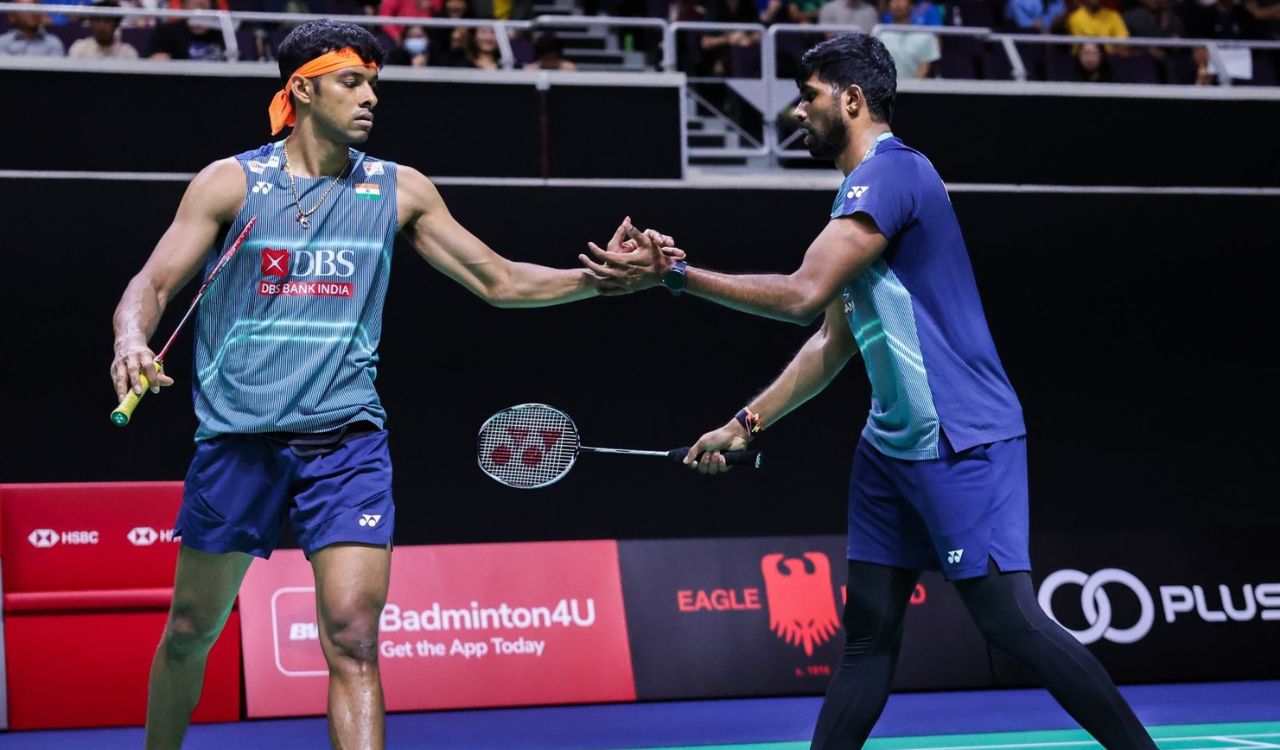
Satwiksairaj Rankireddy and Chirag Shetty will retain their aggressive style despite Satwik’s recurring shoulder injury as they target a better medal at the World Championships on home soil. The Indian duo also identified opening exchanges as crucial to their campaign
Published Date – 15 August 2026, 07:10 PM
New Delhi: A recurring shoulder injury has been “frustrating” for Satwiksairaj Rankireddy and at times “irritating” for partner Chirag Shetty, but the Indian pair will stick to their “aggressive and explosive” brand of badminton as they target a better medal at their first World Championships on home soil.
Satwik has been managing the shoulder problem for the last few years, making it difficult to maintain momentum after a good tournament. The duo had won the Singapore Open Super 750, their first title in two years, but subsequent flare-ups forced mid-match retirements and withdrawals at both the Indonesia Open and the Japan Open.
“It is always tough with the shoulder injury. I have been managing it for the last few years. It is on and off all the time. Sometimes I feel good and sometimes I feel not so good. It is frustrating. Obviously, you have the momentum and you want to continue,” Satwik told PTI.
“If you play a good tournament and then again you are off, it is irritating for your partner as well. It is not easy, but we are used to it. We know how to handle this situation. We have to respect the body as well.”
The injury, however, has not prompted the pair to alter their style.
“Our game style is the same. We didn’t change so much. It will be aggressive and explosive. That is what we played when we started and we will stick to that only,” Satwik said.
Satwik and Chirag are among the top five pairs to watch in a men’s doubles draw that has traditionally been wide open. No pair has dominated the event for long, with six different combinations from five countries winning the last six editions.
“Doubles has evolved over the years. It is much faster, a lot of flat exchanges and long rallies, and every pair in this tournament is quite strong,” Chirag said.
“In men’s doubles you can’t say that this pair will go on to win the title. So I won’t say there is a favourite. It is an open competition. Every pair is capable of winning a medal.”
The opening exchanges could prove decisive, with both Satwik and Chirag placing particular emphasis on the first four strokes of a rally.
For Chirag, the focus on the opening exchanges has already produced results.
“We need to be really focused on our first couple of strokes once the rally starts. I think we can manage the rallies, but the first four strokes will definitely be important. No matter if you’re serving or receiving, it becomes quite crucial,” he said.
“Even at the Singapore Open, I think that worked really well for us. We had some really good insights from the coaching chair. Yeah, I think even for this World Champs, they just asked us to keep it simple and take it one match at a time.”
Satwik echoed that approach.
“We have been working with Tan coach for quite some time. We just needed that small break. We have been training the same way for some time. It is not new things. The tactics will be the same,” he said.
“His point was very much open and clear: just take one at a time. Don’t think too much and don’t take so much expectation. Of course, we want to do well, but still take one match at a time.
“As we are coming back from the injury, it will be tough to adjust, so just find that momentum and try to play as deep as possible.”
World No. 1s Kim Won Ho and Seo Seung Jae had carried their dominance from 2025 into the opening part of this season, but have looked more vulnerable since the Thomas Cup Finals in May, opening the door for challengers including Fajar Alfian and Muhammad Shohibul Fikri, Goh Sze Fei and Nur Izzuddin, and the Indian pair.
“I think Fajar and Fikri, Goh and Nur, they are quite good at the first four strokes. They are kind of little short guys. They have very quick rackets. They have good skills on the racket. So they are very good at reading the shuttle, understanding and catching those four strokes. Then they put you in a very under-pressure situation.
“So it is not an easy thing playing against them. It is not easy to play against them. So it is always tricky to play against them. But once you get adjusted to their game style, I think you will feel a little bit more comfortable.
“Apart from that, they don’t make you feel very comfortable on court. You have to play a little bit in an uncomfortable situation. So it is always a tough battle against both the players.”
The home setting, though, is something Satwik is keen to embrace rather than treat as an additional burden.
“It is fun and challenging, exciting. There is no pressure. Everyone says pressure is privilege. We love taking the challenge. Hopefully, we will handle it in a positive way. Hopefully, people will come in good numbers and see how badminton is growing,” he said.
For Satwik, the occasion also carries a deeply personal connection.
He was at the 2009 World Championships in Hyderabad, where his brother was volunteering and his father was working as a line umpire. Satwik recalled watching the men’s doubles final and playing with the racquet that was thrown into the crowd by the winner and retrieved by his father.
“I have very good memories from 2009… Now I am playing back in India at the World Championships. It is quite a long journey from a small town to here, so it is a great thing to remember.”