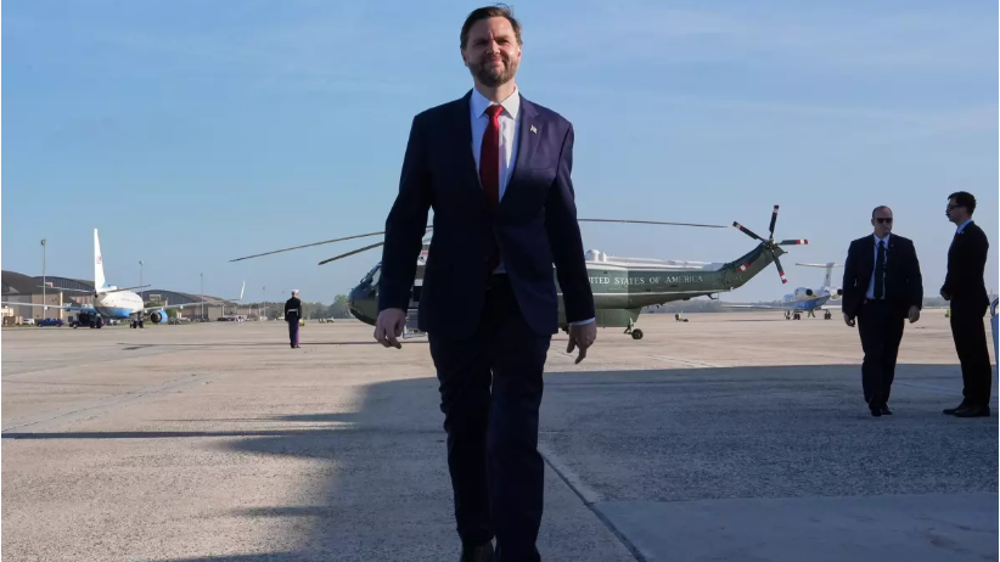
US Vice President JD Vance has declared that keeping oil and gasoline prices low for Americans is Washington’s top priority in the war on Iran, placing what he called the prevention of a nuclear-armed Iran as the administration’s second goal.
Vance made the remarks in an interview with Fox News on Thursday, marking a notable departure from President Donald Trump’s repeated claims that the war on Iran was primarily aimed at preventing Tehran from obtaining a nuclear weapon, which the Islamic Republic has repeatedly declared — and US intelligence has confirmed — it has never pursued.
“That’s goal number one — keep oil and gas cheap for Americans all over our country,” Vance said, referring to the administration’s priority of containing energy prices.
“And then obviously goal number two is ensure that Iran never gets a nuclear weapon,” he added.
Vance pointed to the sharp rise in oil prices during the early days of the war on Iran, saying Washington was now closely focused on preventing further pressure on American consumers.
“I know that oil is down today and it’s way down from the highs in the early days of the conflict,” he said.
His comments come as the Strait of Hormuz has emerged as a major pressure point in the US-Israeli aggression against Iran.
Tehran says the reopening of the strategic waterway depends on the US meeting Iran’s demands, including a total end to the war on the country.
Commander of Iran’s Islamic Revolution Guards Corps. (IRGC) Navy says that the Strait of Hormuz is closed and Iran’s control over movements is complete and decisive; no movement in this strait escapes the watchful eyes of the IRGC Navy. pic.twitter.com/wun4ekhbiQ
— Press TV 🔻 (@PressTV) August 13, 2026
The Strait of Hormuz is one of the world’s most important energy corridors, and any sustained disruption could put further upward pressure on global oil prices and fuel costs.
Shifting objectives
Since the terrorist war on Iran began on February 28, Trump has cycled through multiple, often contradictory, war objectives. On the first day of the attacks, he called on Iranians to “take over” their government, declaring “It will be yours to take” in a social media video.
Days later, Pentagon chief Pete Hegseth vowed to “destroy Iranian offensive missiles, destroy Iranian missile production, destroy their navy and other security infrastructure.” On March 6, Trump demanded “UNCONDITIONAL SURRENDER” from Tehran.
The timeline has also shifted repeatedly. Trump first said the war would last four to five weeks, then said it could take longer, while Hegseth later stated Washington was not setting any time frame at all.
On March 2, Secretary of State Marco Rubio admitted that Israel’s determination to attack Iran “forced” Washington to strike.
“We knew that there was going to be an Israeli action, we knew that that would precipitate an attack against American forces, and we knew that if we didn’t preemptively go after them before they launched those attacks, we would suffer higher casualties,” Rubio said.
Trump contradicted Rubio the following day, claiming he “might have forced their hand” and that Iran was about to attack first.
Climbdown to ‘low-keying it’
According to The Wall Street Journal, Trump has privately told senior aides he may abandon the nuclear objective entirely and settle for reopening the Strait of Hormuz — which was already open when Trump and Israel started the war in February.
The president described the administration’s approach as “low-keying it” in an interview with Axios.
The shift comes as Iran has forced the Strait of Hormuz to the top of the negotiating agenda. Tehran has demanded billions in US payments, removal of American troops from the region, and an end to the naval blockade as conditions for reopening the waterway.
Vance said the administration was simultaneously dealing with energy prices, military considerations and Iran’s nuclear program.
“Sometimes we’re focused on the energy piece of it because we want Americans to be able to afford the price of oil and gas,” he said.
The vice president has previously been viewed as one of the more cautious figures within the Trump administration regarding the war on Iran.
His latest remarks, however, indicate that economic considerations are playing a central role in Washington’s calculations as the war continues.
With midterm elections approaching and gas prices remaining above $4 per gallon — more than $1 above pre-war levels — Trump is reportedly desperate for a way out.
The Pentagon has also faced alarming ammunition depletion, with reports of missile shortages weakening the administration’s bargaining leverage.
The New York Times has reported that the Pentagon has used more than 1,500 Patriot interceptors during the war and has fewer than 1,700 remaining.
“The pressure points for the Iranians are, while real, more endurable and bearable than those that are impacting the US economy,” said Suzanne Maloney, an Iran specialist at the Brookings Institution.
The reported strain on US missile stocks could further complicate Washington’s military calculations, particularly as the administration seeks to maintain pressure on Iran while containing the economic impact of the war at home.