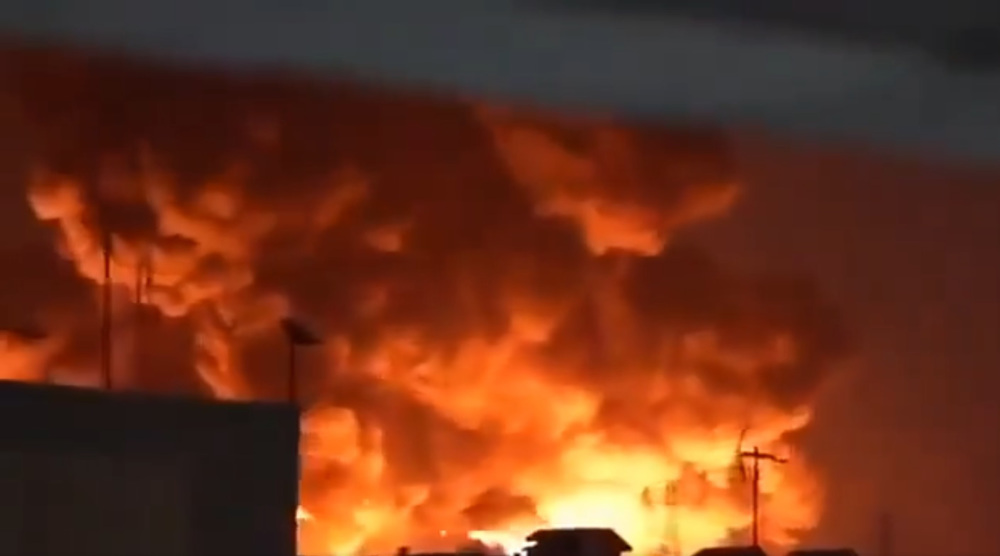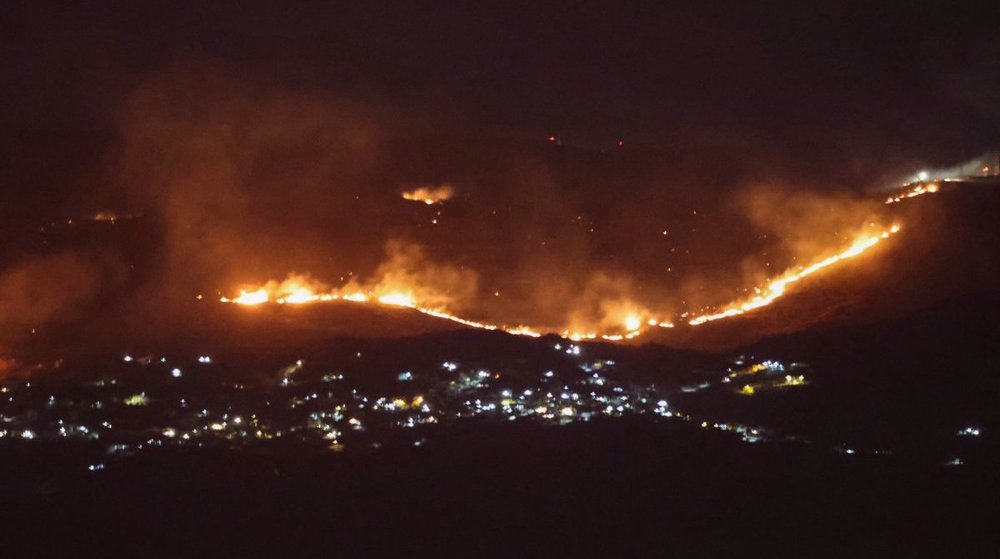
Firefighters and local residents in southern Lebanon say the Israeli military is responsible for igniting wildfires in the area, as forested regions were consumed by flames triggered by Israeli airstrikes and artillery shelling.
According to environmental advocates, the fires that have occurred in recent weeks are a continuation of Israel’s long-standing strategy aimed at damaging Lebanon’s natural environment.
On Tuesday, the Israeli military released flares in a forested region near Khiam, located in southern Lebanon, igniting fires.
Hussein Fakih, the head of civil defense in the Nabatieh area, said firefighters had to retreat when a drone struck nearby as they tried to put out the flames.
“Most of our missions are now related to fires. There are enormous areas of woodland that have burned; I don’t have the exact figures, but in the areas close to the [frontline], around 30-40% of the land has been affected by fires,” he said.
Videos and accounts from first responders indicate that the Israeli military has ignited fires throughout southern Lebanon, particularly affecting olive groves and agricultural areas, in the nearly two months following the June 17 ceasefire that largely concluded hostilities between Hezbollah and Israel.
“They started doing this right after the ceasefire, and there have been incendiary bombs every day,” said Fakih.
He added, “Small drones come out and drop incendiary materials, [white] phosphorus shells are fired at the woodlands, in addition to illumination flares that they drop during the daytime so the vegetation catches fire.”
Firefighters and residents from various regions in southern Lebanon report that similar fires are ignited by Israeli munitions and drones in arid scrub and forested areas.
On August 7, Israeli munitions caused large wildfires in two densely wooded regions: one in Kfarchouba, near the border, and the other between Jezzine and the western Bekaa Valley.
Samir Hardan, the chief of the civil defense station in the area, reported that a fire started near Kfarchouba on Friday afternoon when a drone discharged a munition in the wooded region.
Following an overnight struggle to combat fires and successfully putting them out on Saturday, a second drone ignited another blaze on Sunday, Hardan noted.
“These are long-established woodlands, dominated by productive stone pine alongside oak. They perform critical functions. The wider area is also an important passage and resting ground for migratory birds,” Hisham Younes, the founder of the Lebanese conservation organization Green Southerners, said.
Younes characterized the Israeli attacks as an “ecocide,” asserting that they are consistent with the military’s pattern of targeting the environment in southern Lebanon to undermine its ecosystem through the use of munitions, fire, and chemicals.
“It is not about any single fire or attack, but a pattern of destruction that progressively erodes the ability of ecosystems to function, regenerate, and sustain life. When those cascading effects also undermine livelihoods and people’s ability to return to and remain on their land, environmental destruction becomes inseparable from the wider transformation of the territory itself,” he pointed out.
Despite ongoing direct negotiations between the Beirut government and the Tel Aviv regime, the Israeli regime presses ahead with its acts of aggression in Lebanon, which began on March 2.
According to Lebanese authorities, Israel has killed at least 4,330 people, injured over 12,270, and displaced over 1 million people.