By Mina Mosallanejad
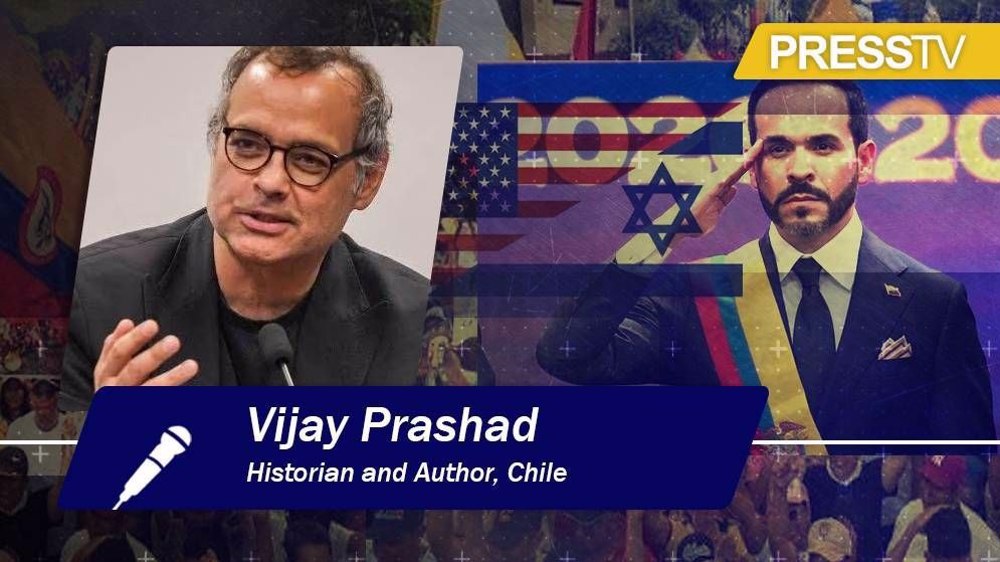
The narrow victory of right-wing billionaire Abelardo de la Espriella as Colombia’s president reflects a deeply polarized and divided Colombian society rather than a decisive mandate for the new government, says a political commentator.
De la Espriella, a lawyer and businessman who had never held public office, defeated left-wing candidate Iván Cepeda in Colombia’s June presidential runoff by less than one percentage point, securing 49.66% of the vote against Cepeda’s 48.70%.
His victory marks a sharp shift to the right after the left-wing government of President Gustavo Petro, who had developed closer ties with Palestine and a foreign policy independent of US influence.
In an interview with the Press TV website, Vijay Prashad, the executive director of the Tricontinental Institute for Social Research and a political commentator, sees the Colombian election as part of a broader rightward shift across Latin America.
He said de la Espriella’s government is likely to bring Colombia significantly closer to Washington, adopt a more militarized approach to security and counternarcotics, restore ties with the Israeli regime and move away from Petro’s unwavering support for the Palestinian cause.
He also warned that the new administration’s hardline security agenda could intensify tensions with opposition movements and human-rights groups, while its closer alignment with Washington could deepen Colombia’s regional polarization.
Prashad also cautioned that de la Espriella’s victory does not amount to an uncontested mandate.
The extremely narrow electoral margin, a divided Congress and Colombia’s deeply polarized society could make the next four years a defining test of whether the new government can consolidate a lasting political transformation or turn the country’s political conflict into a permanent confrontation between “order” and “resistance,” he noted.
A narrow victory, a divided country
According to Prashad, a vocal critic of neocolonialism and US imperialism, de la Espriella’s victory with an extremely narrow margin over left-wing candidate Cepeda points to a deeply divided electorate.
“Colombian society is extremely polarized,” Prashad told the Press TV website, describing the country as one marked by “enormous extremes of wealth and income inequality.”
He said these disparities are rooted in “older oligarchical structures that date back to the old colonial days” and were later reinforced by “the long period of effectively dictatorial rule by two parties of this oligarchy.”
According to Prashad, Colombia’s Gini index stood at 54.38 in 2024, while 31.8 percent of Colombians remained below the national poverty line despite overall economic growth.
He linked the political opening that brought Petro to power in 2022 to the mass demonstrations of 2019-2020 and the 2016 peace accords.
Colombia’s 2016 peace accord ended the government’s decades-long war with the FARC (Revolutionary Armed Forces of Colombia), which was Colombia’s largest left-wing guerrilla group. It fought the Colombian government for more than five decades, beginning in 1964, before signing the 2016 peace agreement and laying down its arms.
But the peace accord’s incomplete implementation, combined with deep economic inequality, political polarization and police violence, contributed to growing social unrest that erupted in mass protests in 2019 and again on a much larger scale in 2021.
Petro won 50.42 percent of the vote, benefiting from a population that, according to Prashad, was increasingly agitated but also eager to move beyond Colombia’s long history of political division.
However, Petro’s presidency did not fundamentally alter the balance of political forces, Prashad said.
“While Petro did move an agenda on many issues, he was not able to change the balance of forces in one presidential term,” he told the Press TV website.
As a result, Prashad sees the latest election as a movement back toward Colombia’s traditional power structures. “The needle went back to the oligarchy,” he said.
But that shift did not simply restore the old political order. Traditional oligarchic candidates were unable to contain de la Espriella’s far-right challenge.
“Their preferred candidates could not hold off the far-right wing challenge from de la Espriella,” Prashad said, adding that the final result, however, underscored the limits of his victory.
✍️ Feature – Trump’s man in Bogotá: How Colombia is pivoting toward US and Israel under new far-right president
By Mina Mosallanejadhttps://t.co/TnIDI8kQNU
— Press TV 🔻 (@PressTV) August 8, 2026
Washington’s ideological muscle
US President Donald Trump’s open endorsement of de la Espriella during the election campaign, followed by Washington’s announcement of a major security assistance package, raises the question of how far US political and financial backing may have shaped the outcome, Prashad said.
Asked to what extent he believes Washington’s support influenced Colombia’s election, he placed the Colombian vote within a much broader US effort to reshape the political landscape of Latin America.
“The United States has made it clear that it would like to erase the entire progressive and democratic force that was once dominant in Latin America,” the analyst stated, pointing to the broader regional shift to the right, as only Brazil and Uruguay still have progressive forces in power in the region.
“Elsewhere, the far-right has prevailed,” he said, adding that these forces have continued to consolidate support by building “majority blocs around issues such as anti-immigration, anti-crime, and pro-capitalist policies.”
Prashad added that Washington has played an important role in strengthening this political shift, particularly through its ideological influence.
“The US has certainly helped these forces with its considerable ideological muscle,” he said.
In Colombia, he pointed to clear evidence of an attempt by Washington to influence the election directly.
Two weeks before the runoff, Prashad noted, Trump gave de la Espriella his “complete and total endorsement,” urged Colombians to support him, and said the result would be important for Colombia’s relationship with the United States.
“There is clear evidence of attempted political influence in this election in Colombia,” Prashad said, noting that Trump’s language went beyond a routine political endorsement.
By tying the election result directly to Colombia’s future relationship with Washington, he said, Trump’s intervention could reasonably be understood “as implying diplomatic or economic consequences.”
Bogotá tilt toward Washington
With de la Espriella now in power, the question of what his presidency will mean for Colombia’s relationship with the United States becomes particularly significant.
Asked whether he expects Bogotá to become substantially more aligned with Washington’s foreign-policy priorities, Prashad predicted a major shift away from the approach pursued by Petro.
“De La Espriella’s election is likely to produce a substantial realignment toward Washington, especially after the Petro years,” Prashad told the Press TV website.
He pointed to “unusually strong early evidence of this shift,” saying de la Espriella’s government has joined the US-led “Shield of the so-called Americas” initiative, adopted a harder counternarcotics strategy, and received a proposed $1 billion US security package immediately after his inauguration.
Washington itself, Prashad noted, has described the relationship as entering a “new era,” with regional security, migration and economic cooperation at its center.
Prashad said he expects the alignment with Washington to become most visible across four key areas: expanded military and intelligence cooperation against drug cartels and armed groups; renewed coca eradication efforts and the possible return of aerial spraying; closer cooperation on migration and Venezuela; and more US-friendly policies on energy and investment.
The foreign-policy shift is also likely to extend beyond Washington. Prashad said he expects de la Espriella to restore diplomatic relations with the Israeli regime as he has already announced, distance Colombia from Cuba and Nicaragua, and expand oil and gas production.
Yet despite the strong indications of a strategic realignment, Prashad does not expect Bogotá to simply follow Washington’s lead on every issue due to internal divisions.
“De la Espriella has a divided Congress, faces strong domestic opposition, and must manage Colombia’s economic relationships with China and its Latin American neighbors,” he said.
Prashad also warned that aggressive US-backed policies could trigger legal challenges, human-rights criticism and nationalist resistance inside Colombia.
“My expectation is therefore significant strategic alignment, particularly on security and regional diplomacy, but selective autonomy on trade and other issues where Colombian interests diverge,” Prashad told the Press TV website.
A return to interventionism?
De la Espriella’s support for joint military operations with the United States, including the possibility of hosting US troops in Colombia, raises the prospect of a major transformation in the country’s security policy, Prashad warned.
Asked whether this could mark a return to a more interventionist model and what it could mean for Colombia’s relations with Venezuela and other governments in the region, Prashad said the shift could resemble an earlier chapter in Colombia’s security history – but potentially in a more aggressive form.
“Yes, it could mark a return to an interventionist model resembling Plan Colombia, but potentially with a more overtly kinetic and regional character,” Prashad said.
Plan Colombia was a US-backed so-called counternarcotics program launched in the late 1990s that brought extensive US military, intelligence and financial support to Colombia. Under de la Espriella, Prashad expects the model to return with an even stronger emphasis on direct military action.
“De la Espriella has advocated US bases, joint aerial eradication and operations against ‘narco-terrorist’ targets,” he said, adding that such a policy would represent a significant departure from Petro’s approach, which placed greater emphasis on negotiations with armed groups and rural development.
Prashad expects the new government to instead prioritize intelligence sharing, extraditions, fumigation, special operations and military control of contested territory.
However, he noted, the prospect of permanently stationing US forces in Colombia faces significant legal and political obstacles.
Prashad pointed to Article 189 of Colombia’s Constitution, which regulates the entry or transit of foreign troops, as well as the requirement for congressional approval of formal international agreements.
As a result, he believes a more gradual arrangement is likely.
“It is therefore more likely initially to involve rotational deployments, advisers, intelligence personnel and access to Colombian facilities than sovereign American ‘bases’,” Prashad said.
He warned that a renewed military campaign could also reproduce some of the failures associated with Plan Colombia, particularly its impact on civilians and its inability to permanently eliminate armed groups and coca cultivation.
“Operations also risk civilian casualties, displacement and repeating Plan Colombia’s tendency to move armed groups and coca cultivation elsewhere rather than eliminate them,” he said.
Venezuela caught in the crossfire
The most immediate regional consequences could emerge along Colombia’s 2,200-kilometre border with Venezuela. Prashad warned that Caracas – as well as armed groups operating on either side of the border – could begin to view Colombia as a platform for expanding US power in the region.
The risks are particularly serious because Bogotá has indicated that its Venezuela policy will be closely coordinated with Washington, even as Colombia remains deeply dependent on managing practical issues with its neighbor, including migration, trade and armed organizations operating across the border, Prashad told the Press TV website.
“Any cross-border pursuit, reconnaissance, or strike could therefore trigger military incidents, border closures, proxy retaliation, or another migration shock,” he remarked.
Those risks, he added, may ultimately force de la Espriella to preserve direct communication with Caracas.
A deeper regional divide
The consequences would not be limited to Colombia and Venezuela. According to Prashad, more interventionist security policy could deepen the political polarization already visible across Latin America.
“Regionally, the policy would deepen polarization,” Prashad said, expecting right-leaning governments such as Argentina, Ecuador, El Salvador and Paraguay to welcome stronger US-Colombian security cooperation.
By contrast, he said, Brazil, Mexico and other governments committed to the principle of non-intervention would likely view permanent US deployments or unilateral military strikes as threats to national sovereignty.
Prashad sees a similar divide emerging from the reaction to the 2026 US attack on Venezuela and the abduction of it leader Nicolas Maduro.
“Colombia could consequently regain its role as Washington’s leading security partner in South America, but at the cost of weaker regional trust and reduced ability to act as a diplomatic bridge,” Prashad warned.
A dramatic shift on Palestine
De la Espriella’s strong support for Israel and his pledges to restore full diplomatic ties with the regime, move Colombia’s embassy to occupied al-Quds and resume coal exports to Israeli-occupied territories would represent a major departure from the foreign policy pursued under Petro.
Asked how significant such a shift would be for Colombia and for its longstanding support for the Palestinian cause, Prashad described it as a “major reversal” of Petro’s policy, although he noted that restoring diplomatic and security ties would “partly revive Colombia’s historically close pre-2022 relationship with Israel.”
For Prashad, however, the most consequential move would be relocating Colombia’s embassy from Tel Aviv to occupied al-Quds.
“The more consequential step would be relocating the embassy from Tel Aviv to [al-Quds] and align Colombia with a small group of strongly pro-Israel governments,” he said.
The decision to resume coal exports to Israeli-occupied territories would also carry both material and symbolic importance, he added.
However, he explained, the importance of the trade is not equal for both sides. While reopening exports would benefit Colombian producers and restore commercial ties, Colombian coal has been considerably more important to Israel’s energy security than the trade has been to Colombia’s broader coal industry.
Before Petro imposed restrictions, Israel obtained more than half of its imported coal from Colombia, while Colombian coal sales to the Israeli regime exceeded $320 million in the first eight months of 2023, he highlighted.
“Thus, exports mattered considerably more to Israeli energy security than to Colombia’s roughly $9 billion coal-export industry,” Prashad said.
That is also why the decision could carry consequences beyond trade. Prashad noted that restoring coal exports to occupied territories would remove one of Bogotá’s most significant economic levers over Israel amid the genocidal war on Gaza.
What happens to Colombia’s support for Palestine?
The shift could be equally consequential diplomatically. Colombia’s formal recognition of the Palestinian state in 2018 would not necessarily be revoked under de la Espriella, but Prashad warned that recognition could become little more than a symbolic gesture.
“For Palestine, the shift would not necessarily revoke Colombia’s formal 2018 recognition of the Palestinian state, but it could make that recognition largely symbolic,” he said.
According to Prahsad, de la Espriella has reportedly cancelled plans for a Colombian mission in Palestine.
His government, he said, could also reverse several of Petro-era positions at the United Nations, scale back diplomatic engagement with Palestinian representatives and withdraw or soften Colombia’s support for legal proceedings concerning Israel at the International Court of Justice.
The broader result, Prashad said, would go well beyond simply normalizing relations with Israel.
“It would move Colombia from Petro’s position as one of Palestine’s strongest Latin American advocates to an explicitly pro-Israel alignment,” he said.
“That could improve defense, intelligence, agricultural and technological cooperation with Israel and strengthen ties with Washington,” Prashad said, “but it would weaken Colombia’s credibility with Palestinian representatives, Arab governments, and states that see recognition of [al-Quds] as prejudging a negotiated settlement.”
A harder, more militarized state
De la Espriella’s hardline positions on protesters, drug trafficking and security raise another major question about the direction of Colombia’s domestic policy.
Prashad expects a substantial transformation of Colombia’s security apparatus.
“Colombians should expect a substantial militarization and reorientation of the security apparatus, though not necessarily an across-the-board expansion of the state,” Prashad said.
“De la Espriella simultaneously promises austerity and cuts to civilian bureaucracy, so the probable pattern is greater funding and authority for the military, police, intelligence agencies and prisons at the expense of peace-building and social programs,” he added.
Early signs of that direction, Prashad said, include proposals for “urban security defence blocs,” plans for Bukele-style mega-prisons and renewed aerial coca fumigation.
De la Espriella has also pledged stronger military operations against armed groups and could transfer the prison service to the Defense Ministry, he noted.
On his first day in office, he ordered 117 prisoners associated with peace negotiations to be transferred to high-security facilities. For Prashad, these measures point to a fundamental departure from Petro’s approach.
“These measures suggest a shift from Petro’s negotiation-based ‘Total Peace’ policy toward deterrence, incarceration, and territorial military control,” he said.
Opposition and human-rights concerns
Conflict with opposition movements is also probable, Prashad said, noting that since De la Espriella won the presidency by less than one percentage point and does not have an uncontested mandate in Congress, his government could face significant political resistance.
“Human-rights groups, unions, Indigenous organizations, environmental activists, and the left have already begun forming coalitions to defend constitutional rights, while his rhetoric depicts parts of the opposition as allies of disorder or criminality,” he said.
Yet Prashad stressed that a slide toward authoritarianism is not inevitable.
“Colombia’s Constitutional Court, Congress, Procuraduría, Defensoría del Pueblo, independent media, and the Inter-American human-rights system can scrutinize decrees and security operations; even established conservative parties have objected when de la Espriella appeared to weaken civilian control of the armed forces,” he highlighted.
For Prashad, the decisive question will ultimately be how the government uses its expanded security powers.
“The decisive test will be whether his government targets demonstrable criminal conduct under judicial oversight or uses national-security language to restrict peaceful dissent,” he said.
Colombia at a political crossroads
Looking beyond the immediate transition, the bigger question is what Colombia will look like over the next four to five years under a strongly pro-US and pro-Israel right-wing government.
Prashad expects the country to move significantly to the right, but argues that one presidential term alone may not be enough to permanently transform its political identity.
“De la Espriella can rapidly change foreign policy, policing, counternarcotics, and energy regulation; transforming Colombian society or dismantling its institutional pluralism would require sustained congressional support, popular legitimacy, and results that outlast him,” he said.
At the same time, Prashad expects de la Espriella to make sweeping changes to the country’s security and economic direction.
“He will change the security framework of the country, embolden corporations to loot the economy, become totally pro-Washington in its foreign policy,” Prashad said.
He also sees the emergence of a new political model that could move beyond Colombia’s traditional right-wing politics.
The new government, he said, could “replace traditional uribismo with a more personalist mixture of nationalism, evangelical conservatism, anti-left rhetoric, and Bukele-style security politics.”
Uribismo refers to the political movement associated with former Colombian President Álvaro Uribe, whose emphasis on hardline security policies and opposition to left-wing movements has shaped Colombia’s right for decades.
“Whether this becomes a lasting political transformation depends on outcomes,” Prashad said.
The real test: Colombia’s polarization
Prashad identified the country’s internal political divisions as the decisive factor.
“The most important test is polarized domestic politics, because it determines whether the government can address every other challenge,” he said.
For Prashad, the central question is therefore not simply whether de la Espriella can implement a more conservative and pro-US agenda. It is whether he can govern within Colombia’s constitutional framework despite having won by an extremely narrow margin and facing a deeply divided society.
“De la Espriella’s defining challenge is whether he can use a narrow mandate to govern constitutionally, or turn political conflict into a permanent confrontation between ‘order’ and ‘resistance’,” Prashad said.