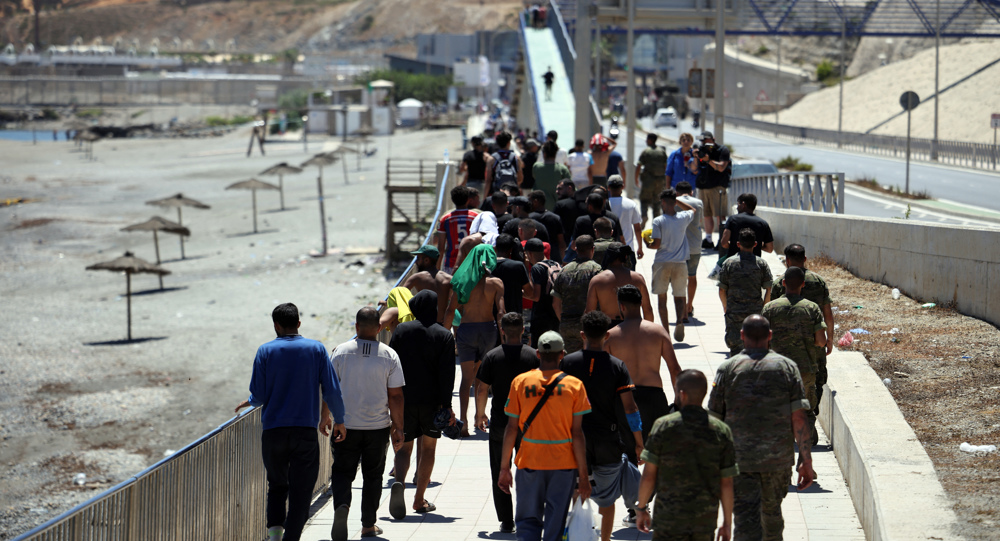
Spain has returned nearly 70,000 migrants to Morocco following a mass influx into the Spanish enclave of Ceuta in North Africa, as the European Union (EU) backed Madrid’s response and called for a coordinated approach to securing the bloc’s external borders.
Spanish Interior Minister Fernando Grande-Marlaska said on Tuesday that around 70,000 of the more than 72,000 people who entered Ceuta on July 30 and 31 had since been returned to Morocco, adding that the situation had been brought under control.
The influx turned deadly, with at least 75 people reported killed on the Spanish side of the border and another 11 deaths reported in Morocco.
EU interior ministers expressed solidarity with Spain at a meeting on Tuesday, stressing the need for a coordinated European response to migration.
Ireland’s Justice Minister Jim O’Callaghan, who chaired the meeting, said responsibility for protecting the EU’s external borders was shared by all member countries.
The meeting followed criticism from several European governments over Spain’s handling of the influx. Italy, Denmark and others voiced concerns that migrants could use Spain as a gateway into the Schengen free-movement area, prompting Rome to temporarily introduce additional checks on transport links with Spain.
On Thursday, Italian Prime Minister Giorgia Meloni described the scenes in Ceuta as “shocking,” warning on social media that “uncontrolled immigration posed a security threat” to Europe.
A day later, Italy suspended its application of the Schengen free-movement agreement with Spain, a move that, given the absence of a shared land border between the two countries, would mainly affect air travel by introducing additional passenger checks.
The Schengen zone, which allows passport-free movement across member states, currently covers more than 450 million people in 29 European countries.
However, EU officials struck a more conciliatory tone at the meeting, with Migration Commissioner Magnus Brunner saying the influx had been “instrumentalized” by smugglers and human traffickers.
French Interior Minister Laurent Nuñez said attempts had been made to exploit images of the crossings to create divisions within the bloc.
“The divisions that we have heard over the weekend were not welcome and they were exploited by foreign countries,” Nuñez told reporters, adding that the discussions among ministers had helped ease tensions.
Spain had come under scrutiny after the unprecedented crossings, but officials said Madrid’s rapid response demonstrated effective border management.
Spanish Prime Minister Pedro Sánchez rejected accusations that his government had mishandled the crisis, saying some European governments had targeted Spain instead of showing solidarity. He argued that the criticism was driven by “prejudice, fake news, ignorance, or political interest.”
Grande-Marlaska said the Schengen area had never been at risk and called for Italy to lift its additional transport controls as soon as possible. He also praised Morocco’s cooperation in managing the return of migrants.
EU officials said further measures would be considered, including improving early-warning systems, strengthening cooperation with non-EU countries and expanding the role of the EU border agency Frontex.
The European Commission is expected to examine in September what triggered the sudden influx and whether social media played a role in organizing or amplifying the crossings.