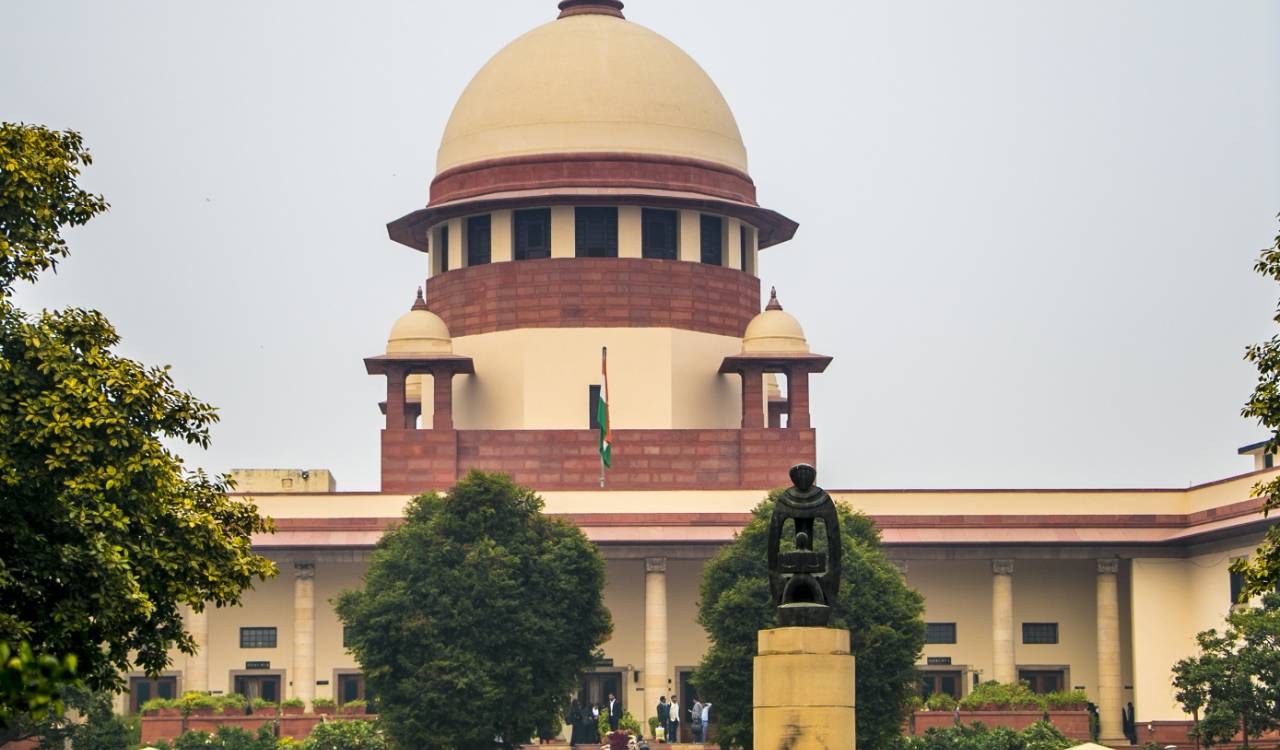
The Supreme Court directed the Centre to frame comprehensive guidelines for imposing and collecting environmental compensation under the Solid Waste Management Rules, 2026, stressing that compensation must be rational, proportionate, restoration-focused and supported by reasoned assessment of environmental damage
Published Date – 4 August 2026, 08:45 PM
New Delhi: The Supreme Court on Tuesday directed the Centre to formulate comprehensive guidelines for the imposition and collection of environmental compensation from polluting entities and individuals under the Solid Waste Management Rules, 2026.
A bench comprising justices P S Narasimha and Alok Aradhe also asked the Ministry of Environment, Forest and Climate Change to file an affidavit and place on record the progress in the making and the issuance of the regulations.
The bench referred to a recent judgement in which the court had placed an important pre-condition for imposing environmental compensation by holding that any compensation that is awarded must be proportionate, bearing some rational nexus to the pollution caused by the polluter.
“This court has consistently underscored that environmental compensation must rest on a foundation of rationality, proportionality and reasoned assessment,” it said.
The bench then went on to formulate the principles and said, “Environmental compensation cannot be seen as a replacement for penalties levied against the erring polluter. It is restitutionary in nature and is paid in addition to the penalty or fine that the polluter is liable to pay.”
It said that the temporal extent of paying compensation by the polluter ends only when the damage caused is reversed. “The appropriate authorities of the state have a duty to undertake an exercise of valuing the damage caused by the polluter and collect such compensation required for restoration of the environment,” it said.
While determining the amount of environmental compensation, it said both tangible and intangible damage caused by the polluter must be considered. “Even if actual harm is not caused but is imminent or the actions/activities of the polluter have the potential to cause harm, the liability to pay compensation will come into place,” it said.
“Factors such as the financial capacity of the polluter, the cost involved in assessing the damage and loss suffered by individuals and the environment as well as the cost of remediation or restoration are also to be taken into account while valuing such compensation,” it said.
Any environmental compensation levied must be proportional to the damage caused by the polluter and must have some rational nexus to the pollution caused, it said.
“All courts and tribunals must record reasons while determining environmental compensation, listing the factors considered, the valuation standard used to assess such damages and the formula or guidelines applied to quantify the compensation payable,” it said.
The directions were issued while hearing appeals filed by the Amravati Municipal Corporation. The bench said the institutionalisation of solid waste management requires not only robust laws but also effective regulatory mechanisms and accountability to ensure their implementation.
It observed that constitutional courts and the National Green Tribunal have an important role in ensuring that statutory authorities created under environmental laws are constituted, adequately staffed and function efficiently instead of existing only on paper.
It noted that, following its earlier directions, the Centre had constituted the Central Implementation Committee under Rule 18 of the Solid Waste Management Rules, 2026. It appreciated the move and said it as a positive step towards effective implementation of the Rules.