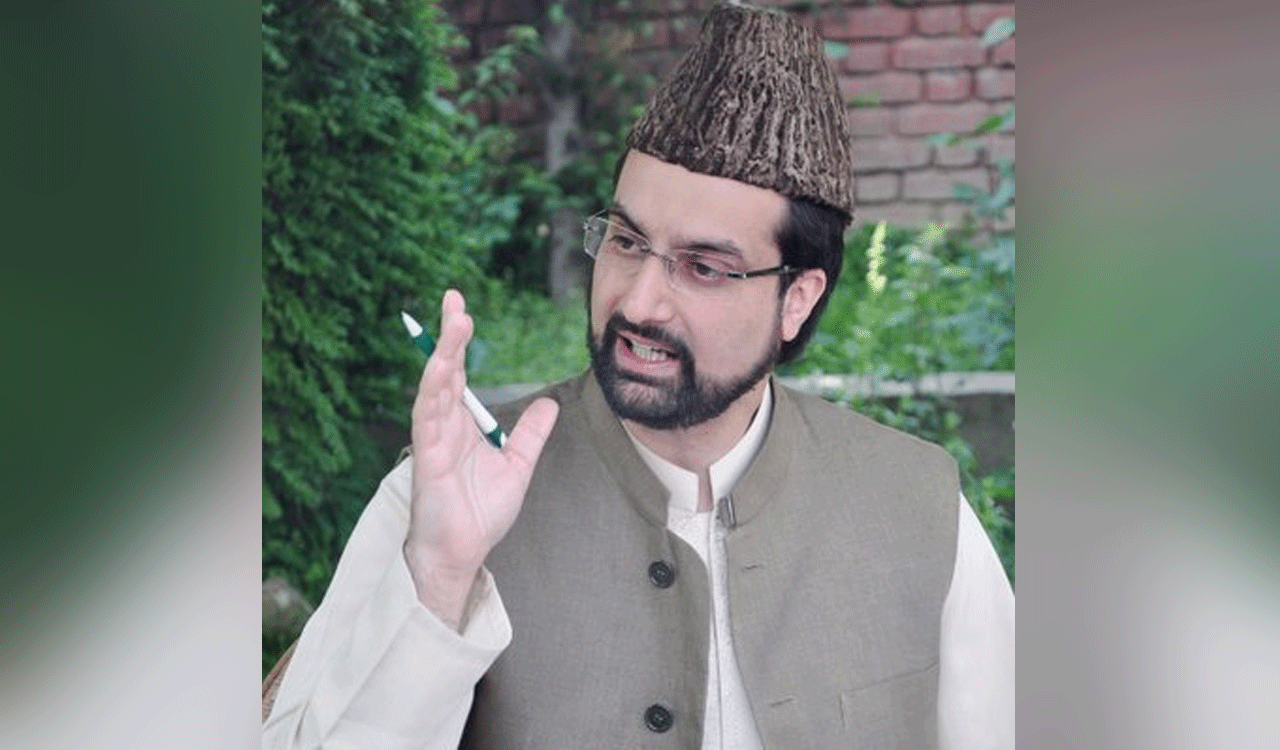
The bypoll verdict conveys a larger political message, pointing to a broader shift in voter behaviour in Bihar
Published Date – 5 August 2026, 12:24 AM
Never in the recent past has the result of a single by-election evoked such widespread national interest as the Bankipur bypoll in Bihar. Political strategist and founder of the Jan Suraaj Party, Prashant Kishor, has achieved what many considered virtually unthinkable: breaching the BJP’s fortress and ending its three-decade hold over the constituency. His convincing victory over BJP candidate Neeraj Kumar carries significance far beyond Bankipur and sends a clear message to the saffron party that the ground beneath its feet may be shifting. The verdict conveys a larger political message, pointing to a broader shift in voter behaviour. Bihar’s politics has long revolved around caste equations. Kishor’s victory suggests that voters are increasingly willing to back a leader based on aspirations rather than social identities. It also reflects a growing desire for clean governance and a greater focus on issues such as education, healthcare, employment, and development, rather than on caste, religion, and welfare politics. The result came as a major setback for the BJP. The seat had been represented by the party’s national president, Nitin Nabin, since 2010 and, before him, by his father, Nabin Kishore Prasad Sinha, making it one of the BJP’s most entrenched urban bastions in Bihar. The defeat is particularly painful because the party invested considerable political capital in retaining the constituency. It even replaced its original candidate with Neeraj Kumar Sinha after the first nominee withdrew, underscoring the importance it attached to the contest.
The bypoll was the first electoral contest after Samrat Choudhary assumed office as Bihar’s first BJP Chief Minister in April, succeeding JD(U) stalwart Nitish Kumar, who had dominated the state’s politics for nearly two decades. In many ways, it served as the first electoral test of public approval for Choudhary’s leadership. It was also Prashant Kishor’s maiden electoral contest and resulted in the Jan Suraaj Party’s first-ever victory, following its disastrous performance in last year’s Assembly elections. In the previous Assembly election, Nitin Nabin had retained the seat with a margin of nearly 52,000 votes. The bypoll became necessary after he vacated the constituency following his election to the Rajya Sabha. Prashant Kishor successfully framed the contest as a direct battle between himself and Samrat Choudhary. Throughout the campaign, the Jan Suraaj founder repeatedly targeted the Chief Minister over his alleged criminal cases and educational qualifications, transforming what might otherwise have been a routine by-election into a high-stakes political showdown for the BJP’s new face in Bihar. A sense of voter fatigue also appears to have played a role, with the BJP having held the constituency continuously since 1995. Beyond caste arithmetic and anti-incumbency, the campaign narrative itself may have influenced the electorate. Kishor’s campaign, coming just months after his high-voltage statewide outreach during the 2025 Assembly elections, remained firmly focused on Bihar’s local issues and governance challenges. That emphasis appears to have resonated with voters.