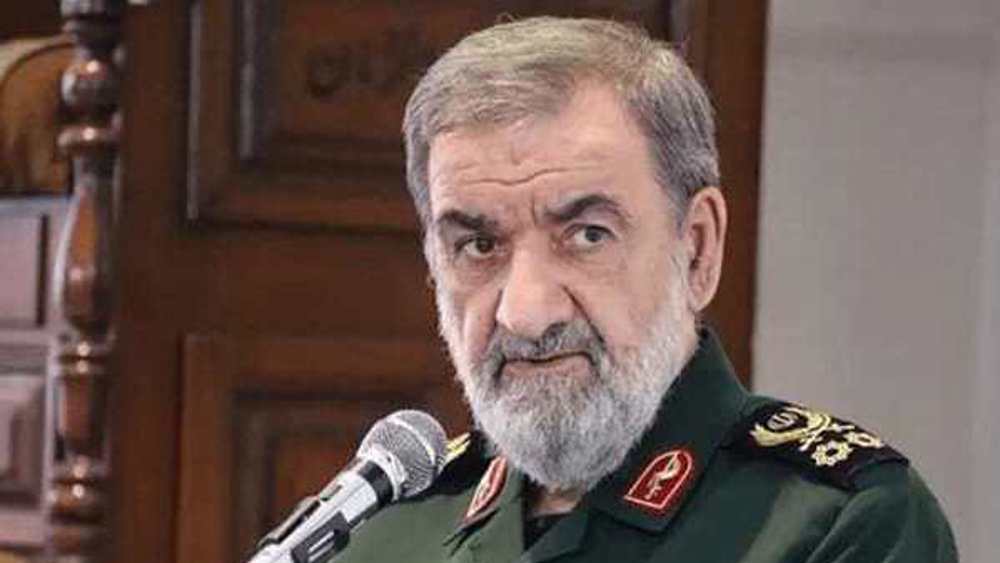
Mohsen Rezaei, advisor to the Leader of the Islamic Revolution, has said the United States was defeated midway in what he called “Trump’s third war” against Iran, as Iranian forces disrupted American plans, forced the relocation of US command centers, and inflicted heavy casualties, adding another major failure to Washington’s record of setbacks.
Speaking in a special television interview on Monday, Rezaei, former commander of the Islamic Revolution Guards Corps (IRGC) during the Sacred Defense, revealed that Iran prepared to strike three locations inside Ukraine in response to an attack on an Iranian ship, but suspended the operation after Kiev claimed the incident was a mistake, while stressing that compensation remains obligatory.
“We were ready to attack three areas in Ukraine,” Rezaei stated, referring to the Ukrainian strike on an Iranian vessel. “But after they claimed it was a mistake, we halted our response to examine their claim. Even if it was a mistake, it still requires compensation.”
Offering condolences on the occasion of Arbaeen, Rezaei said Iran has already advanced far along the path toward victory and must, following the doctrine of the martyred Leader of the Islamic Revolution, Imam Seyyed Ali Khamenei, based on dignity, wisdom and expediency, preserve unity and steadfastness through prudence.
He characterized the recent American aggression as Trump’s third war against Iran, coming after earlier 12-day and 40-day conflicts.
Rezaei recalled that Washington’s bad faith had been clear from the beginning. The US violated previous understandings by creating a corridor south of the Strait of Hormuz and then bombing the area, rather than referring any dispute to the designated conflict-resolution committee involving Qatar and Saudi Arabia.
Detailing the battle of Hormuz, Rezaei noted that Israel was absent from the latest round of attacks, which focused on southern Iran. The likely objectives were to pave the way for a ground operation to force open the Strait of Hormuz or to target Iran’s nuclear facilities.
American forces bombed communication bridges, radars and some military centers in an attempt to weaken Iranian logistics, he said.
“Trump demanded heavier strikes from the CENTCOM commander because conditions for a ground operation had not been created,” Rezaei said. “But his commanders replied that maximum capability had already been used, and still they failed. This exposes the miscalculations of American military commanders.”
In response, Iran launched successive, intense and precise strikes against US bases across the region. These attacks forced the relocation of American forces and shifted their command first from Qatar to Jordan and then to the Israeli entity, placing command and support far from the battlefield.
“Iran disrupted their plan. Trump’s third war against Iran was defeated midway, adding a severe failure to his previous setbacks. We continued our strikes for two days after the Americans stopped,” he added.
Rezaei explained that the Zionist regime stayed out of the latest confrontation because it remains entangled in Gaza, the occupied West Bank and Lebanon, and because Trump sought to create the appearance of acting independently of Israeli pressure.
On the current situation, he said no formal ceasefire exists in the conventional sense, but Iranian strikes have become purposeful. The US recently admitted to 650 killed and wounded in the recent clashes; Iranian estimates place the figure at nearly 500 killed and a large number of wounded.
While a full-scale American ground invasion plan is no longer realistic and has been greatly weakened, limited operations cannot be entirely ruled out.
Washington is already preparing a fourth round, including plots to stir internal unrest and attempts to drag other countries into the conflict, as seen in the Ukrainian attack on the Iranian ship and claims of Saudi involvement in bombings of Iraq which Riyadh has denied and which Iran is investigating.
Rezaei warned that America’s desperate maneuvers risk igniting the sparks of a third world war. West Asia today holds far greater potential for escalation than Europe on the eve of World War II. The Strait of Hormuz and the Persian Gulf form a highly sensitive point; US efforts to dominate the strait could draw other powers into a wider conflict.
He noted Trump’s desire to activate NATO and growing interventionist signals from Britain’s new prime minister, describing these moves as signs of desperation following defeats in the 40-day and 17-day wars. Netanyahu’s recent efforts to drag the US into further escalation largely failed this time.
Rejecting claims that Iran is the aggressor, Rezaei stressed that America is the warmonger. “If a global poll were held, the overwhelming majority of people worldwide would identify the United States as the warmonger.
“Iran always sought to prevent war and entered negotiations despite knowing America’s bad faith. The enemy miscalculated Iran’s political nobility and acceptance of talks as weakness, betrayed negotiations three times and imposed war on Iran,” he stated.
“It was America that attacked our country and our people, martyred our Leader and our children. Did we attack them and massacre their nation?”he asked.
Iran does not seek to expand the war or welcome conflicts involving other countries, as such developments risk global war. Diplomacy remains necessary, but as the Leader has stated, America must change its behavior and honor its commitments. Only such a change can signal seriousness.
The Leader’s advisor emphasized that Iran has acted responsibly in the Strait of Hormuz, ensuring security for all, because global economic security matters to Tehran. It is the United States that creates insecurity. The war-negotiation-ceasefire cycle must end and the shadow of war be lifted. America must take the first step by changing its conduct. Continued blockade will endanger US warships and vessels.
Finally, Rezaei called on the Iranian people, who have turned the streets into the frontline of a great national uprising, to extend this awakening into the economic sphere. Sanctions relief alone will not produce economic rebirth.
Obstacles and restrictive laws must be removed, the state-dominated economy transformed, and the people made partners in economic activity, he noted.
Through collective savings, Iran can generate $100 billion annually, with benefits returning to the people, Rezaei noted.