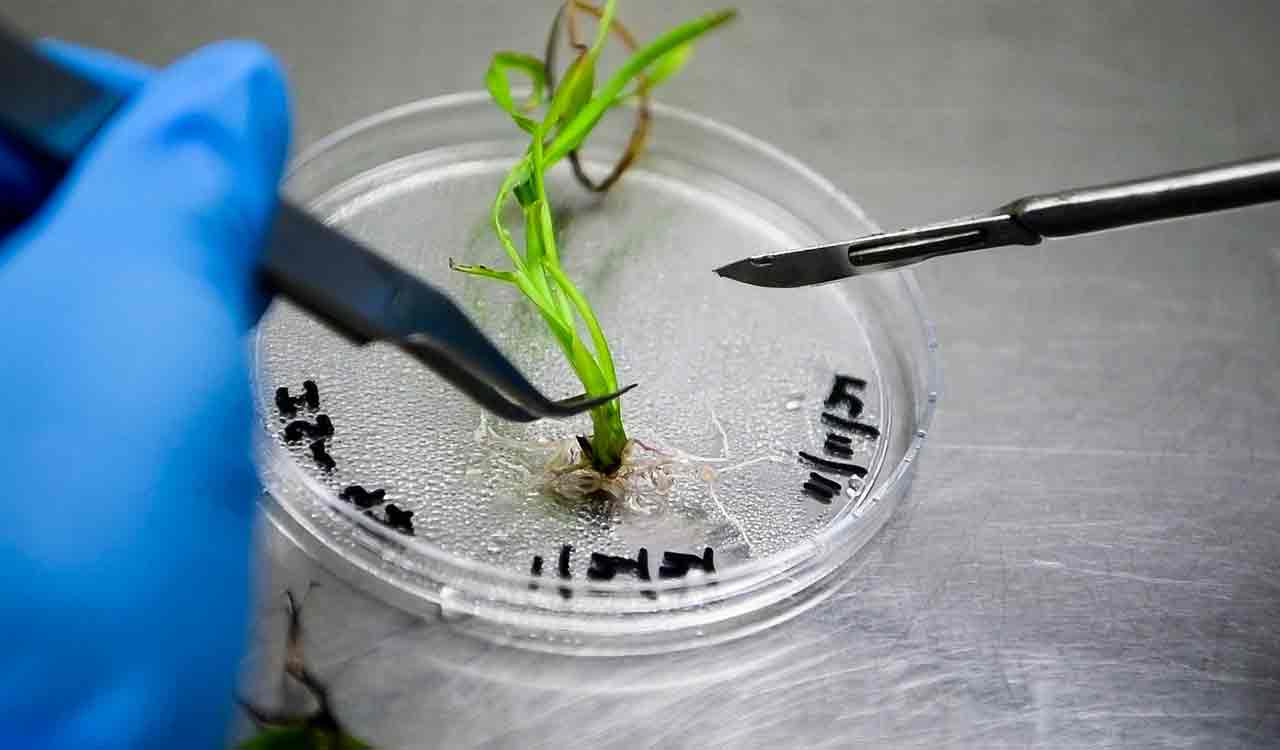
ICRISAT has secured long-term access to CRISPR-Cas9 through a humanitarian licensing agreement with Corteva and The Broad Institute, enabling faster development of climate-resilient, high-yielding crop varieties for smallholder farmers across Asia and Africa while strengthening food security and agricultural sustainability
Published Date – 3 August 2026, 07:57 PM
Sangareddy: In a key milestone for food security and climate-resilient agriculture, the International Crops Research Institute for the Semi-Arid Tropics (ICRISAT) has secured long-term access to CRISPR-Cas9, a fast and precise gene-editing tool, to deploy gene editing, one of the world’s most transformative new technologies, across smallholder farms in Asia and Africa.
Unlike conventional breeding, which can take many years to combine desirable traits, gene editing will enable researchers to accelerate the development of crop varieties with improved tolerance to drought, heat, pests, and diseases, while enhancing productivity, nutritional quality, and other farmer-preferred characteristics, all without introducing DNA from unrelated species.
The long-term humanitarian licensing agreement with Corteva and The Broad Institute is especially significant for developing seed solutions for smallholder farmers across Asia and Africa, creating a powerful new pathway to accelerate the development of improved crop varieties that can withstand extreme weather.
Acknowledging Corteva and The Broad Institute for their leadership in making the agreement possible, ICRISAT Director General Dr Himanshu Pathak said it was a transformative humanitarian milestone for ICRISAT and for the millions of smallholder farmers and their families who depend on dryland agriculture.
“Corteva’s leadership in gene editing, combined with ICRISAT’s world-leading breeding programmes and ICRISAT’s long-standing partnerships with national agricultural research systems, will accelerate the delivery of practical crop innovations that strengthen food security, improve livelihoods, and build more resilient agricultural systems across Asia and Africa,” said Dr Pathak.
The agreement now enables the full pathway from research and product development to the deployment of novel gene-edited solutions across ICRISAT’s mandate crops of pulses, millets, and oilseeds, including sorghum, pearl millet and other millets, chickpea, pigeonpea, and groundnut.
The agreement further strengthens ICRISAT’s internationally recognised expertise in genomics, crop breeding, phenomics, seed systems, and partnerships with national agricultural research systems, creating an integrated innovation pipeline that will accelerate the journey from scientific discovery to the deployment of improved crop varieties in farmers’ fields.
Vice President, Biotechnology for Corteva, Dr Wendy Srnic, said they were proud to collaborate with ICRISAT and help smallholder farmers across Asia and Africa access gene-editing technology.