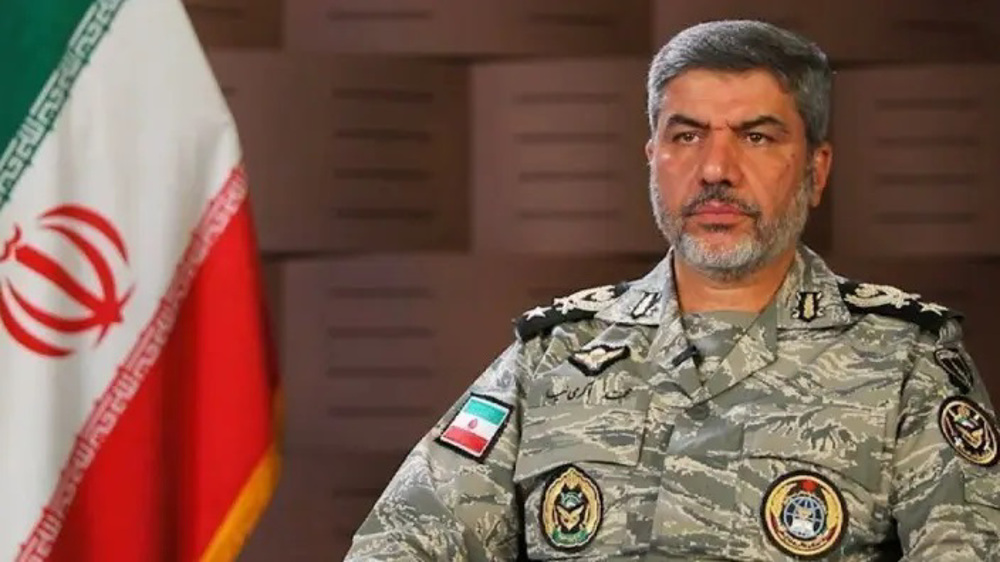
Iran’s decisive retaliatory strikes in the face of the United States’ violations have forced Washington to halt and revisit its regional strategy, Army spokesman says.
Brigadier General Mohammad Akraminia made the remarks during a televised interview on Saturday, stating that coordinated operations by the Army and the Islamic Revolution Guards Corps (IRGC), including airstrikes, missile strikes, and drone operations against US positions in Kuwait, Qatar, and Erbil, Iraq, have brought Washington’s regional strategy to a halt and forced it to alter its strategic approach.
Turning to Iran’s recent retaliatory military operations, Akraminia said the Islamic Republic launched the strikes after the United States violated its commitments under a memorandum of understanding reached last month, and attempted to establish an illegal shipping route through the Strait of Hormuz in violation of the MoU.
Over the past 15 days, he said, the operations focused on US military bases in Jordan, Kuwait, and Bahrain, describing them as among Washington’s most important military installations in the region.
According to the spokesperson, decades of US investment in regional military infrastructure, particularly after the 2003 invasion of Iraq, had made those facilities strategically significant.
However, as a result of Iran’s reprisal, many US facilities across the region have suffered damage severe enough to prevent them from carrying out their previous missions, he stated.
Akraminia cited the US Fifth Fleet in Bahrain as a case in point. “There is now virtually nothing left of this base,” he said, hailing the Iranian operations for rendering the outpost effectively unusable.
The spokesman referred to US President Donald Trump’s acknowledgement that Washington had supplied weapons to counterrevolutionary elements based in Iraq’s Kurdistan Region, but noted that Iranian strikes has robbed those elements of their operational capability and virtually destroyed the American military infrastructure in Erbil.
The official credited the success of the drone strikes among the operations to Iran’s employing a new generation of loitering munitions, citing deployment of the country’s Arash-2 drones.
‘Retaliatory deterrence’
The Army spokesperson described Iran’s military strategy in the face of the American violations as one of “retaliatory deterrence.”
He said the Islamic Republic’s objective was to raise the cost of aggression sufficiently to deter future attacks.
In the face of the retaliation, the United States has reached a strategic impasse, lacking a coherent strategy either to continue the war or bring it to an end, Akraminia said. The official cited contradictory statements by the US president as evidence of strategic confusion.
Akraminia, meanwhile, said the United States would also bear the greatest long-term strategic costs of the cycle arising out of its violations in light of the significant economic, geopolitical, and security consequences that have resulted from the Islamic Republic’s reprisal.
Elsewhere in his remarks, the spokesperson noted how the United States and the Israeli regime also failed to achieve either their declared or broader objectives during their unprovoked aggression against the Islamic Republic that took place from February 28 to April 7.
He noted that Washington’s publicly stated goals included destroying Iran’s nuclear and missile capabilities and eliminating the regional Resistance Front, besides reminding how the US president had also demanded Iran’s “unconditional surrender” during the early stages of the aggression.
According to the official, the adversaries also pursued broader objectives, including overthrowing Iran’s Islamic establishment, partitioning the country, and advancing the so-called “Greater Israel” project that features Tel Aviv’s expansionist ambitions.
None of those objectives was, however, achieved, he stated, attributing the outcome to public support, the Islamic Republic’s sagacious leadership, and the performance of the country’s Armed Forces.
“Tonight marks the 147th consecutive night of the people’s presence and support for the Islamic establishment, and this steadfastness demonstrates that the enemy has failed to accomplish its objectives,” the spokesman said, referring to unfailing presence across the country’s streets in support of the Islamic Republic and its defensive and retaliatory operations.