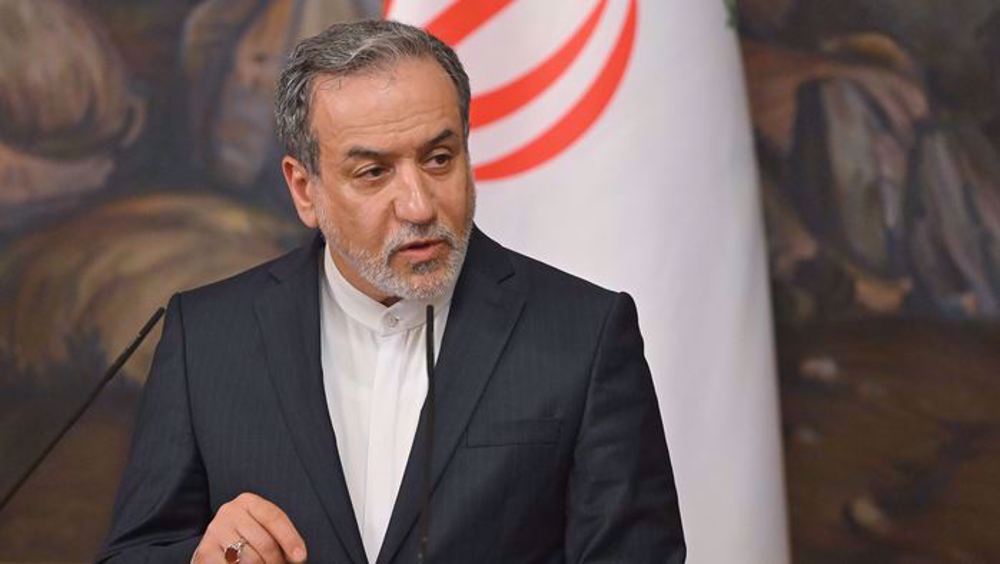
Iranian Foreign Minister Abbas Araghchi says the United States deliberately violated the Iran-US memorandum of understanding by opening an alternative shipping route in the Strait of Hormuz and steering vessels away from corridors designated by Tehran.
In an interview with the Iran daily published on Saturday, Araghchi said Article 5 of the Islamabad memorandum was quite clear and contains no ambiguity. Still, the issue went beyond a mere “misunderstanding,” he added.
“It appeared that they insisted on creating other routes alongside the one Iran had designated to ensure safe and free passage [through the Strait of Hormuz,” he said.
He added that the Americans directed ships away from the route designated by Iran as safe and encouraged them to use the alternative one.
He emphasized that Article 5 of the memorandum clearly states that Iran would make arrangements to reopen the Strait of Hormuz within one month.
According to Iran’s top diplomat, the one-month period was aimed at clearing mines and taking similar measures needed to be completed before maritime traffic could fully return to normal.
The tentative deal also stipulates that services will be provided free of charge for 60 days, after which Iran and Oman will discuss the future management of the strategic waterway and the services to be provided there, Araghchi said.
“When Article 5 says that ‘Iran will make arrangements’, it means that Iran determines the required route and mechanisms to restore traffic to pre-war levels within a month,” he added.
Therefore, the Iranian foreign minister reiterated that the opening of a “separate” route by the United States was inconsistent with the terms of the MoU.
As per Article 5 of the memorandum, any decision to add or remove shipping corridors could have been made in consultation with Iran, he noted.
He insisted that Iran’s designated route was based on security and safety considerations because mine-clearing operations needed to be carried out in the Strait of Hormuz.
“Article 5 explicitly stipulates that responsibility for demining lies with Iran,” Araghchi said, adding that there is no room for any ambiguity.
He emphasized that the use of the southern route began about 10 days after the Strait of Hormuz was reopened, which was truly a spiteful move.
Iran and the US signed the memorandum of understanding last month to end the American-Israeli aggression against the Islamic Republic, which had begun on February 28.
Under the understanding, Iran agreed to allow fee-free maritime transit through the strait for a period of 60 days.
In compliance with the MoU, the Islamic Republic devised a special maritime route for vessels to cross the chokepoint, while warning vessels against using illegal routes.
The US has, however, been trying to escort transit through the strait along an illegal passageway, prompting the Islamic Republic to shut the corridor until Washington ended its interference in regional maritime movement.
Iran harbors no hostility toward neighbors, seeks trust-building
Elsewhere in the interview, Araghchi said Iran harbors no hostility toward neighboring countries and is working to build trust across the region.
The foreign minister added that Iran is in constant contact with regional countries even as Tehran criticizes that facilities in some countries were either made available to the United States or used by Washington against Iran during the imposed war.
“There is no doubt that tensions currently exist in relations [with some regional countries] and this issue is quite natural and clear given the conflicts that have taken place,” he said.
During the US-Israeli war, he noted, Iran targeted US bases in the region and beyond and its military facilities, as “we believe this action was carried out entirely within the framework of our right to self-defense.”
However, Araghchi said, there is a common understanding across the region that Iran’s actions were not motivated by hostility toward neighboring countries but by other reasons.
He stressed the importance of entering a “period of trust-building” with neighboring countries.
“They also seek stability and economic progress, and we too seek a stable region. In fact, a collective understanding has now formed in the region that security and stability must be ensured collectively,” he said.
Security in the region cannot be achieved through dependence on foreign powers while neighboring states face instability or economic difficulties, he reiterated.
Araghchi said the “logic of a strong region” has gained renewed momentum, adding that Iran believes regional countries should be capable of resolving their own challenges without relying on foreign military forces.
“It has now become clearer to some regional countries that the presence of US bases has not brought them greater security and stability, but has in some cases become a factor against security,” the minister pointed out.