De Gaulle made one major mistake: He dismissed students as simply being afraid of examinations rather than recognising their demand for accountability
Published Date – 24 July 2026, 10:39 PM
By Pramod K Nayar
In May 1968, a young man, Cohn-Bendit, who would later become famous as Dany the Red, was arrested and the cop told him: “My little friend, you are going to pay. Too bad you didn’t die at Auschwitz with your parents because that would have spared us the trouble of what we are going to do today.”
The threat to someone whose almost entire family was wiped out by the Nazis resonated for many. Invoking draconian laws, threats of seizure of passports, and raids on houses, the state moved in on the students. The result was an epoch-defining stand-off: Paris, May 1968.
A slogan appeared on the walls of the Faculté de Médecine, Paris, in the same month: A man is not either stupid or intelligent, he is either free or not free.
Freedom Many-layered
The question of freedom was, and has been, many-layered: freedom to speak, to object, to seek accountability. It is interesting to see how little has changed from Paris 1968 when students fought pitched battles with the police, and today.
In Paris, leading up to the events of 1968, as now, it was considered traitorous and anti-national to criticise Charles de Gaulle or any of his policies. François Fontievielle-Alquier, a highly respected journalist, was arrested and tried using an 1881 law. Prosecutors cited 12 passages in his new book, Re-Learn Disrespect, that were deemed to be “attacks on the honor” of the head of state. The “offenses” could be in the form of “speeches, shouts, threats uttered in public places, writings, articles in the press.”
Academic institutions today in India practice precisely this, with gag orders on speaking, writing, posting opinions that are not wrong (or not as wrong as claiming reincarnation has a scientifically verifiable basis) but simply in disagreement with that of the ruling dispensation. This antiquated law, incidentally, had been invoked 300 times since de Gaulle became President.
De Gaulle made one major mistake. In 1968, there were 5,30,000 students in France, although three-fourths of French students failed their courses and left without degrees. As a result of this unfortunate statistic, de Gaulle dismissed the student movement, assuming that the students involved were simply afraid of facing exams, as Mark Kurlansky wrote in his The Year that Rocked the World: 1968 (2004).
Echoes of 1968
Further, the simmering discontent was dismissed by the authorities as ideological positioning when, in fact, the movement (which took the name ‘March 22 Movement’) was suspicious of political parties on the Right as well as the Left. De Gaulle had tried hard to instil the fear of the faceless Other, often declaring: ‘Stay with me or the communists will come to power’, much as leaders now invoke neighbours, the minorities and ethnic groups as threats.
The students, he discovered, had had enough of such vague ‘enemies of the state’. Then of course, de Gaulle played the key card: the mysterious foreign hand. The student protests were part of an international plot against France, there was definitely foreign financing.
The CIA and the Israelis were named, and de Gaulle said, “It is not possible that all of these movements could be unleashed at the same time… without orchestration”, thus dismissing the students as incapable of deciding for themselves what the state of the nation was and could be.
The state responded, as states are wont to do. Punitive measures, and arrests began in earnest. And it backfired. Every time students were targeted and arrested, their demands were reiterated louder, more people joined the protests. This in turn brought in more police forces, which led to even bigger protest crowds. Some protesters were injured by the police, and this unleashed the fury of the rest.
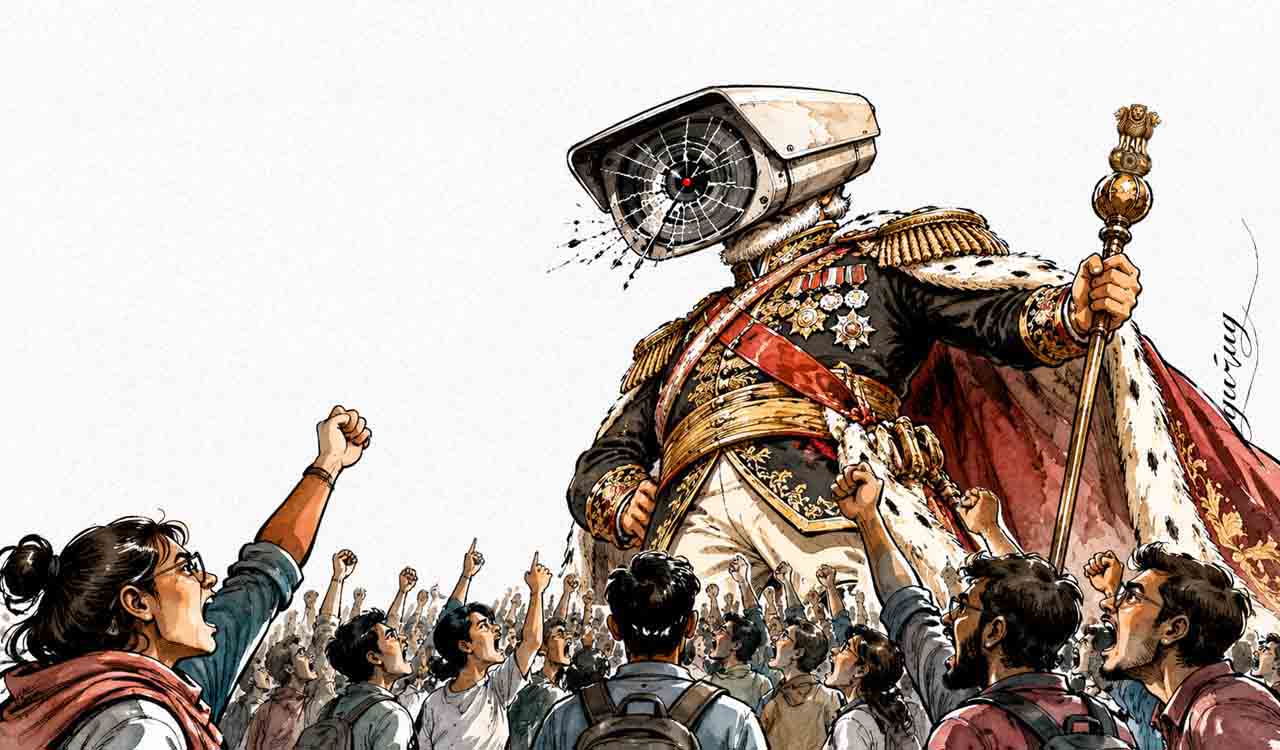
The afflicted and the affected, the ignored and the deceived decided to surveil those in power in Paris, May 1968, and it was a rare occasion when, as Nobel laureate Seamus Heaney put it, hope and history rhymed
Sixty barricades had been erected around the Sorbonne. As the police waded into the students, the general civilian public, not always known for speaking up, lost its cool. They hurried to the ‘front’, with food, blankets, and supplies for the protesters.
And, unsurprisingly, de Gaulle, unfazed by the mounting crisis, left on a tour of Romania, incensing the students further, because he refused to talk to them. The Prime Minister, Georges Pompidou, stated to Paris Match: ‘The General is only concerned about history, and no jury can dictate the judgment of history’. These were to be prophetic words.
The Paris student protests movement was driven, commentators note, by the frustration against capitalism and authoritarianism. This movement also, incidentally, ran parallel to the movement by the working classes for better wages and working conditions. Commentators see the movements as resulting in greater investment in education, wage protection and social protections.
Democracy and Surveillance
The demand for accountability from de Gaulle’s government in 1968 has remained a cornerstone of politics in any democracy. Evidence and visual records (in some cases) of clear corruption, crony capitalism, lack of due process and, as a final insult to the voting public, the excessive use of force by security personnel fixes the responsibility for such behaviour and the resultant loss of trust in the governing bodies and the systems of governance.
We see law enforcement authorities recording protesters, their documents and histories are being mapped as we speak. But the reverse surveillance, as de Gaulle discovered, is never considered.
Trust emerges when we assume that like us, everybody else will respond to the obvious monitoring with a degree of accountability. The crucial democratic challenge, writes the sociologist Andrea Brighenti in a key essay, ‘Democracy and Surveillance’ (2010), is to ‘achieve a deployment of power that is ideally without secrets … the device of public representation is necessarily public’.
What Paris in May 1968 established was a simple fact: the surveillance mechanisms are not the CCTVs of the state alone. Participatory surveillance is the organisation of the public into surveilling itself and its borders to ensure the smooth, legitimate functioning of the state, the safety of the public itself, and to guard against the erosion of freedoms and rights of that public. Accountability of the state in achieving all of these is at stake when the public decides to surveil itself and its structures.
The afflicted and the affected, the ignored and the deceived decided to surveil those in power in Paris 1968, and it was a rare occasion when, as the Nobel laureate Seamus Heaney put it, hope and history rhymed.
(The author is Senior Professor of English and UNESCO Chair in Vulnerability Studies at the University of Hyderabad. He is also a Fellow of the Royal Historical Society and The English Association, UK)