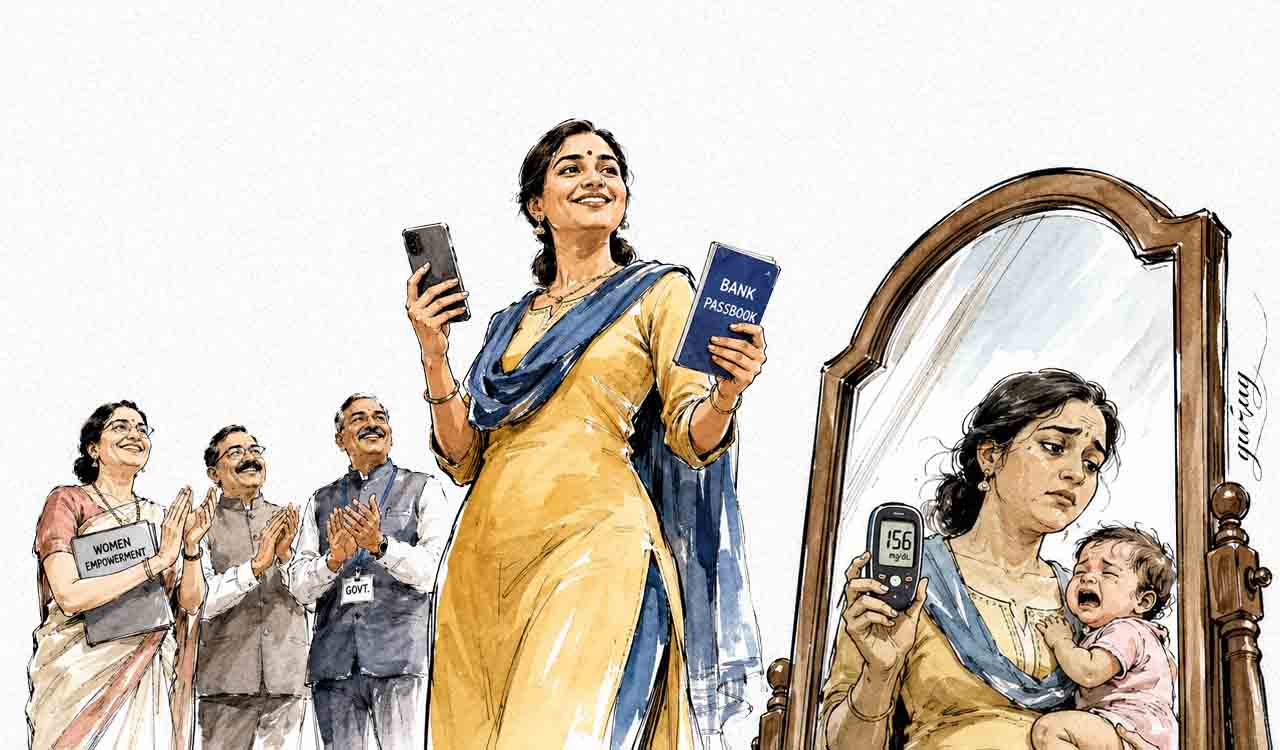
While NFHS-6 celebrates improvements in women’s empowerment, it also reveals rising obesity, high blood sugar levels, and declining exclusive breastfeeding
Published Date – 22 July 2026, 11:04 PM
By Sompalli Pranav Surya, Jayavarma Addepalli, Twisha Mehta
India’s largest health survey shows growing internet use among women, rising bank account ownership, and greater involvement in family decision-making. At the same time, it indicates a significant increase in obesity, blood sugar levels, and a decrease in exclusive breastfeeding.
While the first set of findings was presented at a press conference, the latter was confined to just one paragraph. Such an approach is unacceptable for a health policy agenda that focuses on women’s welfare.
Two Stories, One Survey
With the release of the NFHS-6 fact sheets by the Ministry of Health and Family Welfare in 2023–24, the official discourse focused on achievements. Internet use among women reached 64.3 per cent, nearly double the NFHS-5 figure. Bank account ownership and participation in household decision-making climbed to 89 per cent while child marriage fell from 23.3 to 16.7 per cent. These are real gains, and they deserve credit.
The same survey shows that 30.7 per cent of women aged 15-49 are overweight or obese, up from 24 per cent, an increase of 6.7 percentage points in four years. High blood sugar rose from 13.5 per cent to 17.8 per cent. Exclusive breastfeeding for infants under six months fell from 63.7 per cent to 55.8 per cent nationally. It was just 34.6 per cent in Uttar Pradesh.
Anaemia, which affected 57 per cent of women in NFHS-5 (2019–21) despite the launch of the Anaemia Mukt Bharat programme in 2018, has been omitted entirely. Yet these findings do not describe a different population from the women celebrated as empowered in the headlines. They describe the same women, living in the same households, during the same period.
Nutrition Transition
The rise in overweight and obesity reflects what public health literature describes as calorie-dense diets. This transition is most advanced in India’s most developed States. Kerala records 46.7 per cent of women overweight or obese, Andhra Pradesh 47.9 per cent, Tamil Nadu 44.2 per cent. These are the same States that lead India in literacy, institutional delivery, and financial inclusion. Their growing burden of non-communicable diseases (NCDs) is no coincidence. Rather, it is an outcome of the development process itself — a trade-off that public policy has failed to recognise or address.
Moreover, the current challenge reflects a double burden because 19.7% of Indian women are still underweight, whereas 32% are already overweight or obese. The fact that POSHAN Abhiyaan and the Integrated Child Development Services (IDCS) programmes are directed towards reducing undernutrition among children and mothers does not alter this reality, as no programme exists to monitor the metabolic health of women aged 20-40 years.
Anaemia Blind Spot
The failure to measure anaemia becomes the most important methodological choice in NFHS-6. Officially, the decision reflects concerns about the reliability of haemoglobin estimates derived from finger-prick (capillary) blood samples. Instead, the Indian Council of Medical Research’s Diet and Biomarker Survey in India (DABS-I) has been designated to generate national anaemia estimates using venous blood samples. This has resulted in the omission of the indicator affecting the largest proportion of Indian women, despite the lack of clear evidence that the flagship nutrition programme has reduced anaemia.
The policy that emphasises women’s empowerment through a press release while mentioning the metabolic story in only one sentence is not merely ignoring the other story; it is making a deliberate policy choice
Anaemia impacts cognitive functioning and productivity, hinders maternal health, and increases mortality risks. Without tracking this condition, the government is implementing a women’s health programme without the base for its key indicator. The findings of DABS-I need to be made public, standardised according to NFHS-6 stratifications, and incorporated into State-level programmes immediately.
Breastfeeding’s Collapse
Exclusive breastfeeding is among the best-established interventions in early child development and promotes maternal health. Its drop, leading to 34.6 per cent in Uttar Pradesh, creates a two-generation problem buried behind one statistic. The drivers of this problem are well-known: the Maternity Benefit Act of 2017 leaves out 90% of women working in the informal sector; mandates on lactation facilities remain poorly enforced despite regulation; postnatal support systems have weakened with the decline of the traditional joint family.
Meanwhile, the Pradhan Mantri Matru Vandana Yojana 2.0 (PMMVY 2.0) increased breastfeeding initiation rate from 41.8% to 50.1%, suggesting that while the system reaches women during childbirth, it loses them afterwards.
Structural weakness uncovered by NFHS-6 reveals a post-reproductive gap in India’s healthcare system. Women are closely monitored through pregnancy and the postnatal period, then largely disappear from structured health contact until the next pregnancy. The National NCD Programme offers population-level screening, but its gender-specific outreach has not kept pace with the emerging crisis.
A Coherent Response
Three policy responses follow. First, NITI Aayog’s SDG India Index should include women’s metabolic health and maternal health indicators —obesity, blood sugar levels, and exclusive breastfeeding — into its gender equity composite, signalling that metabolic health is a gender equality outcome, not just a health-sector one.
Second, the Pradhan Mantri Surakshit Matritva Abhiyan should be extended into a postpartum metabolic monitoring programme covering at least 24 months after delivery, using the existing healthcare infrastructure
Third, DABS-I anaemia data must be mapped onto NFHS-6 demographic categories and published State-wise within a year, feeding into ongoing biomarker surveillance rather than a five-year survey cycle.
Policy Asymmetry India Cannot Afford
NFHS-6 tells the story of Indian women who are more educated, more connected, and more empowered to make decisions than any previous generation. It also tells the story of women whose bodies bear the metabolic costs of a development model that hasn’t learned to protect their health alongside their rights.
These stories do not compete; rather, they are different aspects of one and the same process of change.
The policy that celebrates empowerment through a press release while mentioning the metabolic story in only one sentence is not merely ignoring the other story; it is making a deliberate policy choice.
The consequences of that deliberate choice, compounded across generations through practices such as breastfeeding, gestational diabetes, and maternal obesity, have kept pace with India’s rapid development.
(Sompalli Pranav Surya is pursuing Master’s in Public Policy, Jayavarma Addepalli is a Public Policy graduate, and Twisha Mehta is a Research Scholar at the Indian Institute of Technology Tirupati)