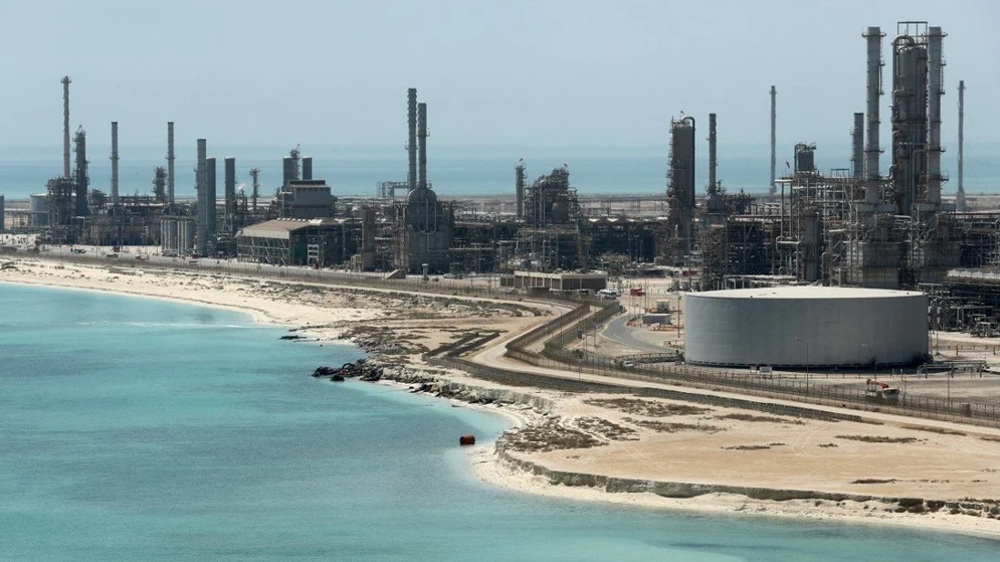
Saudi Arabia’s crude oil exports fell for a third consecutive month in May, dropping to their lowest level on record as the US war of aggression against Iran and mounting regional shipping disruptions continued to weigh on the kingdom’s oil exports.
Data released on Tuesday by the Joint Organizations Data Initiative (JODI) showed Saudi crude exports dropped to 3.434 million barrels per day (bpd) in May from 3.986 million bpd in April, the lowest monthly level since the database began in 2002.
The decline came despite a modest recovery in Saudi crude production, which rose to 6.56 million bpd in May from a record low of 6.316 million bpd in April. Domestic refinery throughput and direct crude burning also increased, limiting export volumes.
The continued decline reflected the impact of the US-Israeli aggression against Iran, which has disrupted oil shipments and trade routes across the Persian Gulf.
Meanwhile, Yemen’s Ansarullah movement announced a naval blockade on Saudi Arabia in retaliation for the blockade on Yemen and the recent attack on Sanaa International Airport.
Ansarullah media office said that the Bab al-Mandeb Strait will be closed to Saudi-linked shipping in response to the kingdom’s “unjust blockade on Yemenis for more than 10 years.”
The warning has already begun disrupting tanker movements. Shipping data showed at least two tankers carrying Saudi crude for China and India reversed course in the Red Sea on Tuesday, while another vessel scheduled to load at Yanbu also turned back before entering the waterway.
In a notice sent to shipping companies, Ansarullah said that any vessel violating the directive could be targeted “in any location.”
The resistance group governs northern Yemen and also controls the Bab el-Mandeb Strait at the southern entrance to the Red Sea. With traffic through the Strait of Hormuz now controlled by Iranian armed forces, Saudi Arabia’s Red Sea port of Yanbu has become the kingdom’s main alternative export route, handling millions of barrels of crude each day.
The warning has prompted maritime security firms and insurers to reassess the risks of operating in the region. British maritime security company Ambrey advised vessels calling at Saudi ports to reconsider transiting the Red Sea, saying such ships now face a “high risk,” while war-risk insurance premiums have also risen.
Clarksons, a global maritime services company, said that while enforcing a full naval blockade would be difficult, any escalation could see Ansarullah forces target Saudi-linked vessels transiting the Bab al-Mandeb Strait, a key shipping route used by an average of 10 crude oil tankers each day.
The shipping company said such disruptions could redirect more Yanbu crude exports towards Europe instead of Asia, while forcing other tankers to reroute via the Suez Canal and around Africa, further tightening global oil supplies and extending delivery times to Asian customers.