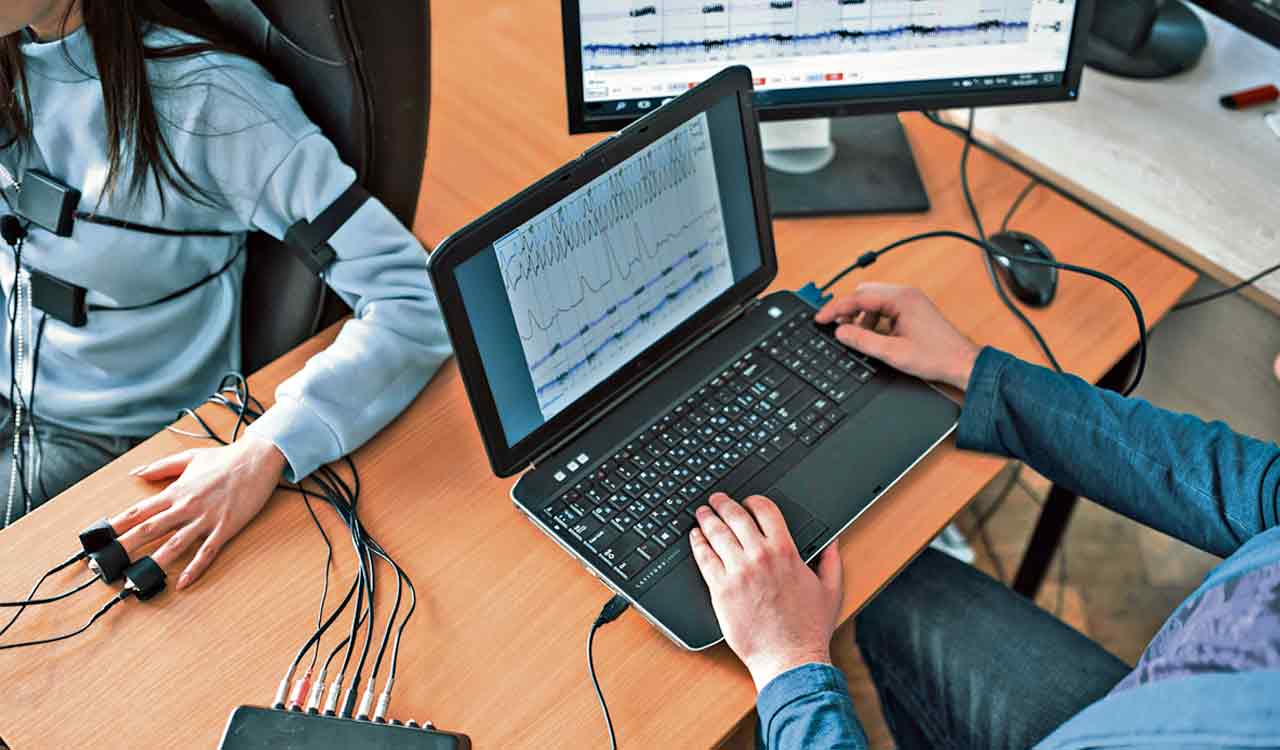
The Lohagad Fort murder investigation has revived debate over the use of polygraph tests in criminal investigations
Published Date – 20 July 2026, 12:38 AM
By Dr Kattamreddy Ananth Rupesh, Dr A Anju Gopi
Perched high above the lush Indrayani Valley, Lohagad Fort is known for its breathtaking views, mist-covered hills, and dramatic green landscapes. The historic hill fort is a well-known weekend trekking destination in the Mumbai-Pune corridor. The fort’s beauty was overshadowed by an alleged murder that took place there. On June 18, a 26-year-old man fell to his death from Lohagad Fort while visiting the site with his fiancée. Initially believed to be an accident, the case later turned into a murder investigation, with police arresting the woman and her friend for allegedly pushing him to his death.
The investigation has relied on CCTV footage, digital forensics, crime-scene reconstruction, witness examination and physical evidence to determine whether the death was accidental or homicidal. With no eyewitnesses or direct proof, police are now seeking the help of AI-assisted forensic gait analysis and a polygraph test to examine conflicting accounts, assess alleged premeditation and identify concealed information.
Although polygraph results can only be used as an investigative aid and are not admissible as conclusive evidence in court, they can help guide further forensic and digital evidence collection. Polygraph tests have been used in several high-profile Indian investigations, including the RG Kar Medical College rape case, the Hathras case, and the Aarushi Talwar–Hemraj deaths. In the Sheena Bora murder case, Indrani Mukerjea offered to undergo a polygraph test, but the CBI declined, stating that it already had sufficient evidence.
Polygraph Test
A polygraph test, commonly called a lie-detector test or a test to detect deception, is a forensic investigative technique used to record a person’s physiological responses while they answer a series of questions.
The origins of polygraph testing can be traced back to the 19th century, when Italian criminologist Cesare Lombroso used a hydrosphygmograph to record changes in the blood pressure of criminal suspects during questioning. The modern polygraph emerged in 1921, when American police officer and physiologist John Augustus Larson developed a device capable of simultaneously recording multiple physiological responses.
While lie detector tests may help investigators develop leads, scientific limitations and legal safeguards mean they cannot conclusively establish guilt or innocence in court
During a polygraph examination, instruments such as cardio cuffs and sensitive electrodes are attached to the subject to measure physiological indicators, including blood pressure, pulse, respiration, blood flow, and sweat gland activity.
The examination begins by establishing a baseline through simple factual questions, after which the recorded responses are compared with those elicited by relevant questions. Significant physiological deviations may indicate stress or possible deception, although they do not conclusively establish that the person is lying.
A polygraph examination is generally conducted in three stages: the pre-test interview, the testing stage, and the post-test interview. During the pre-test interview, the examiner explains the procedure, obtains the subject’s informed consent, discusses the case, and reviews the questions to be asked. In the testing stage, relevant questions are asked alongside neutral or control questions, and the responses may be recorded over multiple rounds for comparison.
In the post-test stage, the examiner analyses the recorded physiological responses to determine whether the subject exhibited stronger and more consistent reactions to relevant questions than to control questions. A consistent pattern of heightened responses to relevant questions may be interpreted as indicating deception, whereas stronger responses to control questions or the absence of any discernible pattern may be classified as no deception indicated or inconclusive.
Limits of Lie Detection
Experts caution that polygraph examinations are not infallible and remain susceptible to manipulation. Under the prevailing legal framework, such examinations may be administered only with the informed, free, and voluntary consent of the individual concerned, and must not be conducted under coercion, duress, or on the basis of any inducement, threat, or promise of release.
Nonetheless, a polygraph does not directly detect lies; its conclusions are based on the interpretation of patterns of physiological arousal. A person may use several countermeasures such as controlled breathing, muscle tensing or mental calculations to create artificial stress during comparison questions.
The reliability of a polygraph examination may be influenced by several factors. Physiological responses may be affected by the use of certain medications, underlying medical conditions, the influence of drugs, or psychological stress, thereby compromising the accuracy of the results.
Additionally, individuals trained in deception or countermeasure techniques may be able to regulate or manipulate their physiological responses, potentially resulting in false negatives or otherwise misleading outcomes. The accuracy of the examination also depends on the competence of the examiner, the testing methodology employed, the subject’s physical and mental condition, and the timing of the examination, particularly where it is conducted after prolonged detention or incarceration.
These limitations have contributed to continuing scepticism regarding the reliability and evidentiary value of polygraph testing in both scientific and legal circles, and its overall accuracy remains the subject of ongoing debate and research.
The Legal Stand
In Selvi & Ors v State of Karnataka (2010), the Supreme Court held that polygraph and other lie-detection tests cannot be administered without the individual’s free and voluntary consent, as compulsory administration violates the constitutional protection against self-incrimination under Article 20(3) and the right to a fair trial.
The court also endorsed the National Human Rights Commission guidelines, which require that the individual be informed of the physical, emotional and legal implications of the test, have access to legal counsel, record consent before a Judicial Magistrate, and undergo the examination through an independent agency with proper documentation.
Any statements made during the examination are treated only as statements made to the police and not as confessions. The court further clarified that an individual’s consent to or refusal to undergo a polygraph test cannot be construed as evidence of either guilt or innocence.
The safeguards governing a polygraph examination should ideally extend beyond voluntary consent and legal representation to include a prior medical evaluation. Although no published scientific guidelines in India currently prescribe a standard medical assessment protocol for polygraph examinations, it is desirable that, before the test, a qualified medical practitioner assess whether the individual is physically fit and of sound mental capacity (compos mentis), and identify any medical condition, medication, or other factor that may influence physiological responses.
The medical practitioner’s role should be confined to certifying the individual’s fitness for the procedure and ensuring medical safety, while the assessment of deception should remain the responsibility of the trained polygraph examiner. Such safeguards would enhance the reliability of the examination and better protect the rights and well-being of the individual undergoing the test.
The proposed polygraph examinations in the Lohagad Fort murder case have once again brought the controversial science of lie detection into public focus. While the technique may assist investigators by narrowing leads and resolving inconsistencies, it cannot establish guilt or innocence.
The central scientific criticism remains that no physiological response is unique to deception; fear, anxiety, embarrassment or emotional stress may produce reactions indistinguishable from those associated with lying. A polygraph records the body’s physiological responses—not the truth itself.
(The authors are faculty members, Department of Forensic Medicine, Siddhartha Medical College, Vijayawada)