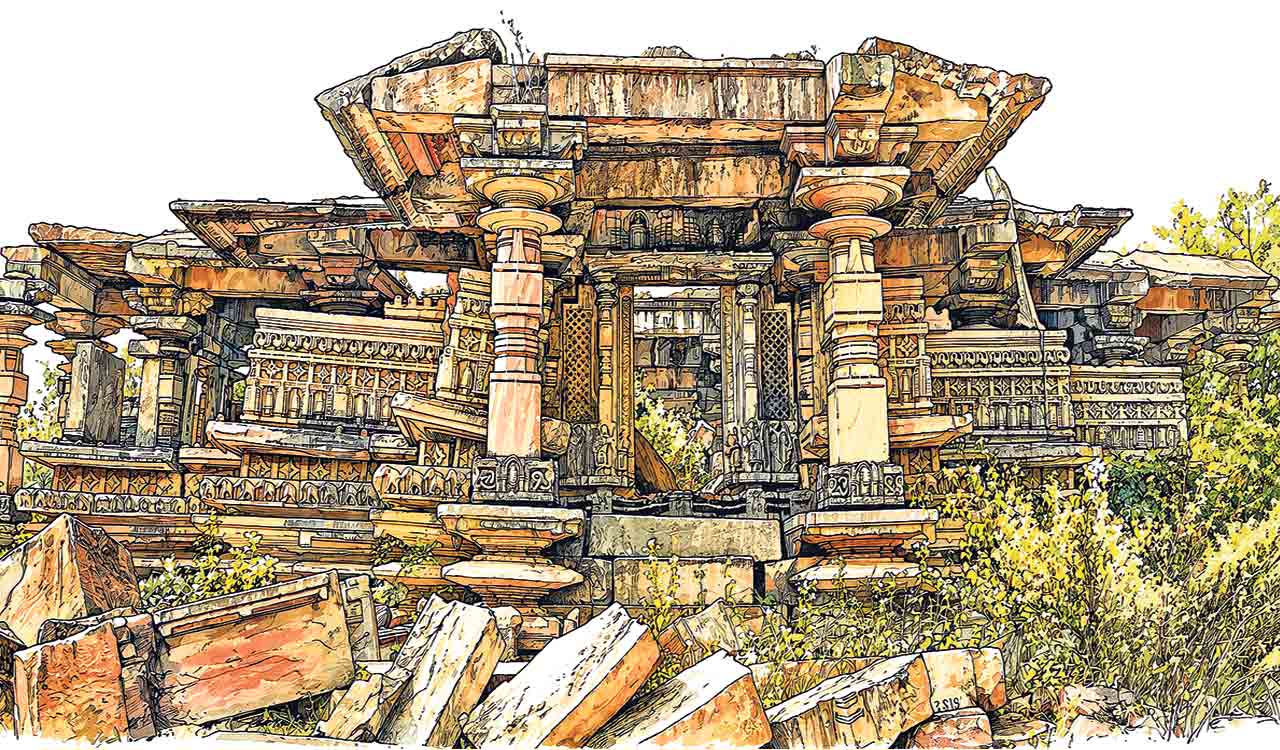
Just a few kilometres from Ramappa, Ganapuram Kota Gullu, one of Telangana’s least-known archaeological treasures, preserves Kakatiya grandeur and the fading echoes of a worldview that embraced both the sacred and the sensual
Published Date – 19 July 2026, 12:27 AM
By Amar Veluri
On a dewy winter morning, after nearly 25 years, I found myself once again walking toward the Ramappa Temple. Much had changed since my last visit. I remembered a couple of monuments rising from an untamed landscape: light vegetation, a few toddy and banyan trees, cows and goats wandering freely through the premises, and farmers spreading their harvest across the temple grounds for drying and aeration.
It looks very different now. Since its designation as a UNESCO World Heritage Site, Ramappa has drawn national attention, government funding, and the stewardship of the Archaeological Survey Department. Improved facilities, paved access roads, curated pathways, and visitor infrastructure have transformed it into a well-organised tourist destination. The temple still stands magnificent!
As we began our drive back home, my driver mentioned that I shouldn’t miss the Ganapuram Kota Gullu, a quiet, lesser-known, slightly secluded cluster of temple ruins. I echoed his enthusiasm, and we drove about 11 kilometres northwest to reach Ganapuram village. From there, we turned onto an unpaved road, which eventually branched into another dirt track leading us to what looked like the remains of an ancient temple complex.
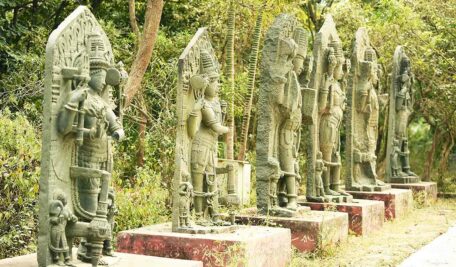
On the right stood a small building with a row of stone statues arranged in front of it, resembling a modest museum. The driver explained that these sculptures had been excavated from the area around the temple, and that local caretakers had once hidden them during the Muslim invasions that followed the fall of the Kakatiya dynasty, hoping to protect them from destruction. Some of the statues had only partially carved eyes, their pupils never opened to the world, a sign that they had never been consecrated or formally unveiled for worship.
Ganapati Deva’s Legacy
The Ganapuram Kota Gullu temple complex was built by Kakatiya King Ganapati Deva in the late 12th and early 13th centuries CE. During his reign, the complex emerged as an important religious and cultural centre. Inscriptions dated 1234–35 CE record that Ganapathi Reddy, a local patron serving under the Kakatiya administration, installed the Shiva deity and donated land for the temple’s maintenance. Together, these details suggest that the cluster of shrines functioned as a ritual and cultural hub for the people of Ganapuram.
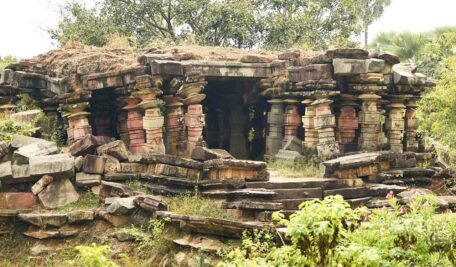
The campus comprises 22 to 24 temples, all enclosed within a double-walled stone fortification, and hence the name Kota Gullu (fortress of temples). At the centre stands the main shrine, Ganapeshwaralayam, dedicated to Lord Shiva. Built on an elevated platform, it follows the classic Kakatiya plan: a garbhagriha (sanctum), a mukhamandapa (front hall), and exquisitely sculpted exterior walls alive with madanikas (celestial dancers), elephants, and mythical beasts carved in red and black sandstone.
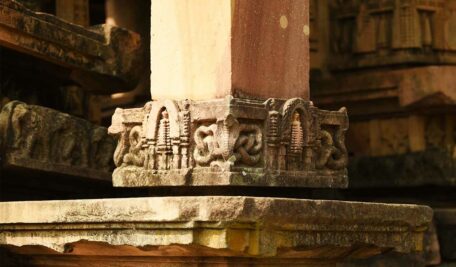
To the south of the main shrine stands the 60-pillared natyamandapa, a dance pavilion whose maze of pillars once echoed with ritual dance and music. To the north lies a smaller but strangely compelling shrine. Its platform is decorated with elephants, lotuses, and swans, but the bases of its pillars are adorned with carvings of coiled cobras, giving the impression that something precious was once safeguarded here, protected by symbolic serpents and perhaps sealed through sacred chants.
One of the walls of this northern shrine features a band of swans carved in the opposite direction from the other swans and elephants encircling the structure. My research did not uncover any explicit scholarly explanation for such directional inconsistencies in Kakatiya-style carvings. However, drawing from broader iconographic traditions, swans (hamsas) are often associated with purity and spiritual refinement, while elephants (gajas) symbolise stability and worldly strength.
If these symbolic associations are extended to the carvings, the elephants’ consistent direction may represent continuity and structural steadiness, whereas the reversed swans could suggest a pause, reset, or turning point in the spiritual journey. In this context, this wall might mark the point where the pradakshina (a ritualistic, directionally prescribed path around the temple) symbolically begins or ends.
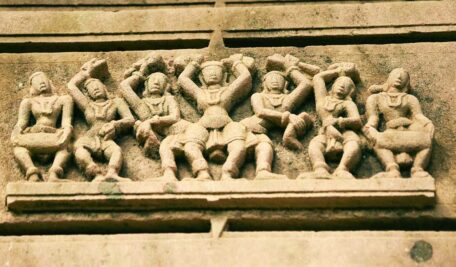
Encircling these three core shrines are clusters of smaller temples, each dedicated to a different deity, forming a sacred constellation around the heart of the complex. There are a few sculptures of three dancers with only four legs carved on the main temple, a distinctive motif that I had earlier noticed at Fort Warangal, an apparent signature element of the Kakatiya period.
In the afternoon sun, as light glistens on the red and black sandstone carvings and weathered temple ruins, an uncanny stillness settles over the place. The silence of the surrounding wilderness is broken only by the occasional chirping of birds or the low mooing of grazing cattle. An eerie feeling emerges from this silence, not one of fear, but of the lingering presence of a once-thriving civilisation in the form of stillness.
At the north-east corner of the campus stands a centuries-old banyan tree. Over the decades, its long, muscular roots and vines have embraced fallen pillars and scattered stone carvings, slowly drawing them into its shadows, as if nature itself has taken responsibility for safeguarding what remains of a once-thriving temple community. A few hundred metres away lies the Ganapuram lake, a vast reservoir whose waters continue to nourish the ecosystem surrounding the temples.
A few hundred metres away lies the Ganapuram lake, a vast reservoir whose waters continue to nourish the ecosystem surrounding the temples.
Religious Conditioning
As I was leaving the temple premises, a loud voice cut through the silence. A small crowd gathered around a man shouting angrily at a young couple. One of the onlookers explained that the couple had been found engaging in an intimate act inside one of the abandoned shrines.
The angry man threatened to report them to the police. The young woman stood trembling, tears streaming down her face, while the young man tried to reason with the accuser. But the man only grew more agitated, berating them for their “shameful behaviour.”
I felt sorry for the young couple, although I was also disappointed by their choice of place. I have always regarded temples as spaces of purity and divinity, and part of me reacted instinctively to the idea of intimacy within a sacred place. But the anthropologist in me kept challenging that reaction, urging me to think beyond emotion and religious conditioning.
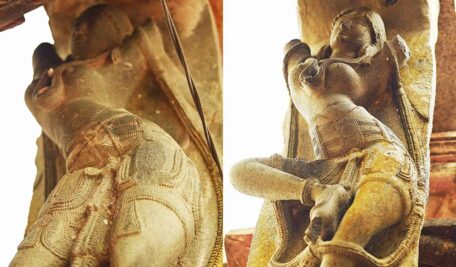
It was a sunny yet slightly chilly afternoon, the breeze moving gently across the carved figures on the temple walls. The sculptures of dancers, frozen in sensual poses, seemed to watch you at every step as you passed through the shrine. The two madanikas, with their teasing smiles and graceful stances, carried an elegance so striking that even Manmadha (the god of love in Hindu mythology) himself might pause for a second glance. The entire constellation of shrines lay in a deep, almost meditative silence, with no one else in sight. In such a vast and deserted landscape, a young couple, perhaps simply two people in love, walking hand in hand through the ruins, could have been swept away by a moment of intimacy.
Did they truly deserve public shaming? Could they not have been spoken to gently, reminded of the sanctity of the place, and asked to leave without humiliation?
On the way back home, I stopped by Navachethana Book House in Hanamkonda. As I browsed through the shelves, I suddenly froze. I couldn’t believe what I was seeing. A book titled Gudilo Sex (Sex in a Temple) caught my attention. Its cover featured one of the famous erotic sculptures of Khajuraho. It was written by Arudra, the renowned Telugu lyricist, essayist and poet. How could this be?
Earlier in the day, I had witnessed the confrontation involving the young couple at the Ganapuram temples, and now this book appeared before me. Was it a coincidence, or was the universe nudging me to think more deeply about the issue?
Knowing Arudra’s style of using provocative titles to compel readers, I suspected it was not a work of erotica but rather an exploration of deeper cultural questions. I quickly picked up the book, slipped it between a couple of others, and walked to the checkout counter. The next morning, with events at Ganapuram still fresh in my mind, I began reading the book. As I had expected, Arudra approached the subject from a cultural and anthropological lens.
Arudra’s Book
Arudra reminds us that the civilisation which built these temples had a very different relationship with the body. He writes that in ancient agrarian societies, long before temple culture crystallised (pre-Aryan period), fertility rites were performed openly under the sky as part of the agricultural cycle. These rituals were not considered shameful; rather, they symbolised the cosmic union of seed and soil, rain and earth.
As ritual culture evolved, these ceremonies moved into sacrificial halls, regarded as auspicious spaces for invoking fertility and prosperity. Later, temples emerged as the new ritual centres, and these practices found their way into the sanctums of shrines, where the landlord’s wife and the chief priest enacted symbolic fertility rituals. Over generations, the devadāsis inherited these roles, transforming them into dance, music, and ceremonial performance.
As society grew more conservative, such rituals became unacceptable, and their memory was carved into stone, on the outer walls of temples. This is why the erotic sculptures, from Khajuraho to Konark to Ramappa to the Kota Gullu, exist at all. They are not decorations; rather, they are fossils of forgotten rituals, the last surviving traces of a worldview that saw no contradiction between the sacred and the sensual.
Arudra points out that both the Chandogya Upanishad and Brihadaranyaka Upanishad describe the union as a yajña (sacrifice), a cosmic act, and a ritual of creation. He also draws parallels with other ancient cultures. He notes that in Cyprus, rituals of intimacy were once offered to the goddess Aphrodite as acts of devotion. In Babylon, every woman, regardless of wealth or status, was expected at least once in her life to participate in a sacred union in the temple of Mylitta, as a gesture of fertility and cosmic alignment.
These examples are not endorsements. They are anthropological mirrors, reminders that ancient civilisations across the world understood sexuality as a ritual of creation, not a moral failing.
Final Reflections
One question continued to intrigue me: why was it necessary to build such an elaborate constellation of shrines when the majestic Ramappa Temple stands just 11 km away? As I researched more, I came to the conclusion that both served different purposes.
Ramappa was erected as a testament to the brilliance of Kakatiya architecture, a deliberate expression of their artistic ambition and engineering prowess. It was directly supervised by the powerful general Recherla Rudra and designed by the master sculptor Ramappa.
Ganapuram Kota Gullu, by contrast, stands as a crown jewel of the Kakatiyas’ emphasis on community, culture, and religion. These shrines form a constellation of sacred spaces, each serving a specific ritual purpose while bringing together diverse communities to celebrate a shared identity and belonging.
The temple complex functioned as the centrepiece of a broader network that integrated tribal, agrarian, and local communities into the Kakatiya state. Its location was chosen strategically, and its establishment required a significant land donation from the local patron Ganapathi Reddy, who also oversaw the consecration of the temple’s principal deity, Lord Shiva.
Returning to the incident involving the young lovers, it is not the purpose of this essay to judge who was right or wrong. The events that unfolded (the encounter itself, the angry man’s reaction, and my unexpected discovery of Arudra’s book) prompted me to trace the historical and cultural threads surrounding the episode. My intention has simply been to summarise the research and allow readers to draw their conclusions.
It would be inaccurate to suggest that the couple at Ganapuram was consciously reenacting an ancient ritual. Yet, it is equally possible that the impulse to seek intimate moments within secluded temple spaces echoes a much older cultural memory, a faint lineage reaching back to pre Aryan fertility traditions, when the boundaries between the sacred, the sensual, and the communal were far more fluid.
By contrast, the angry man’s outrage belongs to a much later moral lineage: the conservative frameworks that developed over the last several centuries, shaped by devotional reforms, the consolidation of territorial kingdoms, and the influence of colonial rule, eventually crystallising into modern norms. His reaction emerged from a worldview that remembers only the chapters shaped by this conservative inheritance, while forgetting the deeper, more complex history in which temples were once vibrant social spaces rather than sites of moral policing.
Finally, it breaks my heart to see that a temple so vast, so deep in history, and so vibrant in architecture and purpose has failed to capture the attention of the authorities, and as a result, remains in a dire state of neglect. The shrines are in a precarious condition, at real risk of collapse, posing dangers to visitors and to the very communities who, with admirable devotion, continue to gather whatever resources they can to reinvigorate the complex and host religious events and congregations.
One hopes that UNESCO will eventually recognise the interdependent system of temples between Ramappa and Ganapuram Kota Gullu, for they are inseparable in spirit and function. Ramappa is the light, but Ganapuram Kota Gullu is the collective reservoir that fuels that light!