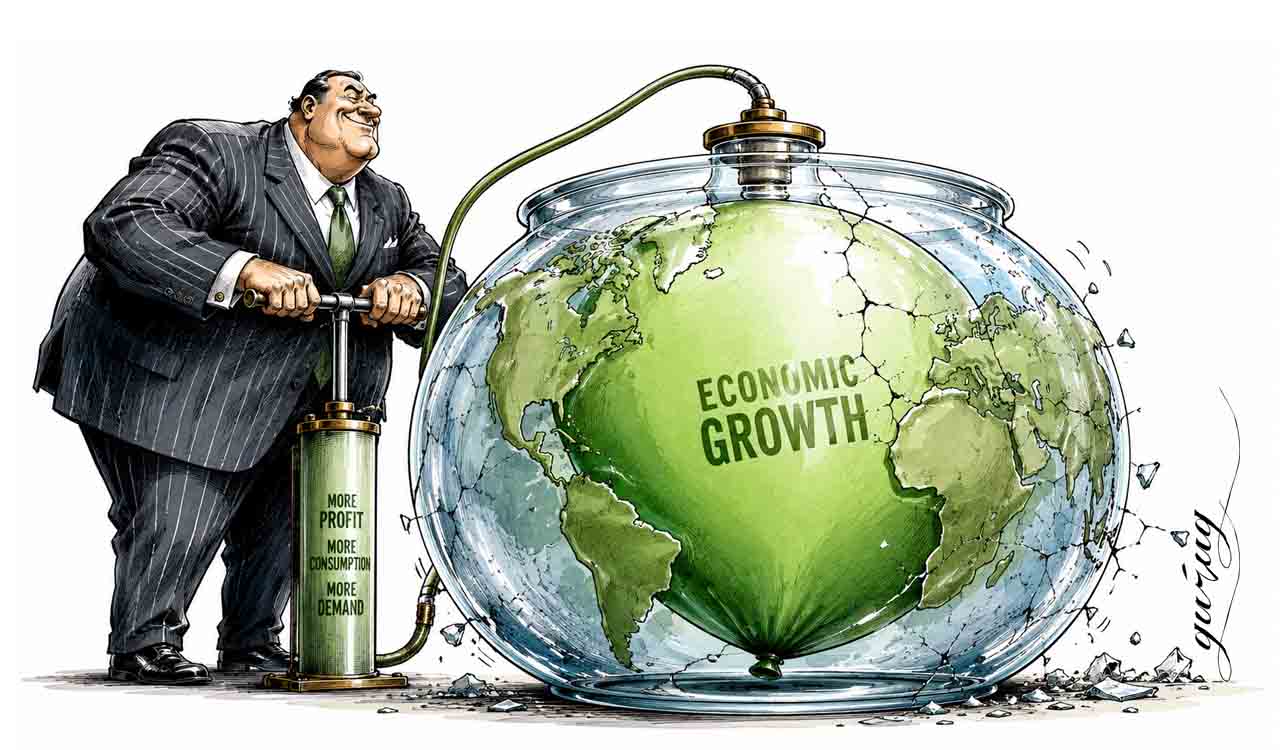
Despite record investments in green energy, emissions and resource extraction continue to rise, highlighting that the real challenge is not just decarbonisation, but rethinking development itself
Published Date – 17 July 2026, 11:55 PM
By Dr Subhashree Banerjee
Even as leaders across the global economy commit to achieving net carbon neutrality, green technology, investments in renewable energy, and climate pledges, the world today is grappling with a plethora of environmental problems that demand immediate action.
According to the United Nations Environment Programme’s Emissions Gap Report, 2025, even if all the Nationally Determined Contributions (NDCs) are fully implemented, global temperatures are projected to rise by approximately 2.3-2.5 degrees Celsius by the end of the century, far exceeding the Paris Agreement target of limiting warming to 1.5 degrees Celsius.
The findings of the State of Global Climate Report, 2025, by the World Meteorological Organisation make it even more alarming, as the last 11 years (between 2015 and 2025) have been the hottest ever recorded, with 2025 alone experiencing a temperature rise of approximately 1.43 degrees Celsius above pre-industrial levels. Atmospheric carbon dioxide has also risen to more than 50% above the pre-industrial level.
Rise in Fossil Emissions
According to the International Energy Agency, fossil fuels continue to account for approximately 80% of global energy consumption. Global fossil fuel emissions are dominated by coal (44%), oil (32%), and natural gas (22%). These are primarily the energy sources that are the foundation of the industrial development and economic growth of a country.
Furthermore, according to NASA Earthdata, the rate of sea-level rise has doubled from approximately 2.1 mm per year in 1993 to 4.5 mm per year in 2024. These alarming developments in the global climate scenario explain why climate change emerged as a central theme for this year’s World Environment Day.
What makes the situation even more paradoxical is that never before has the world invested so heavily in green technology and renewable energy, yet it remains far from achieving its climate goals. As climate-related risks continue to intensify, it is pertinent to raise questions with respect to policies and commitments on sustainability and global climate deterioration. The answer may not lie in climate action and commitments, but in questioning the assumption that economic growth can continue infinitely on a planet with finite resources and ecological limits.
Green Growth
For decades, economists and policymakers have believed in the concept of green growth and weak sustainability, arguing that market mechanisms, technological innovation, and efficiency improvements can enable economies to continue growing while reducing environmental degradation.
The answer may not lie in climate action and commitments, but in questioning the assumption that economic growth can continue indefinitely on a planet with finite resources and ecological limits
However, the approach ignores the rebound effect, wherein better technology and efficiency lead to increased production and consumption, offsetting the environmental benefits. This is evident from the Global Resources Outlook Report, 2024, which shows that the global extraction of resources has increased from 30 billion tonnes in 1970 to 106 billion tonnes in 2024. In this context, the concept of degrowth becomes significant.
Degrowth does not imply economic collapse, austerity, or a reduced standard of living. Rather, it challenges the belief that GDP growth is synonymous with well-being and progress. At the heart of degrowth lies the argument that “even if infinite growth in a finite world were possible, consumption and productivism would still be absurd”.
It advocates reducing excessive resource use and energy consumption while improving quality of life through stronger public goods and services, enhanced social welfare and protection, and a more equitable distribution of wealth and resources. It shifts the focus from increased production and consumption towards living better with lower material throughput and reduced dependence on material expansion.
India and Degrowth
Historically, India’s emissions have been relatively low compared with those of developed countries. However, climate change has already imposed high economic costs, making the country highly vulnerable to its impacts. According to the World Bank 2025, urban flooding in India causes an estimated loss of $4 billion annually and is projected to rise to $30 billion by 2070 if no remedial action is taken. Further, more than $2.4 trillion is required by 2050 to build climate-resilient buildings in urban India.
The government has introduced the Production-Linked Incentive scheme to strengthen domestic green industries, the Perform, Achieve and Trade scheme to improve industrial energy efficiency, and has expanded non-fossil fuel power capacity to 262.74 GW by November 2025, ranking India third globally in renewable energy installations.
Although such initiatives are necessary, they are not sufficient in the current scenario. The problem is that dependence on fossil fuels is increasingly being replaced by dependence on critical minerals such as lithium, cobalt, nickel and rare earth elements required for electric vehicles, while maintaining the same growth-oriented model that encourages both higher levels of production and consumption. A development strategy based on decentralised renewable energy extraction and ecological restoration rather than infrastructure expansion could improve the well-being of its citizens.
In this regard, India’s Mission LIFE (Lifestyle for Environment) is an important attempt to encourage individuals to adopt sustainable lifestyles, reduce waste, conserve resources and make environmentally conscious choices. Similarly, India’s growing emphasis on the circular economy challenges the prevailing linear model of production and consumption by promoting repair, reuse, and recycling. Further, policies such as the Forest Rights Act, 2006, and the Biological Diversity Act, 2002, recognise local communities as custodians of forests and biodiversity.
These initiatives demonstrate that India’s policy framework already has alternative growth-centric models, which address ecological sustainability, social justice and well-being. Therefore, the question is: can the world grow infinitely on a finite planet? Given the present realities, the answer is clearly no. Therefore, the question is: can the world grow infinitely on a finite planet? Given the present realities, the answer is clearly no.
The global community must prioritise human well-being without breaching the ecological limits. Countries that succeed in ensuring equity and prosperity while respecting the planet’s finite resources will be best positioned to thrive.

(The author is Assistant Professor, Department of Economics, CHRIST [Deemed to be University], Bengaluru)