
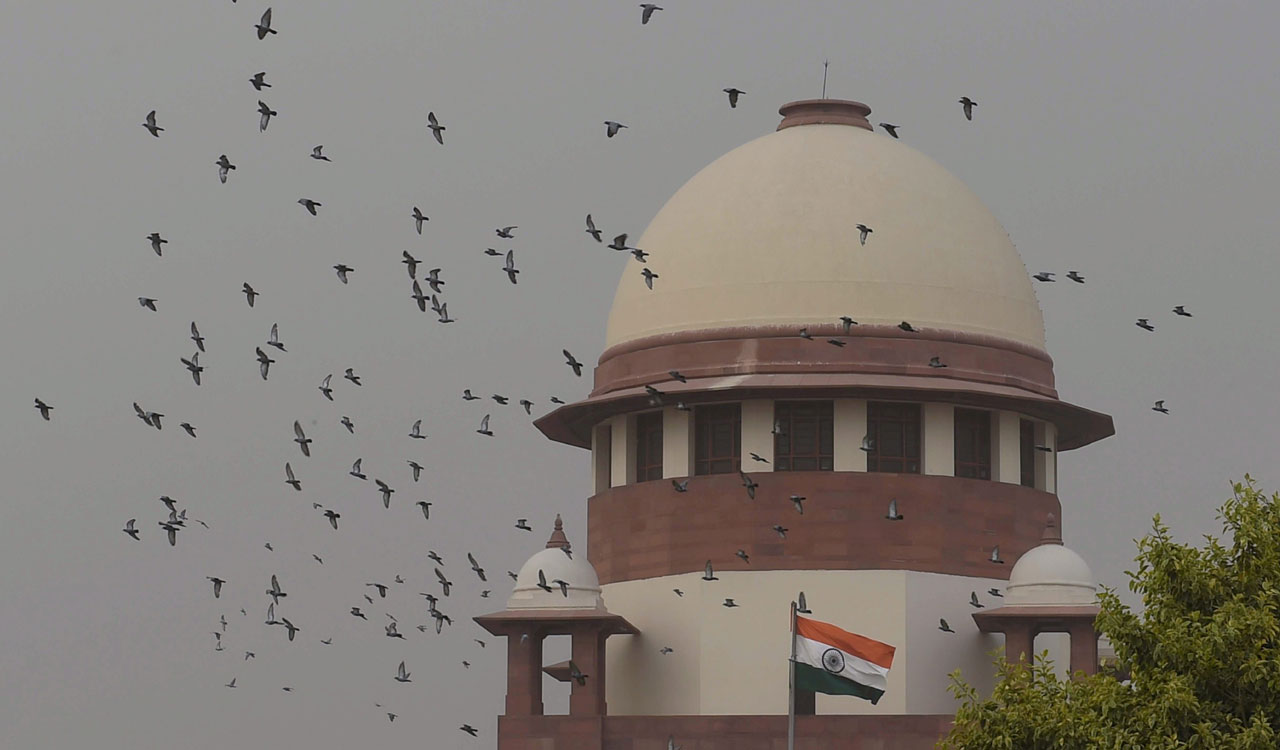
The Supreme Court ruled that the absence of a train ticket on a deceased passenger’s body cannot by itself justify denial of compensation in railway accident cases. The court awarded Rs 8 lakh to a widow and stressed a liberal interpretation of the Railways Act
Published Date – 17 July 2026, 05:59 PM
New Delhi: In a significant verdict, the Supreme Court on Friday said the mere absence of a train ticket on the body of a deceased passenger cannot be a ground to deny compensation to the victim’s family in a railway accident case.
The ruling, aimed to strengthen the rights of railway passengers and their families, set aside the concurrent orders of the Railway Claims Tribunal (RCT) and the Madhya Pradesh High Court, and awarded a compensation of Rs 8 lakh to Lata, the widow of a man who died after falling from a running train in 2015.
A bench of Justices Sanjay Karol and N Kotiswar Singh allowed the appeal of the widow, whose compensation claim was rejected by the RCT and the high court on the ground that her husband was not proved to be a bona-fide passenger because his ticket was not found after the accident.
The top court said the Railways Act is a beneficial welfare legislation and must receive a liberal and purposive interpretation. Referring to earlier verdicts, Justice Karol, who authored the judgment, said, “The beneficial legislations are to receive purposive and liberal construction in furtherance of the intentions of the legislature, as can be discerned, instead of a literal or restrictive approach being adopted. The overall idea is to make the intention so understood, functional.”
The verdict said “technical approaches and lapses in procedure should not defeat the welfare aim of the statute as it does not befit the railways, as an instrumentality of the State, to take such a restrictive, pigeonhole view”. The verdict said the proceedings under section 124A of the Railways Act are based on the principle of “no-fault liability”, intended to provide speedy compensation to victims of untoward railway incidents, without requiring any proof of negligence.
Relying on earlier decisions, the bench said, “Merely because the ticket of a train journey was not found on the person of the deceased, it will not change his status as a bona-fide passenger. It has been held that the initial burden of the claimant can be satisfied by way of an affidavit.”
It observed that the claimant’s initial burden can be discharged through a credible affidavit and surrounding circumstances, after which the burden shifts to the railways to rebut the claim.
The case arose from the death of Chandrakant Thakkar, who allegedly fell from the Ahmedabad-Howrah Mail train while travelling from Raipur to Ahmedabad in November 2015.
His travel bag, which reportedly contained the train ticket, went missing after the accident. Allowing the widow’s appeal, filed through lawyer Shweta Priyadarshini, the bench awarded the appellant a compensation of Rs 8 lakh under the Railway Accidents and Untoward Incidents (Compensation) Rules.
It directed the Centre to release the amount within four weeks, failing which it will carry interest at the rate of 8 per cent per annum from the date of filing of the claim petition.
“Well, the above is about what a passenger or his family members must show to get compensation from the railways. But what is the duty of the railways towards the customer/traveller? To put things in perspective, it must be said that what happened in this case, that a traveller on a train, for whatever reason, fell off the train and injured himself or died, is not a rare occurrence,” the court said.
The judgment also contains significant observations on railway safety and passenger welfare. Referring to recurring incidents of passengers falling from overcrowded trains, the verdict said although the Indian Railways has framed detailed operational manuals requiring ticket checks, crowd-management and passenger-safety measures, effective implementation remains a challenge.
It pointed out that overcrowding continues to be a regular occurrence and has contributed to numerous fatal accidents across the country. The court suggested that expanding railway manpower could improve passenger safety, while simultaneously creating employment opportunities for young people.
It emphasised that passengers also share responsibility for their own safety. “We may observe one more thing. It would be entirely unfair to cast sole responsibility upon the railways. The passengers themselves have an equal responsibility. Incidents, such as these, are not hidden from the general public and despite the painful ends that most of these people meet, there has not been a reform in habit and people still insist on being daredevils in catching trains and making their way from one place to another.
“True it is that most of these choices are informed by one or the other practical consideration, but the risk stares one right in the face. Sometimes then, practical considerations must give way to the preservation of life. It is unfortunate that in the economic rat race, such obvious aspects are readily kept on the backburner,” it said.
The verdict suggested that the Indian Railways reconsider the term “second-class passenger” in its manuals, stating that the expression carries an undesirable class connotation.
It recommended that the classification should relate to the coach rather than the passenger, consistent with the constitutional values of dignity and equality.
“One aspect that caught our attention while perusing the manual and other related documents was the use of the term ‘second-class passenger’. While it is ostensibly linked to the expenditure incurred by the passenger to travel, we may suggest that the class connotation be attached to the coach and not to the passenger…,” it said.