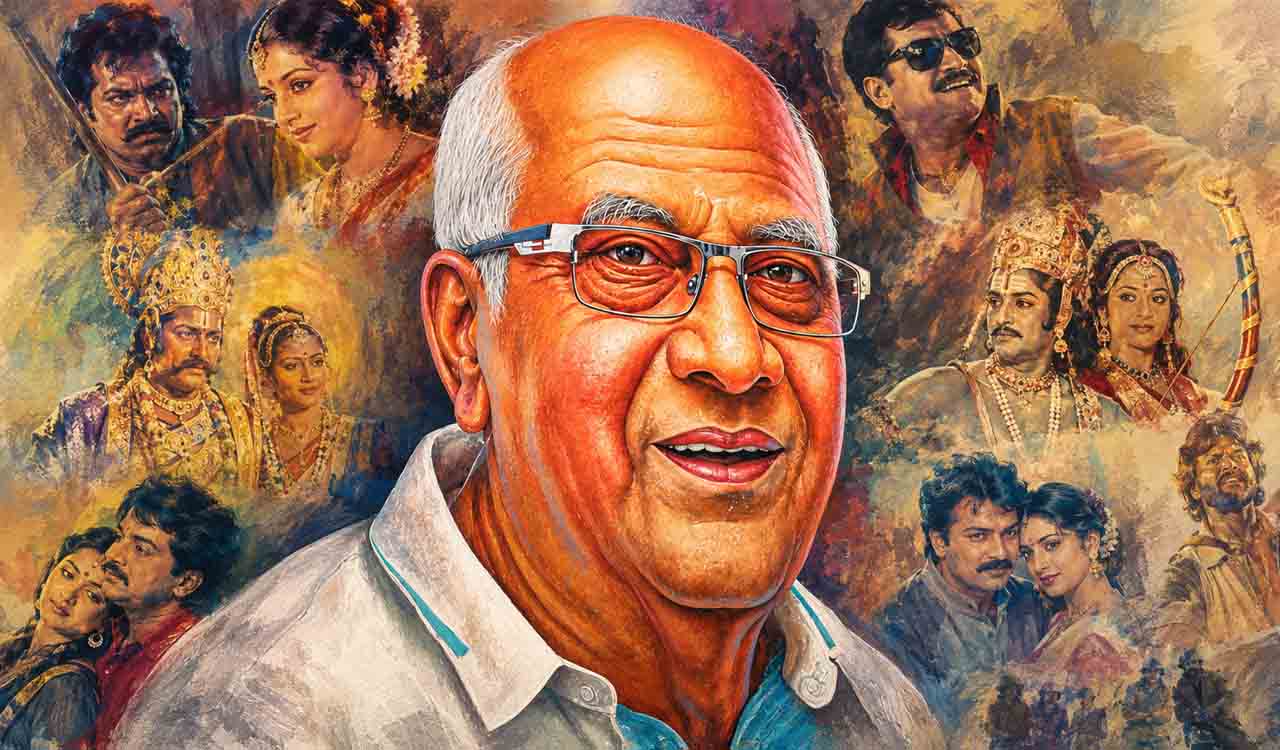
At 94, Veteran filmmaker Singeetham Srinivasa Rao continues to redefine Indian cinema through innovation and genre-defying storytelling
Published Date – 14 July 2026, 11:09 PM
By Dr Mulugu S Neelotpal
An American poet and author once famously noted: “Creativity is the language we use to communicate the urgency of our dreams for a better future”.
It aptly reflects the remarkable record-breaking feat of the 94-year-old Telugu and Indian filmmaker Singeetham Srinivasa Rao, who has just released his 61st film, Sing Geetham (a pun on his surname). The film is a one-of-a-kind musical, the first of its kind in Telugu cinema, and arguably in Indian cinema, demonstrating his unending passion and enthusiasm to realise a dream he had nurtured for more than 40 years.
The life of Singeetham, the son of a school headmaster from Gudur, Andhra Pradesh, is an inspiring journey — from a young physics graduate at Presidency College to a legendary filmmaker who consistently pushed the boundaries of storytelling with innovative ideas and scripts in every film he directed.
The cultural theory of Stuart Hall suggests that culture is not a fixed entity but a ‘fluid’ process that interacts with its geography and people and responds to changing social realities. Indian cinema, however, has traditionally focused on the commercial viability of films and the star system associated with them. As a result, innovative storytelling takes a back seat.
It is in this context that Singeetham Srinivasa Rao stands out as a rare filmmaker who successfully married art and commerce in mainstream Indian cinema.
Coming from the Telugu cinema industry, currently India’s biggest filmmaking industry, Singeetham made bold creative choices. He explored diverse genres, pioneered several, and remained contemporary by keeping pace with the evolving global cinematic landscape.
The Daring Choices
Singeetham started as an assistant to legendary Telugu filmmaker KV Reddy in 1954, and soon became his associate during the making of classics such as Mayabazaar (1957) and Jagadekaveeruni Katha (1961).
The choices Singeetham made later in his career were directly influenced by his apprenticeship under KV Reddy. His mentor effortlessly moved across genres — directing the social drama Donga Ramudu (1955), the mythological classic Mayabazar (1957), the family drama Pellinaati Pramanalu (1958), the folklore fantasy Jagadekaveeruni Katha (1961), and the mythological Sri Krishnarjuna Yuddhamu (1963), among others.
With the release of Sing Geetham, his 61st film, the veteran filmmaker further cements his legacy as one of India’s greatest cinematic visionaries after more than seven decades of pioneering filmmaking
When Singeetham made his directorial debut with Neeti Nijayiti in 1972, he chose an unconventional story about a wealthy mute man manipulated by his elder brother and a young woman who reforms and empowers him. At a time when heroes were celebrated for their lengthy dialogues and larger-than-life personas, this was an extraordinary creative decision.
His decision to place a strong woman at the centre of the narrative became a recurring feature of his work. All his movies portray independent women, whether professionals or homemakers.
Singeetham ventured into Tamil cinema with another bold choice — adapting Dikkatra Parvati, the novel by statesman and writer C Rajagopalachari. The film narrates the story of a village woman and her struggles with an alcoholic husband. It earned him his first National Film Award in 1974 for Best Tamil Feature Film and introduced him to Tamil cinema, where he later collaborated extensively with actor Kamal Haasan across several genres.
Period of Stability
Singeetham consolidated his position as a director in Telugu cinema in the late 1970s. His first collaboration was with Kamal Haasan in the dual-role comedy drama Sommokadidhi Sokokadidhi (1978), which established him as a director who could handle both mainstream and offbeat genres with equal finesse.
His most significant collaboration in Telugu cinema with one of the industry’s greatest legends, Akkineni Nageswara Rao, came in 1980 with Pilla Zamindar, based on a story written by Singeetham’s wife, Lakshmikalyani. Interestingly, when Singeetham began his apprenticeship under KV Reddy, the first film he worked on was Donga Ramudu, starring Akkineni Nageswara Rao, which continues to be studied for its screenplay at the Film and Television Institute of India (FTII), Pune.
Singeetham made two classical music-based dramas, Sangeeta Samrat and Vasantha Geetham, with Akkineni in 1984. He did not believe in casting only big stars for box-office success, nor did he ‘play to the gallery storytelling’.
The late 1980s marked the beginning of another landmark collaboration, this time in Kannada cinema with the legendary Dr Rajkumar. Jwaalamukhi in 1985, made on a modest budget, cast Rajkumar as a professor who unearths a forgery.
Singeetham’s passion for music found greater expression in his next Kannada film, Bhagyada Lakshmi Baramma (1986), which also featured Rajkumar and was a comedy for which he also composed the music. An amateur violinist himself, Singeetham inherited his love for classical music from his mother, who was a trained Carnatic violinist and singer. The film earned him his first Karnataka State Film Award for Best Screenplay.
The following year, he introduced Rajkumar’s son, Shiva Rajkumar, in his film Anand. In 1988, he introduced another of Rajkumar’s sons, Raghavendra, as the lead in Chiranjeevi Shankar. By then, Singeetham had become a celebrated filmmaker in both Telugu and Kannada cinema, while simultaneously embarking on a series of experiments with Kamal Haasan that challenged the stereotypes of ‘superhuman’ heroes.
The Kamal-Singeetham Magic
Singeetham was invited by Kamal Haasan to direct his landmark 100th film, Raja Paarvai (Amavasya Chandrudu in Telugu) in 1980. The film tells the story of a blind violinist who falls in love with a young girl. The craft, shot division, and camera work combined to make it a classic, while laying the foundation for one of Indian cinema’s most celebrated actor-director partnerships.
Mayuri, in 1985, was based on the life of classical dancer Sudha Chandran. After losing a leg in a tragic accident, Chandran rebuilt her career with the help of the Jaipur Foot, eventually emerging as an acclaimed dancer and actor. Casting the real-life protagonist in her own biographical film was a pioneering creative decision, and it won Singeetham another National Film Award.
The greatest triumph, however, was Pushpak (1988), a dialogue-free black comedy, driven entirely by visual storytelling and background music. It won praise from none other than V Shantharam. The movie tackled the issue of unemployment with comic undertones, brilliantly played by Kamal Haasan. The movie went on to win the National Film Award for Best Popular Film Providing Wholesome Entertainment.
In 1989, Singeetham took another bold step by creating the illusion of a dwarf protagonist in Apoorva Sagodharargal, years before computer-generated imagery (CGI) became commonplace. Comedy drama, Michael Madana Kama Rajan (1990), where Kamal Haasan played four roles, remains a benchmark in screenplay writing.
The Pathbreaking 90s
Singeetham gave India’s first time-travel movie, Aditya 369 (1991), which juxtaposed the contemporary world with the golden era of the Vijayanagar empire under Sri Krishnadevaraya, the emperor who loved Telugu literature and patronised art. Through a time machine, the hero travels between centuries, while the film also presents a dystopian future where food is reduced to capsules, without any vegetation—a cautionary vision that Singeetham revisited in his 2026 musical Sing Geetham.
Magalir Mattum was a take on how women face sexual harassment at workplace. He revisited the same theme through a role reversal in the Telugu film Madam (1994), in which Rajendra Prasad plays a man disguised as a woman lecturer who inspires and empowers his students.
The same year, Singeetham returned to his favourite genre of fantasy and folklore with Bhairava Dweepam, the story of a young man who fights a sorcerer to win the hand of a princess.
The Sensational 2000s
His next exploration was animation. He directed Son of Alladin (2003), marking his successful foray into animated filmmaking. He followed it with Ghatothkach (2008), an achievement completed when he was 77 years old. He experimented with an unconventional theme with Welcome Obama (2013), a movie centred on surrogacy at the age of 82.
Dark comedy, Mumbai Express (2005), with Kamal Haasan, was the first Indian movie to be censored in digital format.
In 2022, at the age of 91, Singeetham fulfilled another long-cherished dream by releasing Pratibimbalu, originally shot in 1982 with Akkineni Nageswara Rao and veteran Telugu director KS Prakash Rao.
Finally, in 2026, he realised his four-decade-long dream of making a full-fledged musical with Sing Geetham, which is the first musical in Indian cinema. Sing Geetham is also a powerful statement on environmental conservation.
By directing the film at the age of 94, Singeetham became the world’s oldest living filmmaker, surpassing Clint Eastwood, who directed his recent movie, Juror No. 2, at age 93. It is the right time for a filmmaker who has experimented with genres like no other in Indian cinema to be bestowed with the Dadasaheb Phalke Award, the country’s highest film honour, in recognition of his lifetime contribution to the film industry.
(The author is Assistant Professor, Vellore Institute of Technology [VIT], Vellore, Tamil Nadu)