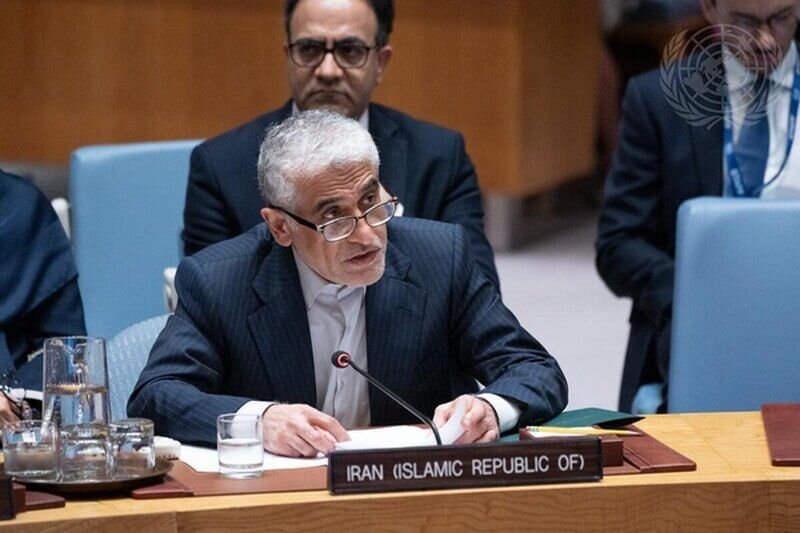
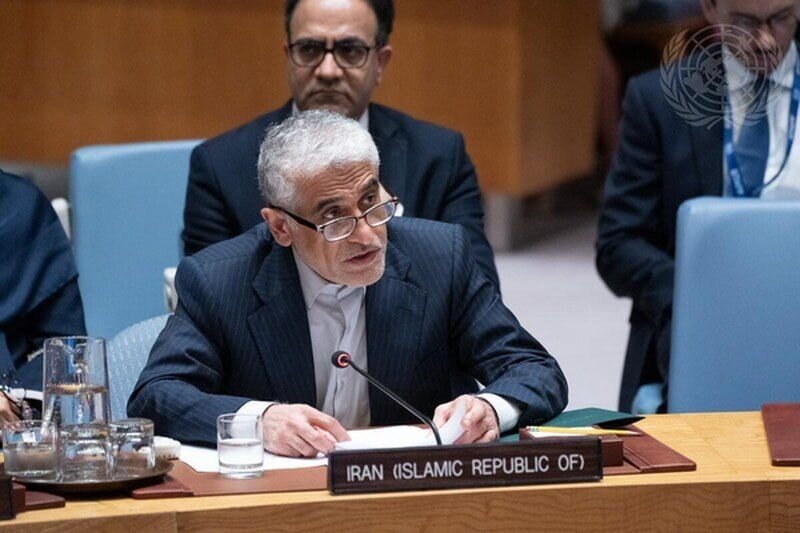
Iravani made the remarks at the UNSC meeting. The full text of the statement by Ambassador Iravani is as follows:
Ambassador’s Statement at UNSC Stakeout: Resolution 2231
Statement by
H.E. Mr. Amir Saeid Iravani
Ambassador and Permanent Representative
of the Islamic Republic of Iran to the United Nations
Before UNSC Stakeout
New York, 10 July 2026
In the Name of God, the Most Compassionate, the Most Merciful
Good afternoon, everyone. Thank you for being here. This morning, the Security Council held a meeting requested by certain members under the so-called agenda item “Non-Proliferation.” This meeting had no legal basis.
We express our appreciation to Russia and China for their principled position at today’s meeting in opposing the convening of this legally unfounded meeting and rejecting the claims made by France, the United Kingdom, and the United States regarding the continued validity and operation of Security Council Resolution 2231 (2015). We also thank Pakistan and Somalia for their voting abstention and for not supporting the convening of this meeting.
Resolution 2231 expired on 18 October 2025. From that date, it ceased to have any legal force or operative effect. All measures, mandates, reporting requirements, and mechanisms established pursuant to that resolution terminated and ceased to have legal effect
There is therefore no legal basis for the Secretary-General to submit reports, for the Secretariat to brief the Council, or for the Security Council to discuss this issue under the agenda item “Non-Proliferation.” The Secretary-General’s report and today’s briefing by Under-Secretary-General, Ms. DiCarlo, violated the Secretariat’s mandate.
Any attempt to continue the implementation of Resolution 2231, whether by claiming to rely on Note 507, established practice, or any other procedural argument, is legally invalid. It is a blatant misuse of Security Council procedures and authority.
Iran’s position on the so-called snapback mechanism has also been clear and consistent. It has been formally communicated to both the Secretary-General and the President of the Security Council and has been supported by China and Russia.
The E3, namely France, Germany, and the United Kingdom, had no legal standing to invoke the so-called snapback mechanism. They failed for years to fulfil their commitments under the JCPOA and Resolution 2231. They then supported unlawful military attacks against Iran, including attacks on Iran’s IAEA-safeguarded peaceful nuclear facilities.
A party that has materially breached its obligations cannot invoke rights arising from the same legal instrument. Accordingly, the E3 have no legal or procedural basis to assert any claim against Iran under Resolution 2231.
In September 2025, there was no consensus within the Security Council, and the Council was therefore unable to take any decision. The Council’s inability to act does not validate the E3’s claims. Under international law, an unlawful procedure cannot create legal rights or obligations.
Iran categorically rejects the politically motivated allegations made today by France, the United Kingdom, and the United States regarding its peaceful nuclear programme. Their claims are a deliberate attempt to distort Resolution 2231, misrepresent the facts, and misuse the Security Council for narrow political purposes.
The root cause of the current situation is well known. It lies in the United States’ unlawful withdrawal from the JCPOA in 2018, the continued failure of the E3 to fulfil their commitments, and the unlawful military attacks carried out by the United States and Israel against Iran, including attacks on IAEA-safeguarded nuclear facilities in June 2025 and again on 28 February 2026.
These attacks violated Article 2(4) of the UN Charter, the fundamental prohibition on the use of force, and seriously undermined the global non-proliferation regime. The President of the United States publicly acknowledged and boasted responsibility for these acts of aggression. The E3 openly supported them and therefore has no credibility when making accusations against Iran.
Iran has remained a responsible State Party to the Treaty on the Non-Proliferation of Nuclear Weapons since 1970. Iran has consistently rejected weapons of mass destruction. Its nuclear programme has never been diverted to military purposes and has remained exclusively peaceful under the most extensive IAEA verification regime. Yet, instead of condemning and holding accountable the United States and the Israeli regime for their unlawful attacks on Iran’s IAEA-safeguarded nuclear facilities, some Council members, particularly France, have sought to shift responsibility onto the victim.
I also reject the unfounded accusations made today by the representatives of France, the United Kingdom, and Bahrain on the situation in the region. Rather than condemn unlawful aggression against Iran, they chose silence. Rather than defend the UN Charter, they shifted responsibility to the victim. Their double standards have deprived them of any moral or legal authority to lecture others.
The Security Council’s failure to uphold its responsibilities has reinforced impunity and encouraged further violations of international law. The United States and the Israeli regime bear full responsibility for the consequences of these unlawful acts and must be held fully accountable. The United States has once again violated its obligations by launching and continuing large-scale military attacks against Iran’s sovereignty and territorial integrity, including attacks on installations in the southern cities of Iran and several Iranian islands in the Persian Gulf on 7 and 8 of July.
These renewed attacks constitute another flagrant violation of Article 2(4) of the Charter and a material breach of paragraph 1 of the Islamabad Memorandum of Understanding, under which the United States expressly committed to cease all military action against Iran and to refrain from the threat or use of force. The United States bears full international responsibility for all legal and political consequences arising from its unlawful actions. Under the Islamabad MoU, responsibility for maritime navigation through the Strait of Hormuz, including its reopening and all necessary demining operations, rests exclusively with Iran.
Any attempt by external actors to interfere with or establish parallel arrangements would violate the MoU, undermine its implementation, delay the restoration of normal commercial navigation, jeopardize maritime safety, and increase regional tensions.
In light of the United States’ persistent and ongoing violations of its international obligations, Iran recalls the responsibilities of the Secretary-General and the Security Council under the UN Charter to maintain international peace and security. Those responsibilities are especially important in cases of aggression, breaches of the peace, and threats to international peace and security.
They must take effective and decisive measures to stop the United States’ unlawful acts of aggression. They must prevent any further escalation. They must also ensure that the United States fully honors its obligations and is held accountable for its aggression, its serious violations of international law, and the crimes resulting from those acts.
Iran remains committed to the faithful implementation of the Memorandum of Understanding, provided that the United States fully and faithfully complies with its own obligations. However, should the United States continue to violate its obligations under the MoU, Iran will no longer be bound to fulfil its obligations under the MoU.
Thank you.
MNA