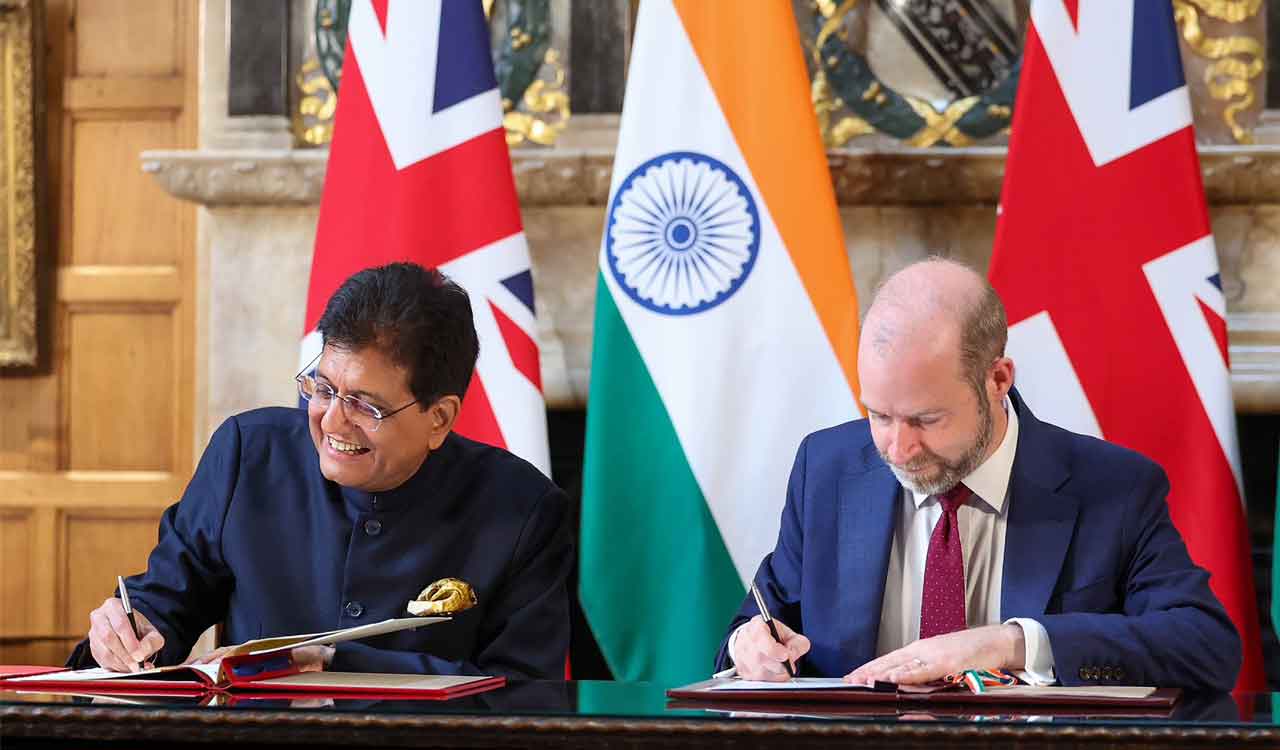
India has notified the procedure for importers to claim tariff quota benefits on UK vehicle imports under the India-UK trade agreement, effective July 15. The framework outlines eligibility, quotas and concessional customs duties for conventional and premium vehicle imports
Published Date – 10 July 2026, 10:15 AM
New Delhi: India has notified the procedure for importers to seek government approval to avail quota-based duty concessions on imports of passenger cars and goods vehicles under the free trade agreement (FTA) with the UK, which will come into force on July 15.
Under the Comprehensive Economic and Trade Agreement (CETA), India will reduce import duties on automotive imports from about 110 per cent to 10 per cent, subject to quotas on both sides.
India will allow the import of 3.78 lakh units of conventional-engine passenger cars, including those in the mass-market segment, from the UK at concessional customs duty during the first 15 years of the implementation of the trade pact between the two countries.
“Procedure for allocation of Tariff Rate Quotas (TRQ) under India-UK (CETA) is notified,” the Directorate General of Foreign Trade (DGFT) said in a public notice dated July 9.
It said that, at the time of clearance of the import consignment, the importer in India has to produce a Certificate of Origin issued by the concerned authorities in the UK.
“Only Original Equipment Manufacturers (OEMs), dealers/channel partners duly authorised by the OEMs of vehicles originating in the UK shall be eligible to apply for the TRQ,” it added.
The DGFT also said that, to be eligible, each applicant will have to submit a pre-purchase agreement issued by an OEM of the vehicles in the UK, setting out the quantity of vehicles agreed to be supplied to the applicant during the TRQ year.
“The year in respect of these imports will be the period from January 1 to December 31, that is, the calendar year in India. DGFT shall monitor the cumulative quantities for TRQ certificates issued. No TRQ certificates shall be issued once the stated TRQ quantity limit is reached,” it said.
These certificates, it said, will be valid for a maximum period of 12 months or till the end of the calendar year, whichever is earlier.
“Importers under the TRQ shall endeavour to pass on the benefit of the concessional customs duty available under the TRQ to the final buyer or consumer,” it added.
For imports from the UK to India, the quota for conventional-engine passenger cars will peak at 37,000 units in the fifth year across specified categories of vehicles, with customs duty reduced to the final rate of 10 per cent. The duties will not be reduced further.
In the first year, the quota for passenger cars with an engine capacity of more than 3,000 cc (petrol) and more than 2,500 cc (diesel) is 10,000 units, with customs duty reduced to 30 per cent from 110 per cent.
For cars with an engine capacity of 1,500 cc to 3,000 cc (petrol) and up to 2,500 cc (diesel), the quota is 5,000 units, with customs duty reduced to 50 per cent from 66 per cent.
In the mass-market segment, with an engine capacity of up to 1,500 cc, the import quota in the first year of the pact is 5,000 units, with customs duty reduced to 50 per cent from 66 per cent, according to the document.
A total of 20,000 passenger cars across the three categories will be allowed to be imported in the first year under the agreement.
India has not opened its market to vehicles priced below GBP 40,000 (CIF), ensuring complete protection for the mass-market electric vehicle (EV) segment, in which India aims to emerge as a global leader through homegrown companies such as Tata Motors, Mahindra & Mahindra and Maruti Suzuki.
For the first five years, India has not provided any concessions for electric, hybrid or hydrogen-powered passenger cars. However, from the sixth year, duties on such vehicles priced between GBP 40,000 CIF (Cost, Insurance and Freight) and GBP 80,000 CIF (inclusive) will be reduced to 50 per cent with a quota of 400 units. For vehicles priced above GBP 80,000 CIF, duties will be reduced to 40 per cent with an import limit of 4,000 units.