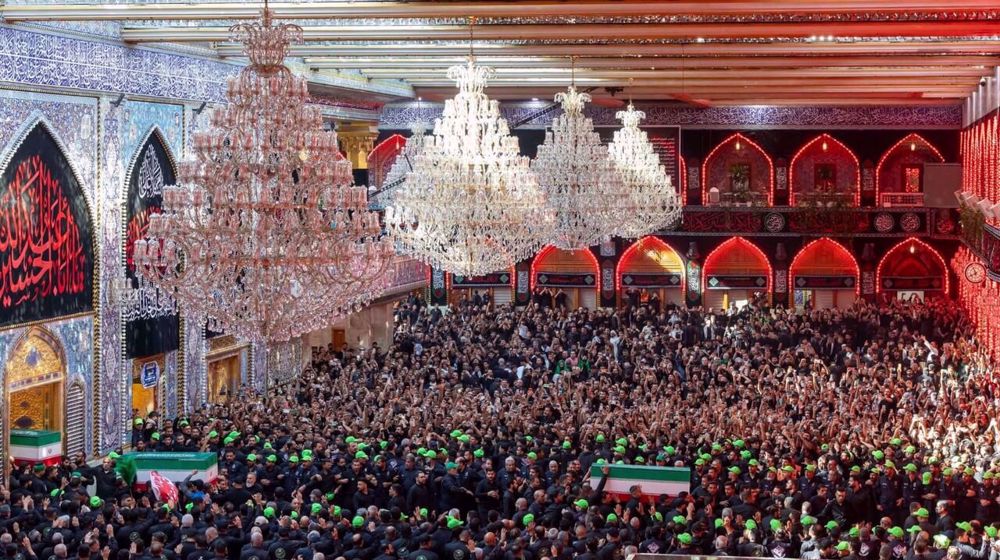
Organizers say the massive funeral procession in Iraq for the martyred Leader of the Islamic Revolution, Ayatollah Seyyed Ali Khamenei, drew more than 10 million mourners.
In a statement issued on Thursday, the supreme committee overseeing the funeral ceremonies in Iraq said preliminary figures showed that more than 10 million people had participated in the processions held in the holy cities of Najaf and Karbala.
Ihsan Yassin al-Awadi, head of the committee and director of the Iraqi prime minister’s office, said the ceremonies concluded “in an orderly and smooth manner without any significant security incidents,” despite the presence of millions of mourners in Najaf and Karbala.
He added that “the Islamic world and global public opinion followed the funeral procession of the martyred leader in Iraq’s twin holy cities with great sorrow and emotion.”
Al-Awadi also thanked government officials, security and service agencies, and volunteers for their role in the unprecedented success of the ceremonies, which he said became a remarkable display of mourning and solidarity.
“The committee, from the very first hours after being assigned the task, formulated a comprehensive plan by holding intensive meetings with officials from Iran, local Iraqi governments, the management of holy shrines, security and service agencies, and other relevant bodies.”
Around 6 million people took part in the funeral procession of the leader in Karbala, Iran’s acting consul general in the city, Jafar Safari, said citing estimates by Iraqi authorities.
Speaking to Iran’s Tasnim News Agency, Safari said Iraqi officials estimated that about 6 million people attended the procession.
He said the funeral convoy had been expected to arrive in Karbala at 4 p.m. local time but did not reach the city until about 1 a.m. because of large crowds.
According to Safari, the funeral procession lasted about 13 hours, roughly twice as long as initially expected. He said tribal groups from Iraq’s Karbala province met the convoy near the town of al-Haydariyah and accompanied it for about 40 km (25 miles).
Safari said no deaths were reported during the event despite the large crowds and high temperatures, adding that a number of Iraqis sustained minor injuries.
Lebanon-based Al Mayadeen television, citing the Karbala governorate, had earlier reported that authorities registered seven million mourners in Karbala alone.
The official funeral procession began at 6 a.m. local time on Wednesday in Najaf after funeral prayers were held over Ayatollah Khamenei’s body at the shrine of Imam Ali (AS).
The procession passed from the shrine through Kufa Bridge and the Thawrat al-Ashreen intersection before reaching al-Sadreen Square, from where the body continued to Karbala.
Although the funeral ceremonies in Najaf and Karbala were expected to last only a few hours, the unprecedented scale of the event made it one of the largest in the modern history of the two cities, which routinely host millions of pilgrims during the Islamic months of Muharram, Safar, Shaaban, and Ramadan.
Among those in attendance was Ammar al-Hakim, leader of Iraq’s National Wisdom Movement.
Former Iraqi prime minister Nouri al-Maliki, who heads the State of Law Coalition, said attending Ayatollah Khamenei’s funeral and honoring his legacy was “a duty.”
The final funeral rites are taking place in the northeastern Iranian city of Mashhad, where Ayatollah Khamenei will be laid to rest at the shrine of Imam Reza (AS), the eighth Shia Imam, in accordance with the martyred Leader’s will.
Ayatollah Khamenei was assassinated alongside several members of his family on February 28, the opening day of the 40-day war of aggression launched by the United States and the Israeli regime against the Islamic Republic of Iran.