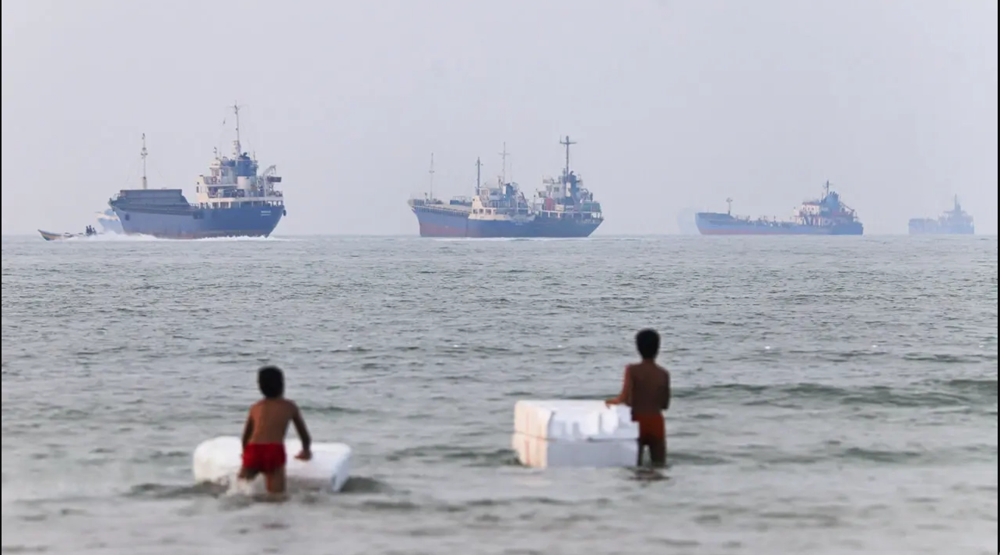
The Islamic Revolution Guards Corps (IRGC) Navy has warned that US attempts to establish independent maritime routes and escort vessels through the Strait of Hormuz will undermine regional security arrangements and threaten the interests of countries relying on the strategic waterway.
In a statement issued Thursday, the IRGC Navy said: “Once again, we declare that foreigners have no share in this land and the Strait of Hormuz.”
The warning followed US attempts in recent days to establish an alternative maritime route through the southern part of the Strait of Hormuz and escort vessels independently of Iran’s security arrangements.
Tehran has described such actions as a violation of regional understandings, including the Islamabad Memorandum of Understanding, which assigns Iran a central role in maintaining security and regulating navigation in the waterway.
The IRGC statement warned that “any adventurism by the terrorist US military and any interference in determining the routes of maritime traffic will not only be met with our decisive response, but will also seriously disrupt the gradual reopening process and put the interests of countries using the Strait of Hormuz at serious risk.”
The IRGC said its naval forces had maintained security and management of the waterway in recent weeks, stating that they had “established management over the Strait of Hormuz and ensured its security during the past two weeks.”
According to the statement, with the gradual reopening of the strait, the capacity of maritime traffic had reached around 50 percent of the levels before the war.
IRGC naval forces, it said, “are increasing the capacity for the passage of vessels that, by maintaining discipline, complying with security regulations, and using the routes designated by the Islamic Republic, obtain authorization from the Islamic Revolution Guards Corps Navy to transit.”
In the past 24 hours, no very large crude carrier (VLCC) unaffiliated with Iran has entered the Strait of Hormuz, and US naval escorts have ceased. Traffic through the southern Omani corridor has ground to a halt, according to HFI Research’s analysis of vessel tracking data .
“The last 24 hours in the Strait of Hormuz are a doozy,” HFI Research said in a post on X, noting that vessels that had been transiting the Oman route appeared to shift toward the Iranian-controlled northern route.
“In the last week or so, US escorts through the Oman lane typically saw VLCCs transit out; that was not the case this time,” the firm added.
“Inbound VLCCs were zero today for the first time since the MOU was signed,” HFI said, referring to the June 2026 Memorandum of Understanding that had temporarily reopened the waterway.
The collapse in traffic through the southern corridor comes after the United States carried out fresh airstrikes against Iranian targets in response to Tehran’s forceful administration of the strait under the MoU.
US President Donald Trump declared the ceasefire with Iran no longer valid, and Iran’s armed forces have vowed to prevent any interference in the management of the Strait of Hormuz.
“What’s clear, however, is that the Oman route will be heavily contested in the coming days,” HFI said. “Any assumption of normality in the Strait of Hormuz is wishful thinking” .
On July 8, only 14 cargo vessels transited the strait in both directions, the lowest number since the temporary agreement was signed in mid-June, according to Kpler data cited by Bloomberg. That compares to a peak of 59 transits on June 24 and an average of 34 in the three weeks following the agreement.
On Wednesday, US forces launched strikes on a number of coastal bases and non-military stations in Iran’s southern Hormozgan province and Mahshahr, which openly violated the ceasefire.
In response, the IRGC struck 85 US military targets in Bahrain and Kuwait with missiles and drones in an initial response to the American aggression and shot down an MQ-9 drone.
The US expanded its terrorism by targeting Iran’s civilian infrastructure in at least five provinces on Thursday. The IRGC and the Army responded to the aggression by striking US military bases in Bahrain, Kuwait and Jordan with missile and drone barrages.
The IRGC statement praised Iranian forces for a “crushing response” to US military actions, saying: “The brave fighters of Islam proved through their decisive response to the aggression of the child-killing US army that the fate of battles is determined not by the abundance of weapons, but by the power of faith.”
The statement further praised large funeral gatherings in Iran and Iraq, saying they showed that “the era of domination by great powers is over and this century belongs to the will of nations.”
The Strait of Hormuz remains one of the world’s most important maritime chokepoints, linking the Persian Gulf with the Gulf of Oman and the Indian Ocean. Iran has long maintained that security of the passage should be managed by regional states.
Iran says its authority over the strait is grounded in international law. At its narrowest point, the strait is 24 miles (39 km) wide, falling entirely within the overlapping territorial waters of Iran and Oman.
Iran, which has not ratified the 1982 UN Convention on the Law of the Sea (UNCLOS), does not recognize the treaty’s guarantee of “transit passage” and instead adheres to the principle of “innocent passage,” which gives coastal states greater regulatory authority.
The MoU calls for Iran and Oman to hold a “dialogue to define the future administration and maritime services in the Strait of Hormuz.” However, the US has established a shipping corridor close to Oman’s shore without prior Iranian consultation, which Tehran views as a violation of both the MoU and international law.