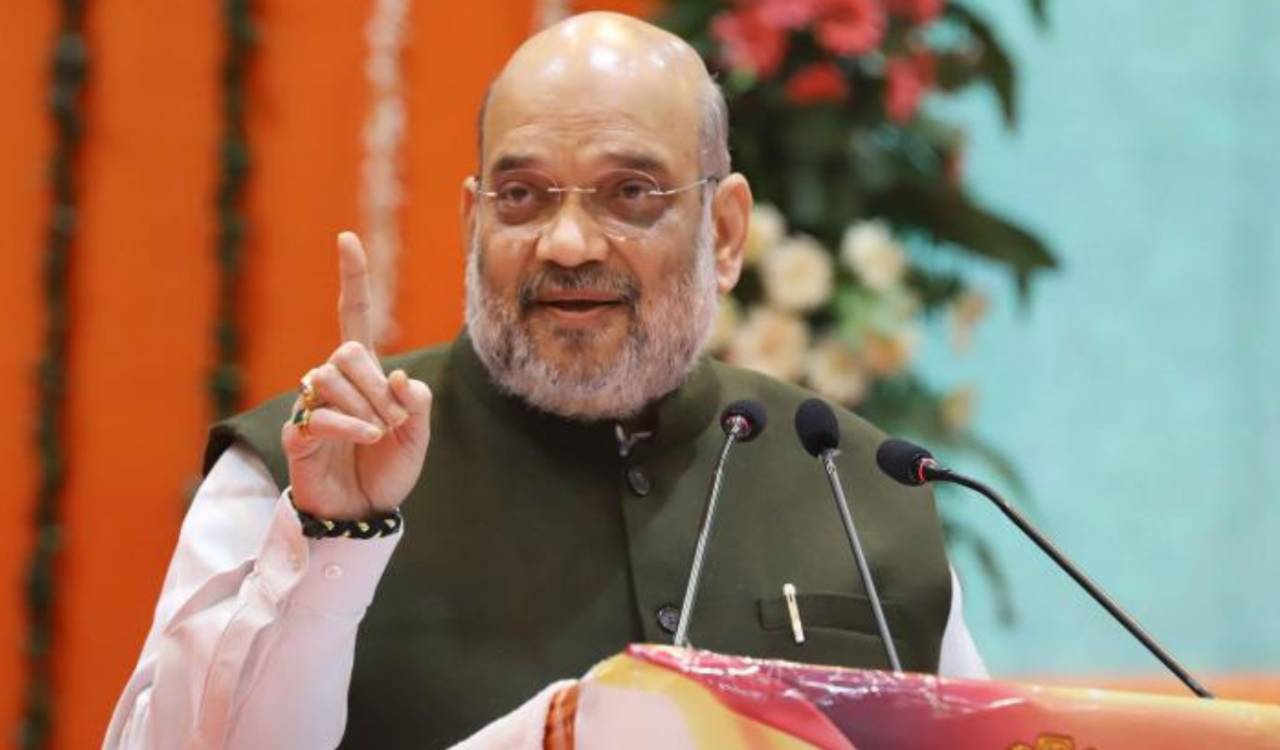
Union Minister Amit Shah announced plans to launch a cooperative life insurance company and expand Bharat Taxi to 500 cities. He also highlighted reforms, technology adoption, professional management, organic farming, and the growing role of cooperatives in achieving the Viksit Bharat vision
Published Date – 6 July 2026, 09:44 PM
New Delhi: Union Minister Amit Shah on Monday announced that a cooperative life insurance company will be established to expand the business areas of cooperatives. He also said the services of ‘Bharat Taxi’ would be expanded to 500 cities over the next two years.
At an event in the national capital to mark the fifth Foundation Day of the Ministry of Cooperation, he stressed the need to eradicate corruption in the appointment of professionals to enhance credibility in India’s cooperative ecosystem.
Shah, the Cooperation Minister, said the establishment of the ministry has given a new “lifeline” to India’s cooperative movement, which was a “neglected movement” during the Congress regime.
India has around 8.5 lakh cooperatives with more than 30 crore members.
Shah highlighted that the ministry has taken several policy initiatives to make the cooperative system modern, transparent, technology-enabled and competitive.
The minister said ride-hailing platform ‘Bharat Taxi’, which was launched under the cooperative model, has been doing well and would be expanded to 500 cities over the next two years.
On similar lines to Bharat Taxi, Shah said, “We will be setting up a life insurance company in the cooperative sector. This will help in the growth of cooperatives in the insurance sector.”
He mentioned that IFFCO-TOKIO, a joint venture of fertiliser cooperative IFFCO, is already in the insurance business. India currently has 26 life insurance companies.
Bharat Taxi is an initiative of Sahakar Taxi Cooperative Ltd, a driver-centric mobility platform based on the cooperative model. At present, Bharat Taxi has 6.37 lakh registered drivers and 35.77 lakh registered customers.
The service is operational in Delhi-NCR, Gujarat, Lucknow, Chandigarh, Mumbai, Jaipur and Kanpur, and will soon be launched in Ranchi, Patna, Guwahati, Bhopal, Kolkata, Indore and Nagpur over the next few months, according to an official statement.
Addressing the event, Shah said a national cooperative was formed especially for seed production and expressed confidence that it would emerge as the country’s largest non-governmental seed production organisation within three years.
The minister noted that cooperative organisations have entered many new sectors, expanding beyond dairy, sugar, fertiliser and banking.
Nearly 20 per cent of agricultural credit, 35 per cent of fertiliser distribution and 31 per cent of sugar production are being carried out through cooperatives, he said.
Shah mentioned that model bye-laws, which enable PACS (Primary Agricultural Credit Societies) to undertake more than 25 business activities, have now been adopted by all states, including West Bengal.
According to the statement, these PACS now function beyond credit, covering retail, storage, healthcare, fuel and digital services. As many as 394 PACS have applied for retail fuel outlets, and three outlets have been commissioned. More than 54,000 PACS are functioning as Common Service Centres, while 4,248 PACS have been approved for Jan Aushadhi Kendras.
Listing the initiatives, Shah said the ministry has identified both the problems and opportunities in the sector. A database of the cooperative sector has been created, which will help identify gaps and enable the expansion of cooperatives.
Shah mentioned that ‘Tribhuvan’ Sahkari University is being established at Anand in Gujarat, which will address the human resource shortage.
He said trained professionals in banking, dairy, marketing, agriculture, fertilisers and other areas of cooperation would be prepared at this university.
“These professionals will be appointed based on merit. Our goal is to implement professional management in a phased manner from primary cooperative societies to top institutions. This will increase transparency in appointments, improve work efficiency and also put an effective check on corruption related to appointments,” Shah said.
“By eliminating corruption in appointments, the cooperative sector can win people’s trust,” he said.
The minister expressed confidence that the cooperative sector would play a key role in building ‘Viksit Bharat’ by 2047.
Shah emphasised the promotion of organic farming and reducing the use of chemical fertilisers.
“We are bringing a 100 per cent circular economy to the sugar and dairy sectors. Through this, manure that can serve as an alternative to DAP will be produced. This indigenous manure will be cheaper than DAP and better in quality, and will provide greater benefits to fields,” he said.
Shah appealed to farmers to give up DAP (Di-ammonium phosphate) and adopt the new manure in the coming days.
Elaborating further, the minister said 50 important amendments have been made to the Multi-State Cooperative Societies Act, 2002, making the entire cooperative system more transparent and democratic.
A total of nine national-level cooperative societies have been formed, including three new ones.
Shah said the flow of credit in the cooperative sector has increased. The Urban Cooperative Banks and District Cooperative Banks are gradually moving forward, he said, adding that the total business of District Cooperative Banks has crossed Rs 25 lakh crore from the earlier Rs 19.6 lakh crore.
The net profit of Urban Cooperative Banks has almost doubled, while the gross NPA has come down from 12.8 per cent to 6.2 per cent.
During the event, Shah laid the foundation stone and inaugurated several major projects and initiatives.