Veteran cricket scorer and statistician H.R. Gopalakrishna will launch his autobiography, Records Galore, on August 7. Reflecting on more than five decades of meticulous scorekeeping, he recalls memorable encounters, statistical milestones and the evolution of cricket scoring from manual records to the digital era
Published Date – 5 July 2026, 06:35 PM
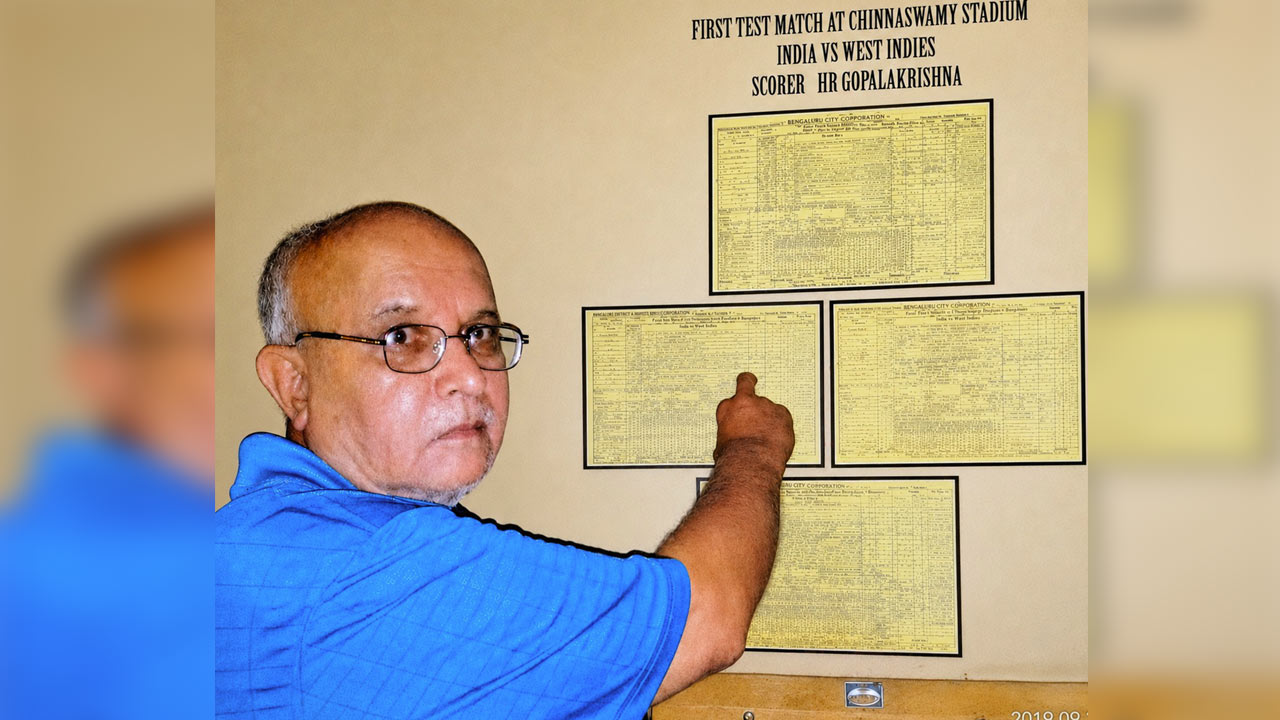
Hyderabad: For someone inspired by his grandfather, a passionate cricket fan, and his neighbour Niranjan Ram, who used to jot down Test match scorecards while listening to radio commentary, H.R. Gopalakrishna, now 80, made a lasting impression in the world of cricket statisticians. The Bengaluru-based scorer is now set to launch his autobiography, Records Galore, on August 7 in the presence of several cricketing greats, sharing the highs and lows of his long and illustrious five-decade journey as a scorer.
“Those were the days when I used to prepare for a Test match by compiling the career records of the 15 or 16 cricketers, along with detailed notes and statistics such as head-to-head results, hundreds, nineties, fifties, ducks scored by batsmen, four-wicket or better hauls by bowlers, and three-figure partnerships of the two competing teams — all updated annually,” recalls Bengaluru-based Gopalakrishna during a conversation with Telangana Today.
“Those were the days of manual scoring, and it was extremely demanding. Now, computers are of immense help in retrieving data quickly and presenting various records,” he said.
“When we started scoring, there was no remuneration from the State associations. It was purely the love of the game that motivated us to score cricket matches. Akashvani used to pay Rs. 25 per match. If there was no play on any day, a prorated amount of Rs. 8.33 per day was deducted. If two days’ play was lost, the payment was Rs. 8.33, while if one day’s play was lost, the payment was Rs. 16.66,” said a smiling HRG, as he is popularly known.
“Things have changed for the better. For all domestic matches, scorers from the BCCI panel are appointed. The remuneration is now Rs. 25,000 per day for Test matches, Rs. 25,000 per ODI, and Rs. 12,500 per T20I match. Akashvani has also revised its payments to Rs. 5,500 per day for Test matches, Rs. 5,500 per ODI, and Rs. 2,750 per T20I match.
“Akashvani also reimburses three-tier AC train fare, pays a daily allowance of Rs. 1,500, and provides hotel accommodation reimbursement of Rs. 1,500 per day on submission of bills,” HRG explained.
“Thanks to the BCCI’s periodic scorers’ examinations, the number of qualified scorers has increased. Consequently, outstation assignments have become fewer,” he said.
“One of my most cherished souvenirs was a statistical compilation I prepared at Lala Amarnath’s request. He wrote, ‘With all my best wishes to dear Gopal,’ in September 1979. I laminated and preserved that sheet. It also contains a prized photograph of Don Bradman, specially signed by the legend for Lala Amarnath. Lala himself told me this during one of our meetings,” HRG said.
“I became a member of the Association of Cricket Statisticians in England and regularly received its monthly journal. In the 1978 issue, I came across an advertisement announcing the release of Bill Frindall’s Cricket Book 1877–1978*. I can proudly say I was the first Indian scorer-statistician to own the book.*
“I used it extensively during the India-West Indies Test in Bombay, where Sunil Gavaskar scored 205 and Alvin Kallicharran made 189. Both captains led their respective teams. It was the first-ever Test in which rival captains scored more than 150 runs each and narrowly missed becoming the first pair of rival captains to score double centuries in the same Test,” he explained.
“Another occasion when I corrected Bill Frindall came during the India-England Test in Chennai. Andrew Strauss had scored centuries in both innings, and England was staring at defeat. Bill was in the BBC commentary box, while I was in the adjacent Akashvani box. He wanted statistics on the number of occasions when a team lost despite one of its batsmen scoring centuries in both innings. I prepared the complete list and found one additional instance that he had missed. He thanked me profusely and, the following morning, presented me with his autobiography, asking, ‘How should I address you, Sir?’ I told him to write ‘Gopal’. He inscribed it, ‘With best wishes to Gopal,’ and signed it. The book remains one of my prized possessions,” said HRG.
“One Test match that particularly excited me, despite my usual composure and concentration, was the India-Australia Test in Chennai in March 2001, which India won by two wickets. I found it difficult to remain seated in the commentary box and had to step out a couple of times because I could not contain my excitement,” signed off the indefatigable scorer.