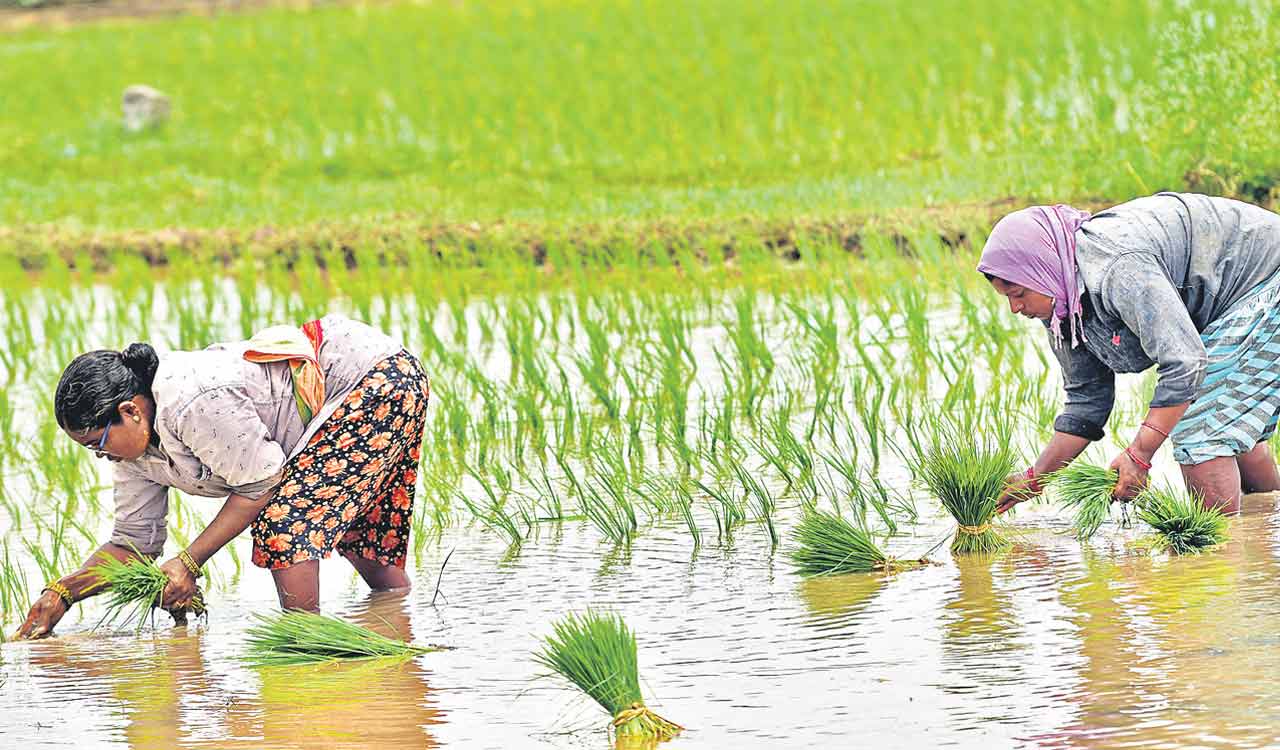
Telangana’s Vanakalam sowing has slowed sharply, with cropped area declining by over 10 lakh acres compared with last year. Below-normal rainfall, lower reservoir storage, groundwater depletion, delayed Rythu Bharosa assistance and irrigation concerns have contributed to the sluggish agricultural season.
Published Date – 3 July 2026, 04:24 PM
Hyderabad: Telangana has witnessed a sharp slowdown in the ongoing Vanakalam (Kharif) sowing season, due to growing uncertainty over rainfall, irrigation water availability and delayed government support to farmers. The total cropped area fell by over 10.2 lakh acres significantly below both last year’s coverage and the normal area for the period.
According to Agriculture Department data, farmers had cultivated only 33.27 lakh acres or 25.12% of the season’s normal cultivated area of 132.44 lakh acres, by July 1. During the corresponding period last year, sowing had covered 43.48 lakh acres or 32.83 per cent of season’s normal area, indicating a decline of over 10.20 lakh acres, or nearly 23.5 per cent, in just one year.
The subdued pace of sowing comes amid below-normal rainfall and declining water availability. Telangana received 123.1 mm of rainfall between June 1 and July 1 against the normal 134.7 mm after the onset of Southwest monsoon, registering a nine per cent deficit. Water storage has also declined considerably, with major reservoirs holding 338.60 TMCft, compared to 458.15 TMCft during the same period last year. Groundwater levels have also deteriorated, with the average depth falling from 9.06 metres below ground level (mbgl) in April to 9.26 mbgl in May.
The uncertainty over a possible weak monsoon, coupled with concerns over irrigation water availability, delayed disbursement of Rythu Bharosa assistance and apprehensions regarding the timely availability of seeds and fertilisers, appears to have prompted many farmers to postpone sowing.
The decline is visible across most major crops. Paddy which is the State’s principal crop, was sown in only 1.1 lakh acres, down from 1.82 lakh acres a year ago, accounting for just 1.76 per cent of the seasonal normal. Maize acreage nearly halved to 1.03 lakh acres from 2.48 lakh acres, while red gram fell to 1.43 lakh acres from 2.70 lakh acres. Overall foodgrain cultivation declined to 3.91 lakh acres, compared to 7.91 lakh acres during the corresponding period last year.
The slowdown has extended to commercial crops as well. Cotton acreage stood at 26.83 lakh acres, compared to 30.69 lakh acres last year, while soybean cultivation dropped to 1.65 lakh acres from 2.64 lakh acres, pulling down total oilseed coverage substantially.
Although agriculture officials attribute the slower progress primarily to delayed monsoon activity, they admitted that lower reservoir storage and falling groundwater levels have added to farmers’ concerns over irrigation. Farmers’ organisations also pointed to delays in investment support under Rythu Bharosa and uncertainty over input availability as factors influencing sowing decisions.
With July being the most crucial month for Kharif cultivation, the progress of the Southwest monsoon and the government’s response on irrigation management, input supply and financial assistance will be critical in determining whether Telangana can bridge the widening gap between the current sowing levels and its seasonal targets.
Sowing operations as on July 1, 2026:
- Total cropped area — 33.27 lakh acres
- Season’s normal cultivation area — 132.44 lakh acres
- Total cropped area last Vaanakalam season (corresponding period) — 43.48 lakh acres
- Decline in cropped area over last year — 10.2 lakh acres