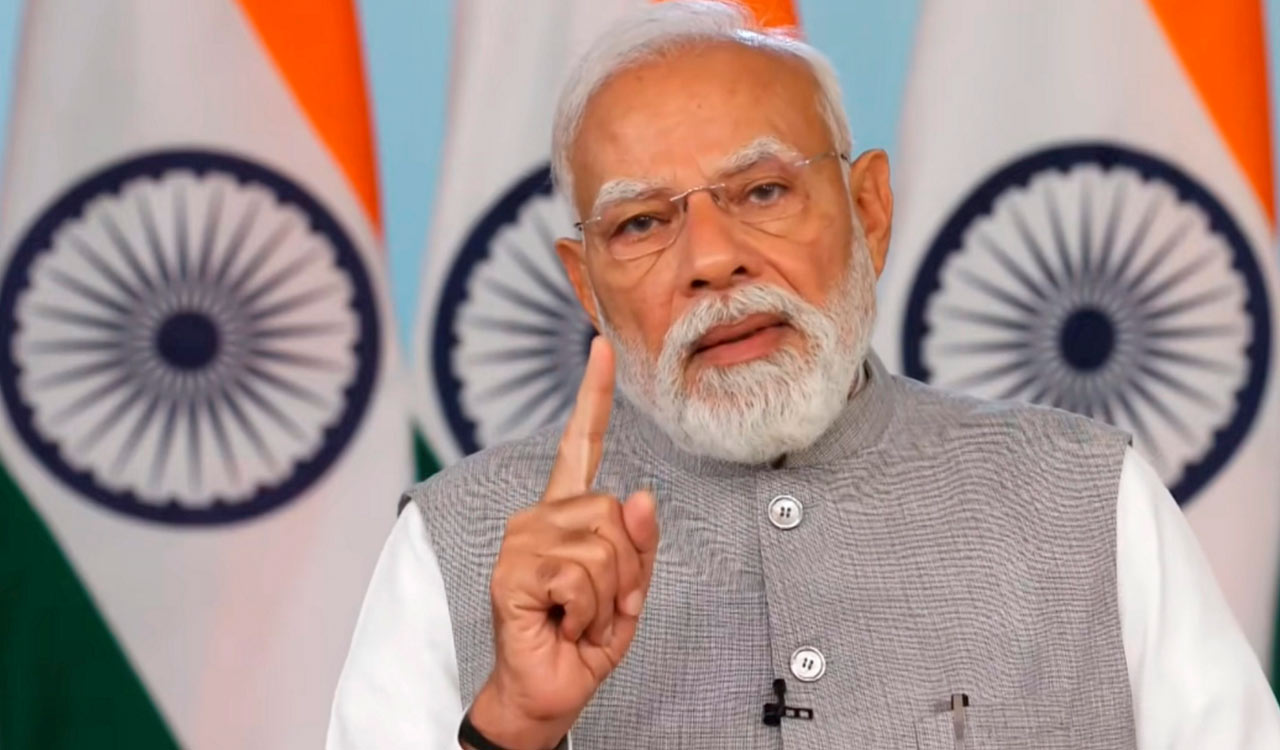
Prime Minister Narendra Modi highlighted India’s growing self-reliance in defence and aviation during ‘Mann Ki Baat’, citing the made-in-India C-295 aircraft and indigenous cruise missile. He also praised environmental initiatives, cultural heritage, youth development and urged support for local Ganesh idol makers
Published Date – 28 June 2026, 03:05 PM
New Delhi: Prime Minister Narendra Modi on Sunday highlighted several milestones achieved by the country to become self-reliant as he cited the maiden flight of the made-in-India C-295 aircraft and the successful test of the indigenous Long-Range Land-Attack Cruise Missile.
In his monthly radio broadcast ‘Mann Ki Baat’, Modi noted that in June itself, the country has achieved a major success in the aviation sector.
Noting that the C-295 aircraft has been made in India, he said, “As many as 40 such aircraft are being built right here in India and this is giving new strength to MSMEs and the aerospace sector”.
It will also increase employment opportunities, he noted. The first made-in-India C-295 military transport aircraft successfully completed its maiden flight on June 10.
The IAF is procuring 56 C-295 transport aircraft at a cost of around Rs 21,935 crore. Forty of these aircraft will be assembled by Tata Advanced Systems Limited in cooperation with Airbus at a production facility in Vadodara. Modi said in June too, the country achieved some other milestones that fill every citizen with pride.
“Recently, I got the opportunity to participate in a Navy-related programme in Kolkata. There, INS Dunagiri, INS Shanshak and INS Agrya were inducted into the Indian Navy’s fleet. From the design to manufacturing of these ships, everything is indigenous,” he said.
The prime minister said in June, the Defence Research and Development Organisation (DRDO) also successfully tested an indigenous Long-Range Land-Attack Cruise Missile (LRLACM). “In other words, from the seas to the skies, our India is becoming increasingly secure and self-reliant,” he said.
The DRDO on June 15 conducted successful flight-test of the LRLACM off the coast of Odisha. The LRLACM is an indigenously built missile with all sub-systems developed by various DRDO laboratories and industry partners.
During the broadcast, Modi thanked citizens for heeding to his appeal to avoid buying gold for some time, holidaying abroad and opting for car pool in view of the West Asia situation.
“I am grateful to every citizen of the country; not only have they supported my appeal, they are also actively cooperating in every way,” he said.
The prime minister said he had also requested farmers to adopt chemical-free farming, protect their farmlands, and maximise the use of natural fertilisers.
Referring to an initiative to prepare the youth for new technology while keeping them rooted in their heritage, he said the Central Sanskrit University in Delhi is launching a B.Tech program in Artificial Intelligence and Data Science.
“This marks a crucial step towards integrating modern technology with India’s traditional knowledge,” he said. Modi said Indian culture is reaching various corners of the globe, noting that in the Dominican Republic, where the Indian population is just around 100, a team has been formed by some Spanish-speaking locals who have named it as ‘Brahmakamal Dominicana.’
“The members study Vedic literature together and are learning to chant Vedic mantras. They have received no formal training on this; but they have learnt the correct pronunciation by listening to audio recordings,” he said.
The prime minister also spoke about the superstition surrounding the Hargila bird in Assam, which plays a vital role in keeping nature clean.
“Hargila was considered inauspicious in certain parts of Assam and trees housing Hargila nests were even cut down,” he said, adding biologist Purnima Devi Barman witnessed this and resolved to change the misconceptions deeply rooted in people’s minds.
“She spoke to women and explained the facts based on science; gradually, women began joining this campaign. Then, a major transformation began. The bird that was once driven away as a bad omen started becoming the identity of the villages,” he said.
Modi said far more young people are now pursuing sports as a career and shared that a special initiative has been taken in Nagaland where the ‘Nagaland Baby League’ of football was launched.
Children, both boys and girls aged 5 to 12 can participate in it. “It not only inspires them and nurtures their speed and talent but also helps establish their identity,” he said.
Talking about Meghalaya’s root bridges, Modi said India has now sought inclusion of the root bridges in the UNESCO World Heritage Site Network.
He said climate change poses several challenges to these root bridges but people of Meghalaya have admirably shouldered the responsibility of preserving this natural heritage.
“Today, local residents look after more than 120 root bridges. Some teams inspect the condition of these bridges annually, and some individuals have even established nurseries to strengthen the surrounding areas. An entire ecosystem has thus developed around their conservation,” he said.
Modi also spoke about how some women from Biaora in Rajgarh district of Madhya Pradesh have resolved to remove plastic waste in their area.
Instead of waiting for someone else to bring about the change, they took the initiative to collect plastic waste and empty bottles from across the town themselves and gradually, this effort expanded, and the collected plastic began to be converted into eco-bricks.
“Today, these very eco-bricks are being used to beautify public spaces. In Rajgarh, hundreds of kilograms of plastic has been recycled and put to productive use over the past few months. In other words, the plastic that once polluted the city is now contributing to its beauty, thanks to the efforts of these women,” he said.
Referring to the Ganesh Chaturthi festival in September, he said many people have written to him suggesting that he should speak on a topic related to Ganesh Utsav, even through the festival is still quite some time away.
He said the work of crafting Ganesh idols begins well in advance and idol makers and those involved in the idol trade become active right now.
“Therefore, I urge all of you… please make an effort to ensure that the idol of Ganpati Bappa installed in your home, society, or neighbourhood is made from the soil of our own country and crafted by the hands of our own potters and local artisans.
“I also urge those who make Ganesh idols to prioritise clay idols, and I ask buyers to check what the idol is made of and which country it was produced in,” he said.