A police force that acts in an extra-legal manner and poses a threat to the life and security of citizens is a threat to democracy and the rule of law
Published Date – 29 June 2026, 12:20 AM
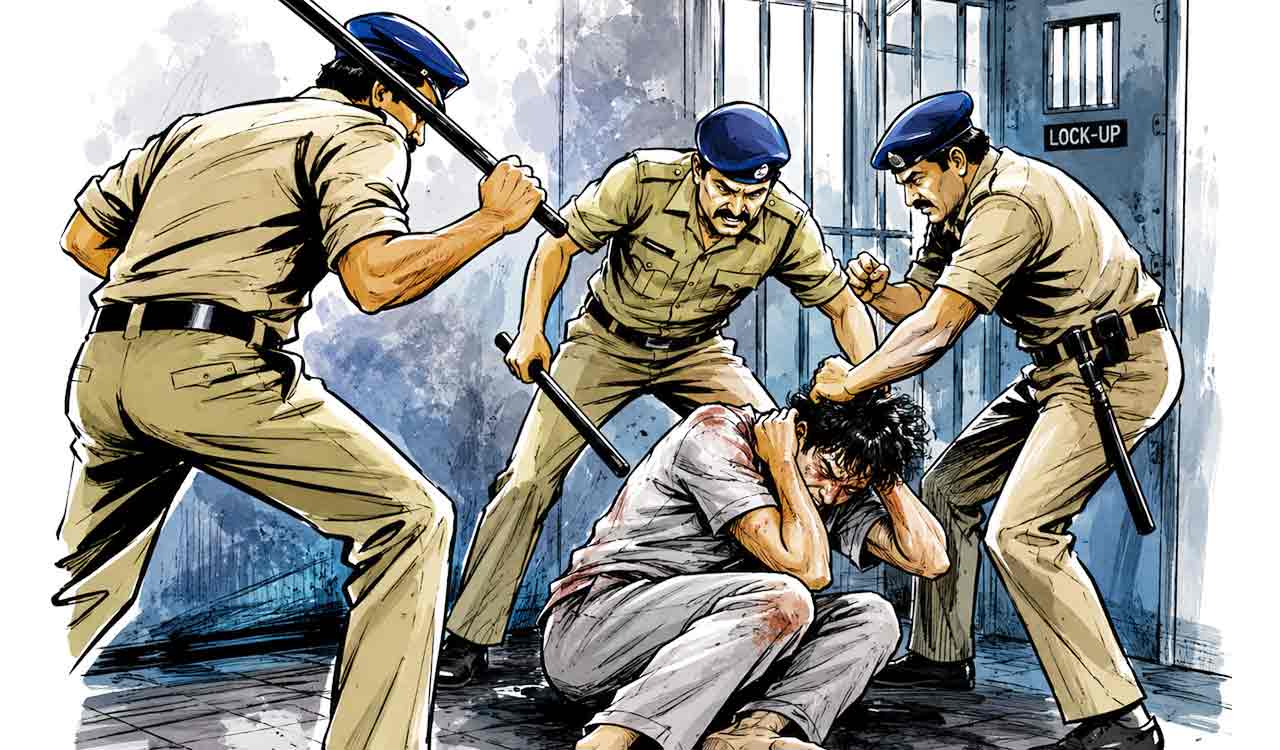
The death of a 25-year- old man in police custody in Vijayawada recently evoked widespread public outrage and once again brought into focus how the inherent brutality and immunity from accountability have come to define the policing system in the country. For weeks, the Vijayawada tragedy was treated as a case of mysterious disappearance, with the local police remaining unhelpful. It was only after the mother of the victim, Gade Sai Krishna, moved the high court seeking his whereabouts, and public pressure started mounting, that the government formed a Special Investigation Team (SIT) to ferret out facts. The probe concluded that the victim died following physical torture in police custody. This is a classic case of an insensitive system perpetrating extrajudicial killings and covering them up using official machinery. What is more disturbing is that not a single conviction was handed out in over 300 judicial inquiries into the cases of custodial deaths between 2017 and 2022. Between 2010-11 and 2021-22, the National Human Rights Commission (NHRC) registered an average of over 1,700 custodial death-related cases a year, yet meaningful punitive action remains the exception rather than the rule. Unfortunately, India doesn’t have a standalone law that defines and criminalises custodial torture. There is no statutory definition for torture, nor are the penalties and compensation specified. Internationally, India had signed the UN Convention Against Torture in 1997 but has still not ratified it, largely because ratification would require domestic legislation that has not fructified so far.
The Prevention of Torture Bill, 2010 — passed by the Lok Sabha but could not be taken up by the Rajya Sabha — remains the only legislative attempt at this, and it lapsed. The Law Commission’s 273rd Report drafted a fresh Bill in 2017 and urged Parliament to act, but nothing has been enacted. Over the years, several expert committees have been set up and several recommendations made on the need to change the functioning of the police force in tune with changing times. However, the issue of police reforms has largely remained on paper. There is no excuse for custodial deaths and torture, and the abrogation of basic legal rights of those arrested. While the policemen involved should get swift punishment, the solution must go beyond it and involve a systemic overhaul of the police. A police force that acts in an extra-legal fashion and poses a threat to the life and security of citizens is a threat to democracy and the rule of law. The Indian police system is governed by a law enacted in 1860, and multiple commissions since 1971 have recommended a string of reforms, but not many of them have been acted on. Way back in 2006, the Supreme Court issued a set of directives for police reforms, but their implementation across the country leaves much to be desired.