Fresh questions have emerged in the SCCL coal discrepancy controversy, with overburden removal data indicating possible inconsistencies in production figures. Sources and experts have called for an independent audit of coal production, stock and mine-wise overburden removal records.
Published Date – 25 June 2026, 06:53 PM
Hyderabad: As the controversy surrounding the alleged disappearance of nearly 40 lakh tonnes of coal at the Singareni Collieries Company Limited (SCCL) refuses to die down, attention is increasingly turning to the less-discussed factor of overburden (OB) removal, which might hold the key to understanding the discrepancies in production, despatch and stock figures.
Sources in SCCL and union leaders told Telangana Today that delays in OB removal at certain mines had also adversely affected coal extraction, forcing officials to resort to adjustments in reported figures to meet production targets between January 2024 and December 2025.
Soon after discovering the disconnect in coal production, despatches and stocks, officials involved in identifying the anomalies are said to have noticed discrepancies in OB removal against coal production. OB removal is a critical mining activity that involves removing soil and rock covering coal seams before extraction can begin.
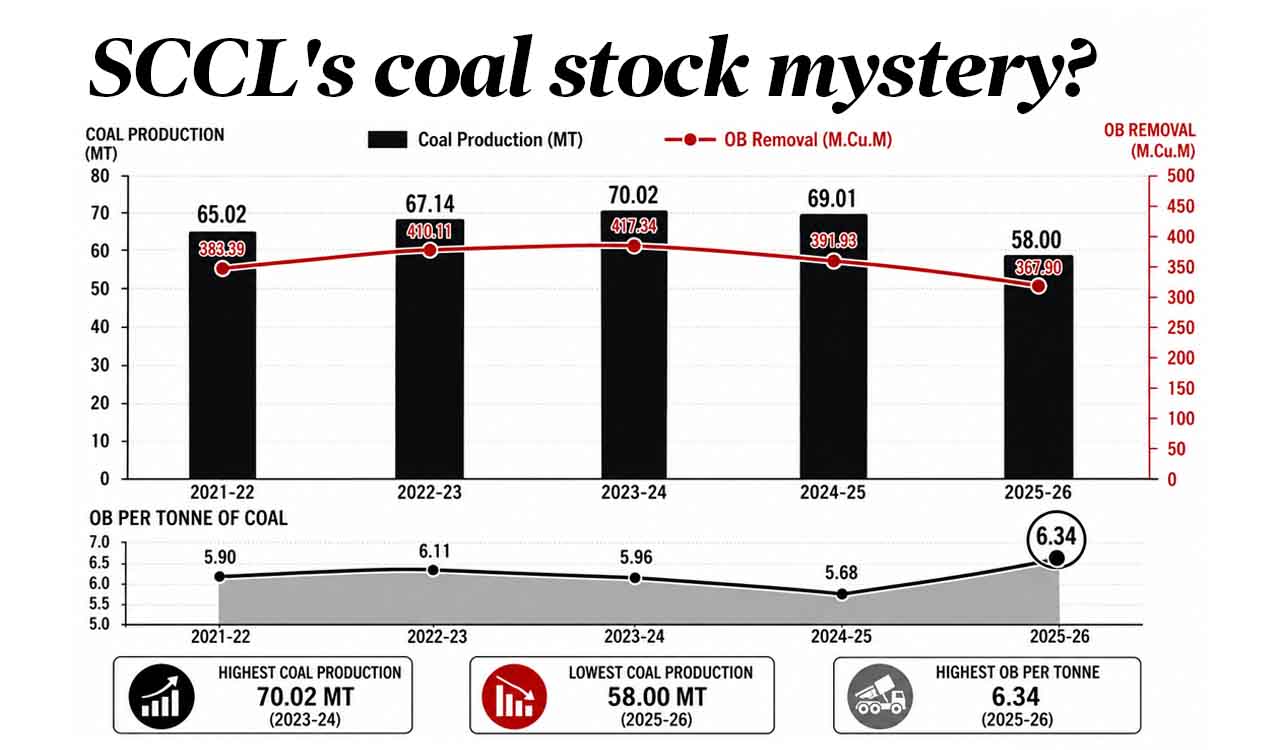
Data available in the public domain displayed a curious trend in the ratio of OB removal to coal production in SCCL. In 2023-24, SCCL removed 417.34 million cubic metres of overburden to produce 70.02 million tonnes of coal, translating into about 5.96 cubic metres of OB removal for every tonne of coal produced.
In 2024-25, despite OB removal falling by around 25.41 million cubic metres to 391.93 million cubic metres, coal production declined by only one million tonnes to 69.01 million tonnes. As a result, the OB-to-coal ratio improved to 5.68, the best performance recorded in the last five years.
However, the trend reversed dramatically in 2025-26. While OB removal declined by another 24 million cubic metres, coal production plunged by over 11 million tonnes to 58 million tonnes. The OB-to-coal ratio jumped sharply to 6.34, the highest in the available data.
Experts said such a sudden deterioration usually indicated either delayed access to coal seams, operational disruptions, geological constraints or inconsistencies in reported production figures.
Sources suspect that delays in OB removal at certain projects might have contributed to the production shortfall. They pointed to OB removal contracts awarded to firms linked to close relatives of two key leaders in the State government. The contracts were awarded after SCCL introduced the controversial Site Visit Certification requirement, a condition that the Opposition alleged discouraged wider participation in bidding.
“We cannot rule out the possibility that officials adjusted production figures to some extent because they could not aggressively push certain contractors with links to top leaders in the government to complete OB removal works on schedule,” another source familiar with operations said.
A retired Singareni official said a forensic examination of mine-wise stripping ratios between OB removed and coal produced could establish whether production figures accurately reflected ground realities. “If OB removal slows down but production figures continue to remain exceptionally high, that naturally raises questions. The data trail can reveal the truth,” he added.
The timing of these developments has drawn attention as they coincide with the period during which SCCL reported an unprecedented increase in coal production and a sharp rise in closing stock, followed by a correction in 2025-26. Under these circumstances, demands for an independent audit of production, stock and mine-wise OB removal records are growing louder.