To drive meaningful results, businesses must focus on maximizing their current content and alignment with user intent. This guide outlines practical organic frameworks, while also examining what happens when you try to Buy Organic Traffic to accelerate visibility, helping you make the most budget-conscious decision.
Why Do Smart SEO Shortcuts Deliver Better Results?
SEO in 2026 relies on data over guesswork. Instead of focusing entirely on creating new pages from scratch, substantial value can be extracted from optimizing your existing assets. Pages sitting on the second page of search results—which already earn impressions but lack clicks—represent a prime opportunity. By applying targeted optimizations, such as sharpening content focus, resolving technical issues, and improving user experience, you can capitalize on pages Google already recognizes, driving efficient and measurable traffic growth.
Speeding Up Your SEO: High-Impact Strategies for Quick Wins
In this game, momentum is everything. You can score serious wins early on by just optimizing assets that are already indexed and carry some baseline authority.
Refresh Old Content to Reverse Traffic Decay
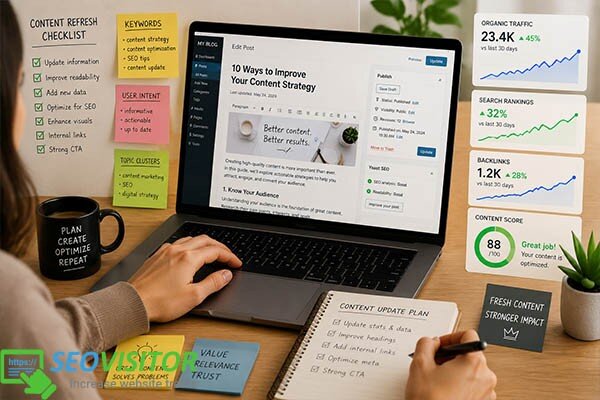
Content goes stale—it’s just a fact. Pull up Google Search Console, find the posts where clicks are tanking, and fix them. Drop in fresh data, add recent industry shifts, and cut out the fluff. Revamping these old posts is honestly one of the fastest organic traffic growth hacks to win back your rankings.
Target Intent-Driven Long-Tail Keywords
Chasing high-volume keywords is usually a money pit. Long-tail phrases, on the other hand, catch buyers right when they have their wallets out. Focus on hyper-specific, problem-solving search queries. They face way less competition and convert like crazy, giving you a clear path to growth.
Build Topic Clusters Around Essential Pillars
Google loves experts, not generalists. If you want to dominate, build a central pillar page and surround it with tightly linked sub-topics. This interlinked setup proves your topical authority to search bots, which naturally acts as a passive framework that lifts the rankings of every single page in the cluster.
Optimize Titles and Meta Descriptions for Maximum CTR
Ranking at the top means nothing if everyone scrolls right past you. Spice up your title tags with emotional hooks, clear benefits, or the current year. Think of your meta description as a mini billboard—make it so compelling that users can’t help but click your link instead of the competition.
Moving Beyond the Basics: Advanced Tactics for Page-One Dominance
Once you have covered the fundamentals, scaling your visibility requires a more strategic approach. These advanced techniques will help you lock in higher rankings and squeeze the maximum value out of your existing setup.
Maximize Internal Linking and Link Equity
Internal links act as a roadmap for search crawlers. Don’t let your high-authority pages sit in isolation; strategically link them to newer or weaker content. Passing this “link juice” down the line is one of the most reliable organic traffic growth hacks to elevate underperforming pages without building external links.
Optimize Content to Win Featured Snippets
Securing “Position Zero” is the ultimate way to leapfrog competitors. Find the direct questions your audience is searching for and answer them instantly beneath an H2 or H3 heading. Keep these definitions or answers tight and objective (around 40–50 words) so search algorithms can easily extract them.
Consolidate Content to Fight Cannibalization
Having multiple weak pages targeting the same keyword dilutes your ranking power. Instead of letting your own pages compete against each other, merge thin content into a single, high-quality “super-article.” This concentrates your authority and provides a much better user experience.
Inject Real-World E-E-A-T and Original Insights
With generic content flooding the web, uniqueness is your greatest asset. To align with Google’s E-E-A-T guidelines, enrich your articles with first-hand experience, practical case studies, or original data. Showing real-world application separates your site from automated noise.
Mine Google Search Console for Low-Hanging Fruit
Stop guessing what to optimize next. Filter your Search Console data to find keywords sitting comfortably between positions 6 and 20. These pages already have search engine’s trust; by slightly expanding their content or refining their intent, you can push them onto the top of page one in a matter of weeks.
Maintaining Momentum: Optimization Tactics for Long-Term Growth
Sustainable growth is never a “set it and forget it” achievement. It requires treating your website as a living asset that demands consistent strategic maintenance and data-driven adjustments to stay ahead.
Implement a Rigorous Content Refresh Schedule
Search algorithms naturally favor up-to-date information. Establish a quarterly routine to review the top 20% of your traffic-driving assets. Fix broken links, update any outdated statistics, and ensure the insights provided are fully accurate and relevant for 2026.
Funnel Information Seekers into Commercial Pages
Your informational content should act as a bridge to your business offerings. When you strategically Buy Organic Traffic to accelerate your visibility, you must ensure your internal linking structure funnels those casual readers directly toward your product or service descriptions, converting cold traffic into qualified leads.
Let Data Dictate Your Next Move
Continuous improvement relies entirely on analytics. Monitor which optimization tactics are moving the needle and which ones are falling flat. Double down on the strategies that yield measurable ROI, and pivot quickly when the data shows a decline in engagement.
Conclusion
At the end of the day, relying on proven organic traffic growth strategies is one of the most sustainable ways to build long-term success in 2026. By blending technical precision with smart content development—whether that means reviving stagnant pages, structuring authoritative topic clusters, or fine-tuning your CTR—you can transform your website into a reliable traffic engine. Ultimately, consistent, data-driven optimizations will compound over time, strengthening your online presence and keeping you ahead of the competition.

Frequently Asked Questions
How long does it take to see organic growth?
SEO is a long-term investment. While some “quick wins” (like updating titles) can show results in weeks, significant organic growth typically takes 3 to 6 months of consistent optimization.
Does internal linking really impact traffic?
Yes. Internal links help search engine crawlers discover your content and distribute authority from your strongest pages to your new or weaker pages, directly boosting rankings.
What is the biggest mistake in organic SEO?
The biggest mistake is “keyword cannibalization”—creating multiple pages for the same keyword. This confuses search engines and weakens your authority. It is better to have one comprehensive page than ten weak ones.
MNA