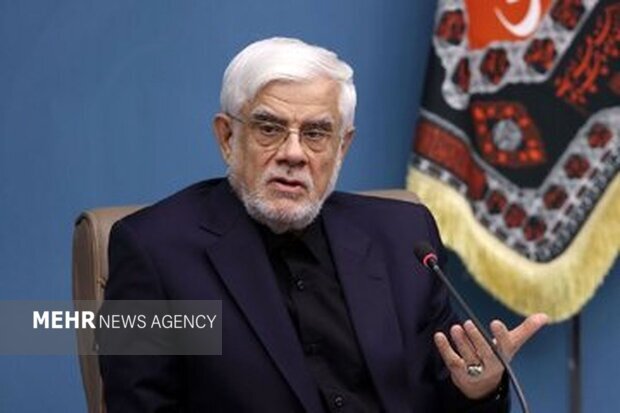
He made the remarks during a meeting with officials from the Vice Presidency for Women and Family Affairs on Tuesday.
The vice president pointed to the strategic Strait of Hormuz, emphasizing that Tehran would retain control over the Strait of Hormuz and that the vessels using the strategic waterway should contribute to the cost of services provided by the Islamic Republic to ensure safe navigation.
Aref went on to say that Iran made significant sacrifices throughout its history to secure its rights in the strait and is now seeking to fully benefit from those rights.
He further noted that Iran provides important services that help guarantee the safe passage of vessels through the waterway, warning that without such measures, ships could face risks, including encounters with naval mines, and cause environmental hazards.
His remarks come amid continued regional discussions over maritime security and commercial shipping through the Strait of Hormuz, one of the world’s most important and strategic energy transit routes.
Iran and Oman have recently been engaged in efforts to establish a mechanism for managing navigation and security in the waterway.
On June 14, Iran and the United States finalized the text of an MoU aimed at ending the war. The memorandum of understanding (MoU) contributed to a temporary reopening of the strait and an end to the US naval blockade against Iran.
Iran shut down the strait to its enemies and their allies after the unprovoked US-Israeli aggression. Iranian authorities began enforcing much stricter controls in April following US President Donald Trump’s announcement of a blockade targeting Iranian vessels and ports.
MNA/6862163