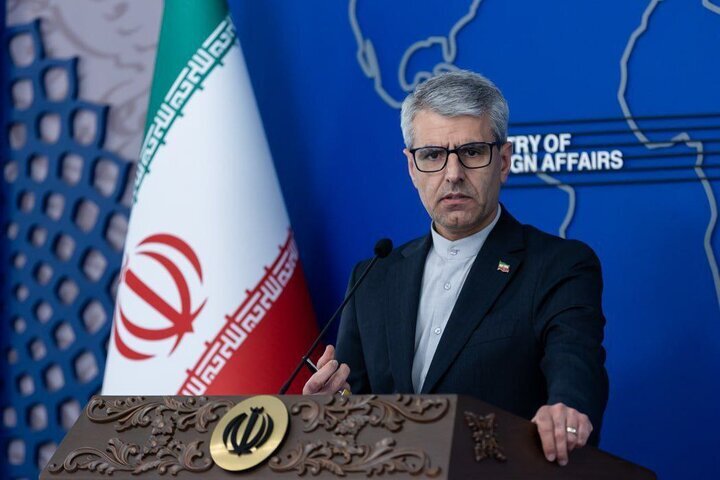
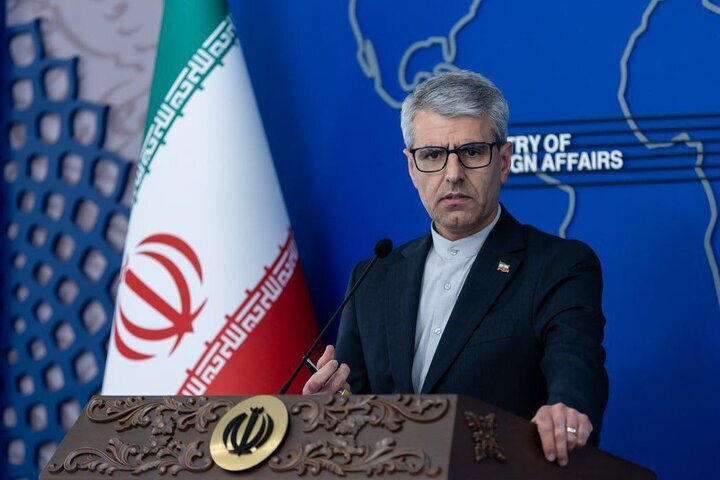
The spokesman made the remarks on Saturday amid reports suggesting Iran and the US have moved very close to signing an initial agreement aimed at ending the US-Israeli aggression on Iran that started in late February and stopped with a fragile ceasefire in early April.
“We should wait for the exact time of signing [a potential agreement]. We have no plans for trips to Geneva or other places for the next two days,” he said, responding to reports that claimed a signing ceremony could be held on Sunday in Geneva or Islamabad.
“Our duty is to pursue this diplomatic process with pessimism,” said Baghaei in a news briefing held in the western city of Hamedan.
“The experience of a year and a half of negotiations with the American side, along with their broken promises and crimes during previous talks, requires us to take every step cautiously and with great foresight,” he said.
The spokesman reiterated his previous statement that the potential understanding with the US would solely focus on solutions aimed at ending the US-Israeli aggression on Iran, as he insisted that Iran’s nuclear program will not be covered in the agreement.
The spokesperson emphasized the immense complexity of the issues between Tehran and Washington. He explained that based on past lessons, the immediate priority in this phase is securing a cessation of hostilities across all fronts, including Lebanon. Consequently, both parties agreed not to address the nuclear issue at this juncture.
Baghaei clarified that the document does not constitute a final bilateral treaty between Iran and the United States. Instead, it serves as an understanding that outlines the broad framework of disputed issues and establishes the terms for ending the war.
He added that the nuclear issue is scheduled to be negotiated within a subsequent 60-day window, meaning no detailed discussions on the matter are occurring at this stage.
Among the primary subjects under negotiation in the current phase are the hostile actions targeting Iranian shipping and matters surrounding the Strait of Hormuz.
Addressing the potential timeline for signing the accord, Baghaei remarked that while a definitive date cannot be confirmed and the signing will not occur tomorrow, the possibility of it taking place in the coming days remains open. However, he urged caution due to the volatile nature of the opposing side’s declarations.
Regarding the legal status of the Strait of Hormuz, Baghaei maintained that under international law, the strategic waterway falls within the territorial waters of Iran and Oman as the two littoral states. He stated that Iran’s exercise of sovereignty in this zone directly serves its national security and sovereign rights—a principle recognized under international law.
The spokesperson noted that although Iran is not a signatory to the 1982 United Nations Convention on the Law of the Sea (UNCLOS), the legal regime governing vessel transit through the strait is clearly defined under customary international law.
He argued that the events of the past two to three months demonstrated that the United States and Israel have exploited the waterway to threaten Iran’s national security and violate its sovereignty, thereby justifying Iran’s implementation of necessary preventive measures.
Baghaei emphasized that Iran’s maritime actions are fully compliant with both international law and domestic legislation, adding that these measures will continue to be pursued in cooperation with Oman and in consultation with regional nations.
He reiterated that managing safe transit through the Strait of Hormuz protects Iran’s national interests while simultaneously serving the public good of the international community.
When questioned about the enforcement of potential agreements, Baghaei criticized the opposing side’s historical failure to properly fulfill its obligations, stating that Iran has integrated necessary safeguards to counter this.
He explained that the commitments are structured on a strictly reciprocal basis. Should the opposing side refuse to execute its duties at any stage, Iran is legally permitted to take corresponding counteractions. Baghaei asserted that a nation’s intrinsic power remains the ultimate guarantee in international relations, pointing to Iran’s defense over the past 40 days as a clear message to its adversaries.
The spokesperson also cautioned domestic media against internalizing Western psychological warfare, dismissing foreign press reports claiming that a final deal is imminent or alleging that an aircraft arrived carrying $3 billion as baseless fabrications.
MNA