
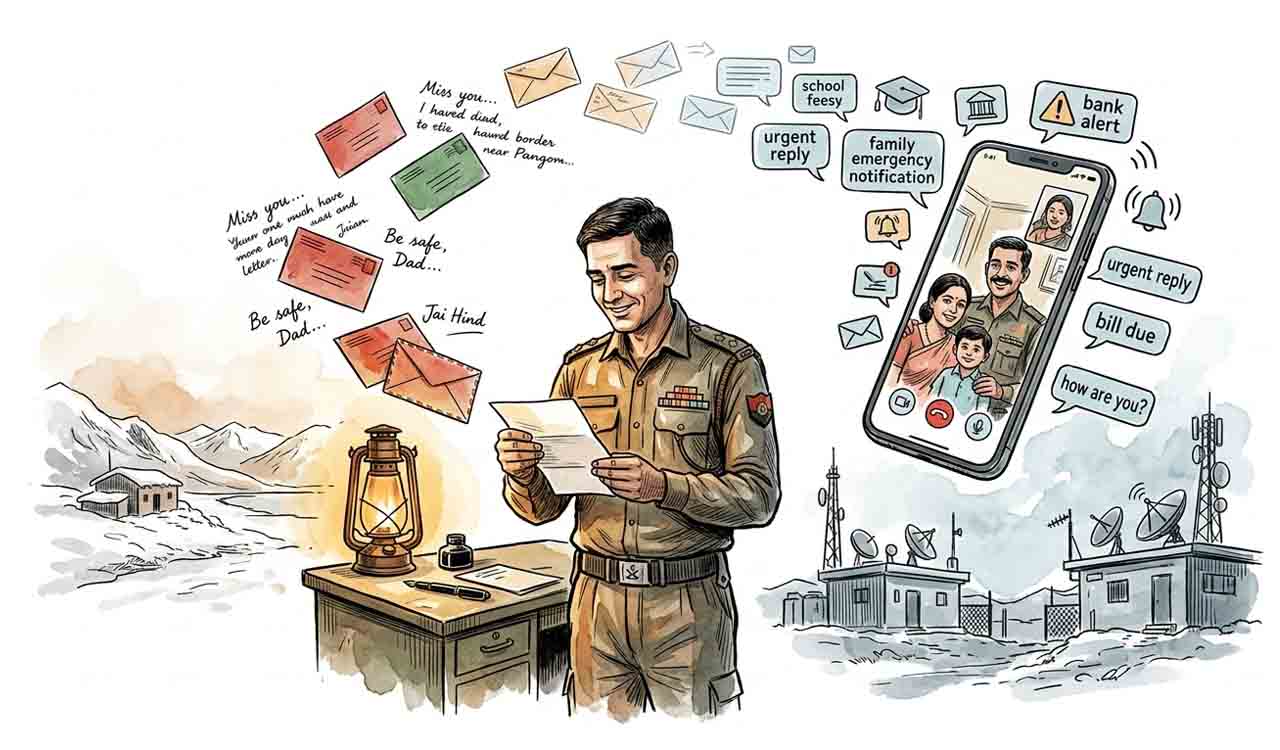
The letters often took days, sometimes weeks, to reach home. Technology has undoubtedly improved the lives of soldiers and their families, but the long silences that once separated soldiers from home also shielded them from the anxieties of everyday life
Published Date – 10 June 2026, 11:11 AM
By Brig Advitya Madan
Last week, my phone crackled well past midnight. “Sahab, kahan ho aaj kal?” (Sir, where are you these days?), asked a voice in a familiar Haryanvi accent. After a few moments of conversation, I realised it was the serving Subedar Major of my regiment calling from Lukung, at the edge of Pangong Tso, not far from the Galwan Valley where Indian and Chinese troops clashed in 2020.
For a moment, I stopped listening to the words and allowed myself to absorb the irony. A routine mobile phone call was coming from one of the most remote and strategically sensitive corners of the country. It instantly transported me back nearly a quarter century.
Around the year 2000, I served as Brigade Major in the same area and attended several Border Personnel Meetings with the Chinese at their Moldo garrison across the Line of Actual Control. In those days, the prospect of making a casual telephone call from Pangong Tso would have sounded absurd. Mobile phones were still a novelty. Our only connection with home was through a cumbersome satellite communication system called INMARSAT.
The machine was temperamental, and conversations were often interrupted by the dreaded “echo effect”, where one’s own voice returned a few seconds later. My wife and daughters found it exasperating. So did I. Yet none of us complained much. Soldiers patiently queued outside military exchanges for the chance to hear the voices of their loved ones. Even a brief conversation was enough to lift spirits for weeks.
My thoughts drifted further back to my tenure in Lebanon as part of a United Nations mission. International telephone calls were prohibitively expensive and consumed a significant portion of our foreign allowance. Speaking to family members was not a convenience. It was an event.
Before satellite telephones came the era of Forces Letters. Every soldier remembers them with affection.
Officers wrote on red envelopes after certifying that the contents contained no sensitive information. Soldiers used green envelopes that required scrutiny by their company commanders before dispatch. The letters often took days, sometimes weeks, to reach home. News travelled slowly. Families frequently received confirmation of a soldier’s safe arrival long after he had already moved to another location. Yet there was something remarkable about those letters. They carried only what truly mattered.
Today, technology has transformed military life. A soldier deployed on the Line of Control can video call his family in seconds. His wife can see not only that he is safe but even what he is eating in the unit langar. Distances that once seemed enormous have effectively vanished.
But every technological advance brings its own challenges. Domestic disagreements, financial concerns and family tensions now reach soldiers in real time. Separated by hundreds of kilometres and unable to intervene, many find themselves worrying about situations over which they have little control. Distance often magnifies anxiety rather than reducing it.
One of my most cherished memories is from my days at the National Defence Academy and later at the Indian Military Academy. During evening fall-ins, the Cadet Sergeant Major would call out names while distributing letters from home. The anticipation was electric. A handwritten letter carried warmth, patience and emotional value that no instant message can fully replicate.
Technology has undoubtedly improved the lives of soldiers and their families. A father posted on a distant frontier can now watch his child take her first steps in real time. Yet something has quietly disappeared along the way. The long silences that once separated soldiers from their homes also protected them from the anxieties of everyday life.
The letters took longer to arrive, but they carried only what truly mattered. In an age of instant communication, that may be the lesson worth remembering.
(The author is a retired military officer and strategic affairs analyst. Views are personal)