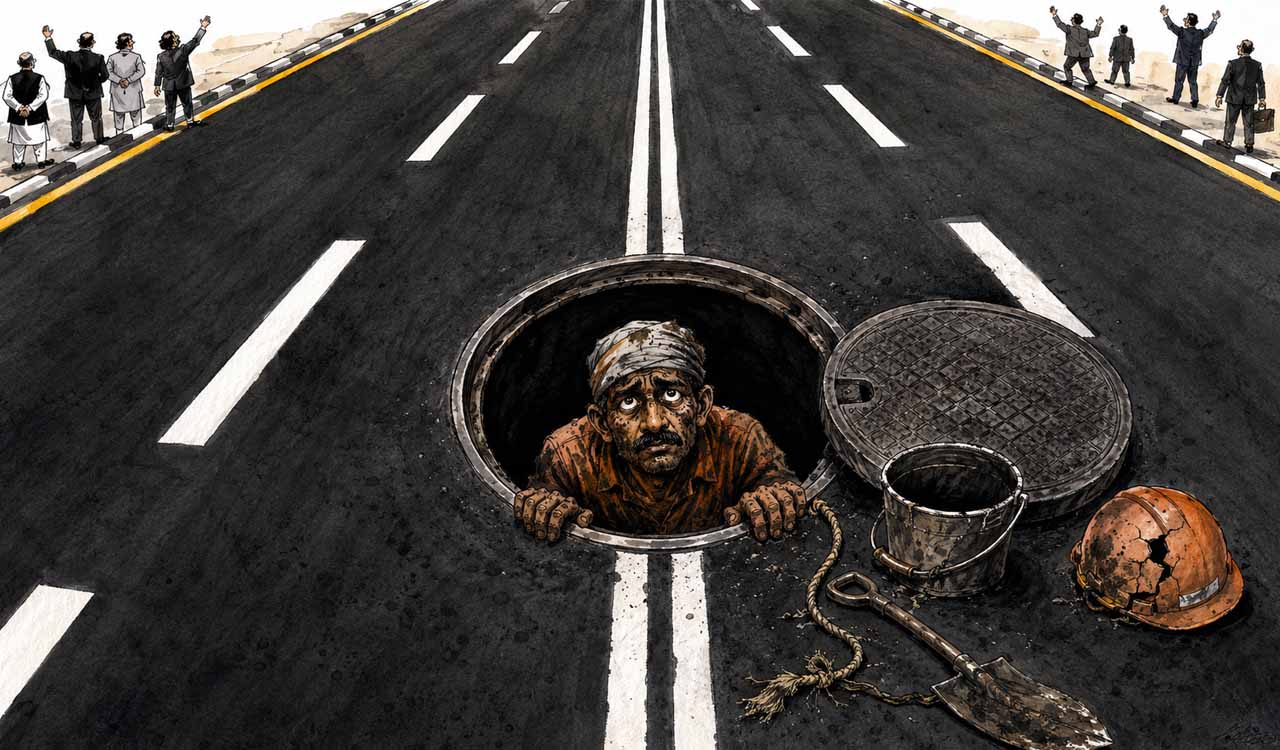
While roads attract political visibility and investment, sewerage systems remain buried and neglected, fuelling India’s hidden urban crisis
Published Date – 10 June 2026, 10:21 PM
By Dr Tarun Arora, Dr Reetika Syal
Indian cities are in the midst of an intense transformation. New flyovers rise across skylines, freshly paved roads stretch across expanding neighbourhoods, and municipal budgets celebrate kilometres of roads constructed each year. Yet beneath this visible progress lies an uncomfortable reality: the underground infrastructure that sustains urban life — sewerage networks, drainage systems, and water pipelines — receives far less attention.
In municipal governance, roads are politically visible assets, while sewerage remains buried, both physically and administratively. The result is a recurring pattern in which optics triumph over sanitation, and the costs of this imbalance are measured not in inconvenience but in lives.
The Politics of Visibility
Roads are among the most visible symbols of governance. A newly paved road is immediately noticeable to citizens, politicians, and media alike, a tangible marker of development that can be showcased during elections or in annual municipal reports. Sewerage infrastructure, by contrast, operates underground and remains invisible unless it fails. Repairing a sewer line or upgrading a drainage network rarely generates headlines or votes. Consequently, municipal leaders face far greater political incentives to allocate resources to roads rather than to the sanitation networks that underpin public health.
This is not simply a matter of perception; it shapes budgetary decisions in concrete and measurable ways. According to budget analyses published by IMPRI, the Union Budget 2026-27 halved the allocation for Swachh Bharat Mission (Urban) from Rs 5,000 crore to Rs 2,500 crore in a single year. The AMRUT scheme, which funds urban sewerage and water supply infrastructure, was simultaneously cut by 20%, from Rs 10,000 crore to Rs 8,000 crore. These are not marginal adjustments; they signal a fundamental retreat from urban sanitation as a policy priority at the highest level of government.
The imbalance is equally visible at the city level. A State-by-State analysis published by India Data Map found that States such as Bihar, Jharkhand, and Odisha allocate less than 5% of their urban budgets to sanitation, directing the bulk of resources towards road development. Sewerage systems require long-term planning, complex engineering coordination, and capital investment with little immediate political reward.
A Crisis Hiding Underground
The consequences of this neglect are not abstract. According to a December 2024 report by the Centre for Science and Environment (CSE), only 28% of India’s urban wastewater is actually treated; the remaining 72% flows untreated into rivers, lakes, and soil. Central Pollution Control Board (CPCB) data show that urban sewage generation is 72,368 million litres per day, equivalent to filling 18,000 Olympic-size swimming pools with raw sewage every day. Installed treatment capacity stands at 31,841 million litres per day, but operational capacity is significantly lower due to poor maintenance.
The gap between what is generated and what is treated has persisted for decades, largely because investment in treatment infrastructure has consistently lagged behind the pace of urbanisation.
The impact on water bodies is severe. The Yamuna receives 2,500 million litres of sewage in Delhi alone, and dissolved oxygen drops to near zero over a 20-kilometre stretch downstream. The Ganga carries 6,000 million litres of untreated sewage across Uttar Pradesh and Bihar. Bengaluru’s Bellandur Lake, receiving 500 million litres of sewage daily, has become notorious for foaming and spontaneous fires caused by methane pockets.
Poor sanitation claims an estimated 5.35 lakh lives and costs India 73 million workdays every year, exposing the consequences of neglecting the infrastructure beneath our streets
Researchers at Cornell University, drawing on Government of India data, estimate that poor sanitation access costs India approximately 5,35,000 lives annually due to preventable waterborne diseases and 73 million working days lost to productivity.
Perhaps the most telling illustration of this gap between surface cleanliness and subsurface neglect came from Indore, a city that has topped India’s Swachh Survekshan rankings for years. In late 2025, sewage contamination entered the municipal drinking water system in the Bhagirathpura locality due to pipeline leakage and infrastructure failure, triggering a waterborne disease outbreak that affected hundreds of residents and led to multiple deaths.
Residents had reportedly flagged foul-smelling, discoloured water for weeks before the crisis escalated. That it happened in India’s most celebrated clean city is not an anomaly; it is a warning about what lies beneath the surface of urban governance across the country.
Invisible Labour, Invisible Infrastructure
The deaths of sanitation workers in Indian cities add another dimension to this crisis. Workers continue to enter hazardous sewer chambers despite legal prohibitions and the availability of mechanical alternatives, succumbing to toxic gases in the absence of adequate safety equipment and institutional safeguards.
Cities that rank highly in cleanliness surveys and showcase beautified public spaces often cannot guarantee basic safety for the workers who maintain their sewer systems. These deaths are not accidents of fate; they are the predictable consequence of a governance culture that celebrates visible cleanliness while neglecting the infrastructure and the workforce that make it possible.
The institutional roots of this neglect run deep. A World Bank report on urban infrastructure financing found that central and State governments finance over 75% of city infrastructure, while urban local bodies raise only 15% through their own revenues. Municipalities are fiscally dependent on tied transfers and have limited autonomy to direct spending towards long-term sanitation investment.
Responsibilities for sewerage are further fragmented across municipal corporations, water boards, and public health departments, resulting in coordination failures that routinely delay maintenance and increase the risk of contamination and system collapse.
Reimagining Municipal Priorities
The question is not whether roads matter; they do. Roads enable mobility, commerce, and connectivity in rapidly growing cities. But when roads consistently take precedence over sewerage systems in municipal priorities, cities risk undermining their own foundations.
A 2024 study found that open drains remain the most common form of drainage in Indian households, present in 37.5% of homes, with prevalence exceeding 42% in more than half of India’s 720 districts. The World Bank projects that by 2036, 600 million people will live in Indian cities, and that the country’s urban infrastructure needs will cross $840 billion over the next 15 years. Without a fundamental reordering of priorities, that population will inherit systems already near breaking point.
Municipal rankings that reward visible cleanliness can create a dangerous illusion of progress. More than 4,300 cities achieved Open Defecation Free status by 2024, a genuine achievement in expanding toilet access. Yet the infrastructure to transport and treat the resulting sewage has not kept pace. A city can rank high in a cleanliness survey while its sewer networks remain outdated, poorly maintained, and dangerously interconnected with drinking water pipelines.
Real urban progress must be judged not only by smooth roads or clean streets, but by the safety of the water people drink, the reliability of the sewer systems beneath their homes, and the dignity of the workers who maintain them. Until cities and the governments that fund them recognise that sanitation infrastructure is as politically important as roads, the cycle will continue. Asphalt will shine under the sun, while neglected sewer networks remain hidden below, until the next crisis forces them back into public view.
(Dr Tarun Arora is Associate Professor and Associate Dean, Jindal School of Government and Public Policy, OP Jindal Global University, Sonipat, Haryana. Dr Reetika Syal is Assistant Professor, Department of International Studies, Political Science, and History, Christ University, Bengaluru)