
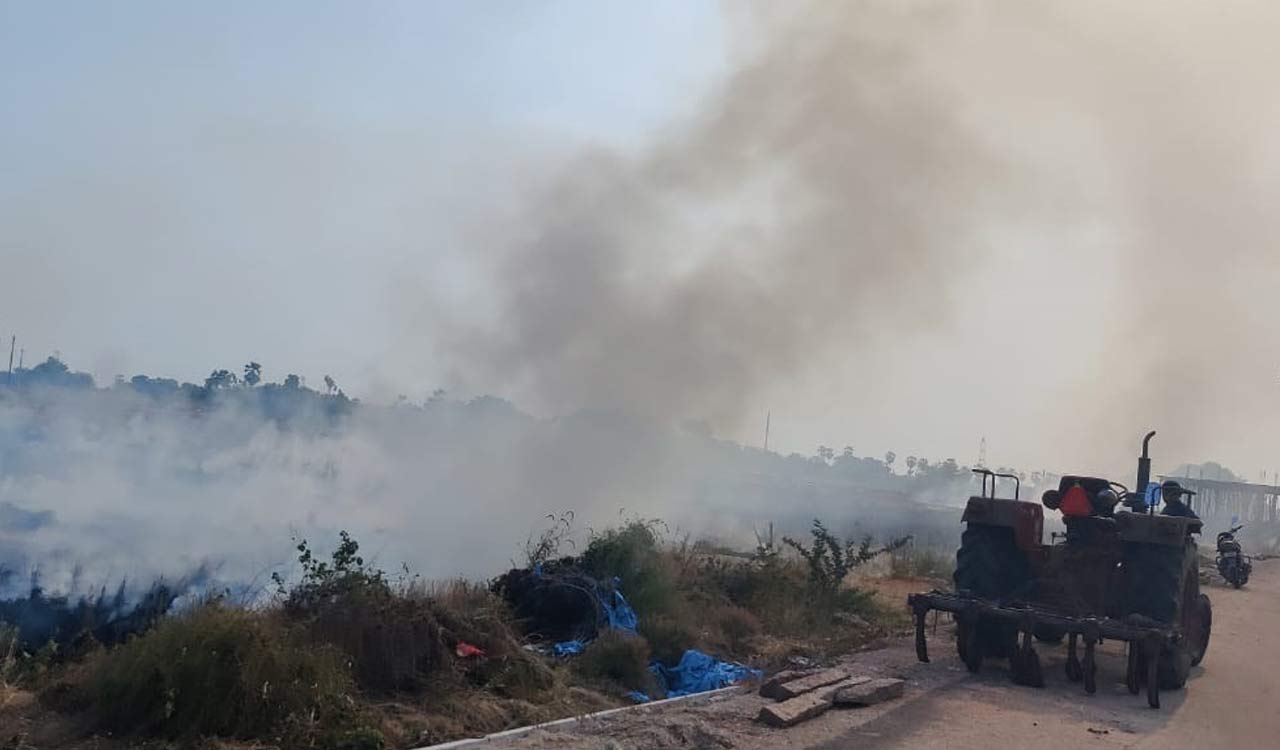
Paddy stubble burning, a practice linked to increased use of combine harvesters, is emerging as a major concern in Telangana. Eight farmers have died this summer, while experts warn of serious environmental damage, air pollution and risks to lives and property.
Published Date – 6 June 2026, 05:06 PM
Siddipet: Farm mechanisation was introduced to improve agricultural productivity and reduce dependence on manual labour. However, some of the unscientific practices that have accompanied increased mechanisation in Telangana are now emerging as serious threats to both farmers and the environment.
One such practice is paddy stubble burning, which was virtually unheard of in Telangana until four or five years ago. The widespread use of combine harvesters has significantly reduced the need for human labour in paddy harvesting. At the same time, it has led to the dangerous practice of burning paddy residue in fields, creating a growing concern across the State.
The consequences have been severe.
As many as eight farmers have died in incidents directly linked to stubble burning in Telangana this summer alone. Apart from the loss of human lives, several incidents have resulted in damage to cattle, irrigation pipelines, pump sets and horticulture orchards. Environmentalists are also raising concerns over the long-term ecological damage caused by the practice.
Stubble burning destroys organic matter in the soil, leading to gradual soil degradation. It also destroys insects, reptiles, birds and other organisms that form part of the local ecosystem. The resulting smoke contributes to air pollution and poses health risks to nearby communities.
The issue has become particularly alarming in recent weeks.
Agriculture experts point out that the problem is closely linked to the increasing use of combine harvesters. These machines typically leave behind six to ten inches of paddy straw in the field after harvesting. In contrast, manual harvesting leaves behind stubble of less than three inches, which naturally decomposes and enriches the soil before the next cultivation cycle.
Harvesters cannot cut the crop close to the ground because the rotating components of the machines could be damaged. As a result, substantial lengths of stubble remain in the field. For many farmers, setting fire to the residue becomes the quickest and least expensive way of clearing the land for the next crop.
However, this convenience comes at a heavy cost.
The practice, which has long been associated with Punjab and Haryana and has contributed significantly to severe air pollution in Delhi, is now gaining ground in Telangana. Experts warn that if corrective measures are not taken, the State could face similar environmental challenges in the future.
The human cost has already become evident.
Siddipet district alone reported two deaths related to stubble burning this week, while at least eight farmers have lost their lives across Telangana during the current summer season. In May this year, a farmer couple, Sagarla Chandramouli (65) and his wife Bhagyamma (58), were charred to death while burning crop residue in Repakapalli village of Jayashankar-Bhupalpally district. In another incident, Nunemetla Sathaiah (60), a farmer from Shaligouraram in Nalgonda district, lost his life under similar circumstances.
The damage has not been limited to human casualties. More than 60 sheep were killed in a fire triggered by stubble burning at Patharlapadu in Khammam district. In another incident, a tree weakened by the flames collapsed onto a moving car, causing an accident, though the occupants escaped with minor injuries.
Two farmers were also charred to death in separate incidents in the erstwhile Adilabad district. Similarly, Eluka Narayana (60) of Thallapalli village in Illanthakunta mandal of Rajanna-Sircilla district lost his life while burning paddy residue.
With the number of such incidents rising, concerns are growing that a practice adopted for convenience is increasingly becoming a threat to farmers’ lives, property and the environment.