On this State Formation Day, Telangana celebrates not only its geographical identity but also its people’s resilience and KCR’s visionary leadership, which turned a distant dream into reality
Published Date – 1 June 2026, 11:03 PM
By Deshapathi Srinivas
June 2nd marks a historic milestone in the annals of modern Indian history—the formation of Telangana as the 29th State of the Indian Union. The realisation of this decades-long dream was neither accidental nor easy; it was the culmination of an intense, emotionally charged, and structurally sophisticated public movement. At the epicentre of this monumental geopolitical shift was the Telangana Rashtra Samithi (TRS, now known as Bharat Rashtra Samithi — BRS) and its visionary founder K Chandrashekar Rao (KCR).
To understand the essence of Telangana’s Statehood is to understand a journey where Chandrashekhar Rao acted as the intellect, the catalyst, and the executor of a people’s collective will.
A Legacy of Discrimination
The roots of the Telangana movement trace back to a historic error made in 1956. The merger of the Telugu-speaking regions of Telangana and Andhra into a single State of Andhra Pradesh, against the explicit warnings of the States Reorganisation Commission (Fazal Ali Commission), proved detrimental. The commission had rightly noted that a mere shared language could not bridge the vast socio-economic and cultural disparities between the two regions.
Following the merger, Telangana quickly transitioned from a self-sufficient region into an “internal colony.” The promises made in the “Gentlemen’s Agreement” were systematically violated. For over five decades, the people of Telangana faced severe discrimination in three core areas, locally summarised as:
- Neellu (Water): River waters were diverted away from Telangana’s parched lands.
- Nidhulu (Funds): Wealth generated in Telangana was disproportionately spent on developing other regions.
- Niyaamakaalu (Employment): Locals were denied government job opportunities, which were instead filled by outsiders.
The Tragedy of 1969 and the Era of Disillusionment
The stifling oppression led to the fierce “First Phase” of the Telangana movement between 1969 and 1971. Driven primarily by students and intellectuals, the movement faced brutal state suppression, resulting in the martyrdom of 369 students. Despite overwhelming democratic mandates in which regional parties swept parliamentary seats on the statehood plank, the ruling political establishment (chiefly the Congress party) compromised the movement through political absorption and empty promises.
This betrayal left the people of Telangana deeply disillusioned. For the next three decades, political opportunism ruled the day. Traditional politicians raised the Telangana banner for personal gains and shelved it upon receiving cabinet berths. By the late 1990s, the identity of Telangana was systematically erased to the extent that even uttering the word ‘Telangana’ on the Assembly floor was heavily discouraged.
2001: KCR and the Rebirth of Hope
When the embers of the movement had nearly cooled, K. Chandrashekhar Rao infused fresh life into the struggle. On April 27, 2001, he resigned from his high-profile legislative post and launched the TRS, declaring that Telangana would no longer accept subjugation.
Chandrashekhar Rao’s greatest initial challenge was not fighting the state, but fighting the profound scepticism embedded in his own people. By sacrificing his political power at the very outset, he established credibility and disproved the notion that the Telangana sentiment was merely a tool for political bargaining.
The Paradigm Shift: A Peaceful and Constitutional Struggle
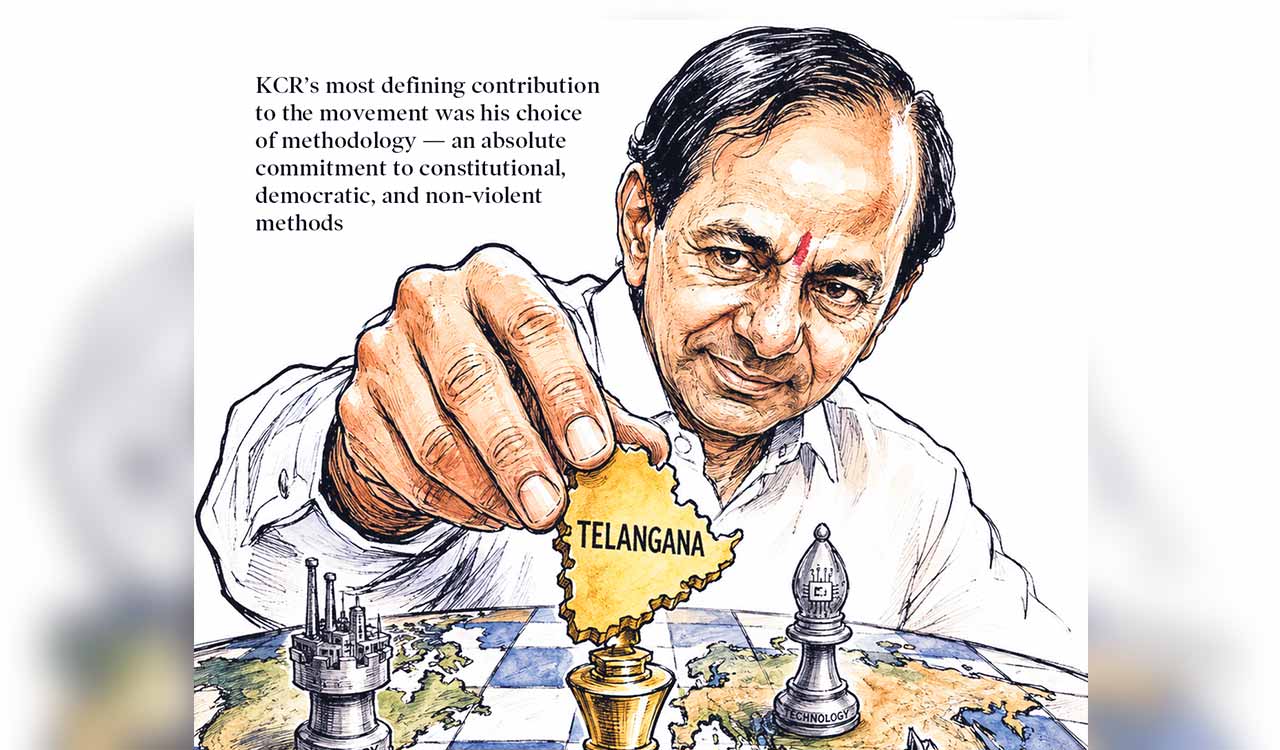
Chandrashekhar Rao’s most defining contribution to the movement was his choice of methodology. Prior to 2001, public agitations were often synonymous with violence, state crackdowns, or underground insurgencies. Rao chose a radically different path: an absolute commitment to constitutional, democratic, and non-violent methods.
He innovated unique forms of mass protests that minimised property and human loss while maximising public participation and political pressure. Under his guidance, the movement utilised:
- Sakal Janula Samme: A massive, all-people strike that brought administration to a standstill.
- Vanta-Varpu: Mass cooking on the highways to register peaceful protest.
- Electoral Leverage: Using every single local and general election as a referendum on statehood, forcing national parties to acknowledge the issue.
Navigating the Labyrinths of National Politics
Rao proved to be an astute diplomat on the national stage. In 2004, he successfully pushed the Telangana issue onto the National Common Minimum Programme of the UPA government. Alongside intellectuals like Professor Jayashankar, he walked the corridors of power in New Delhi, knocking on every political door. His relentless advocacy resulted in 36 national political parties submitting letters of support for the creation of Telangana to the Pranab Mukherjee Committee.
When the ruling coalition attempted to stall the process, TRS leaders demonstrated unparalleled integrity by resigning from their Union and State cabinet portfolios—a rare phenomenon in Indian political history where power was willingly sacrificed for an ideological goal.
The Ultimate Weapon: The Fast Unto Death
The turning point came in late 2009. Sensing a deep political conspiracy to suppress the movement permanently, Rao launched his ultimate weapon—a “Fast Unto Death” beginning November 27, 2009.
As his health deteriorated over 11 days, the entire region erupted. Universities turned into epicentres of passion, streets became seas of humanity, and the entire nation watched in collective anxiety.
Realising that any harm to Rao would lead to uncontrollable unrest, the Central government relented. On the historic midnight of December 9, 2009, the Union Home Minister announced the commencement of the process for forming a separate Telangana State.
A Dream Realised
Though the establishment tried to backtrack by forming committees, the momentum Rao built was unstoppable. Through strategic alliances, constant legislative pressure, and unyielding public support, the resistance finally culminated in triumph. On June 2, 2014, the new State of Telangana was officially born.
As former President of India Pranab Mukherjee profoundly noted, Rao achieved a rare and magnificent feat in modern history: spearheading a massive public movement and successfully delivering its ultimate objective within his own lifetime.
On this State Formation Day, Telangana celebrates not just its geographical identity but the resilience of its people and the masterful leadership of the architect who turned a distant dream into a vibrant reality.
(The author is an MLC)