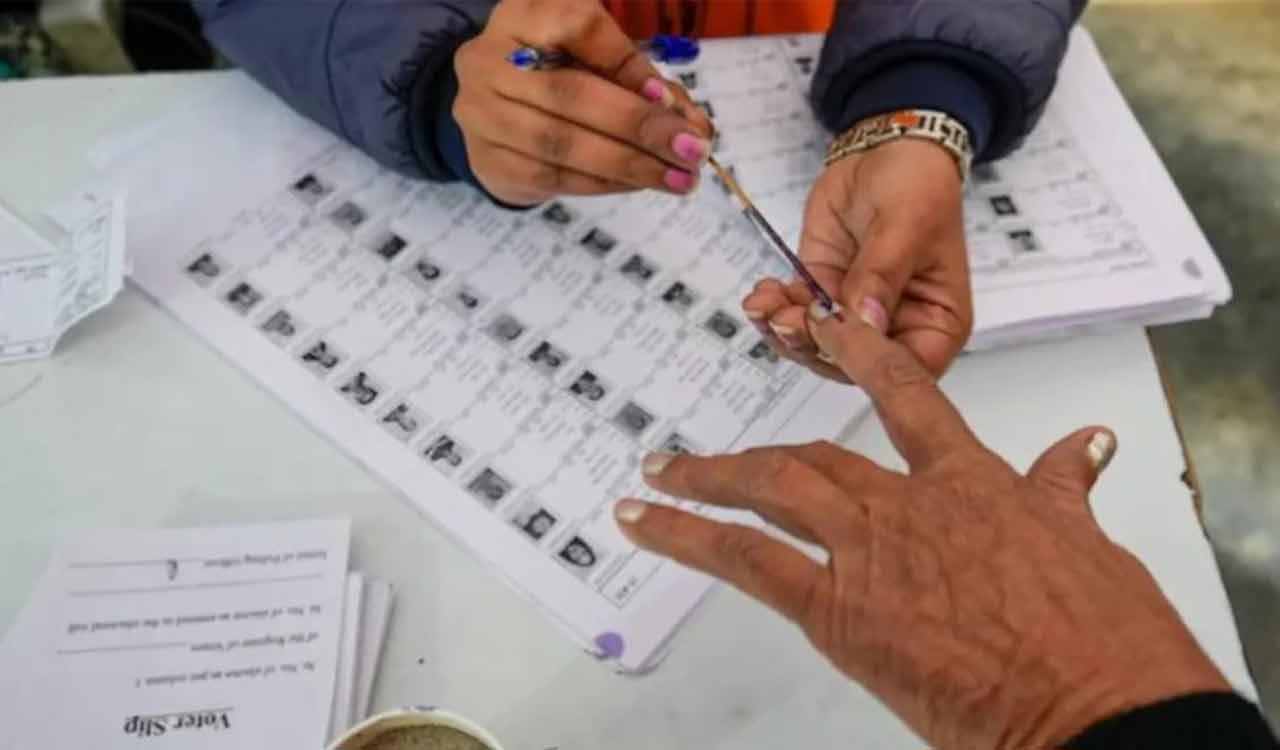
Telangana’s Special Intensive Revision exercise, scheduled from June 25 to July 24, aims to identify duplicate voter registrations and ensure that each voter remains enrolled in only one Assembly constituency and one state through extensive verification and enumeration
Published Date – 30 May 2026, 05:11 PM
Hyderabad: The massive exercise of the Special Intensive Revision (SIR) to be taken up in Telangana will ensure that a person registered as a voter in two states can retain voting rights in only one state.
Hitherto, if a person got registered as a voter in, say, Telangana and Andhra Pradesh or Maharashtra or Karnataka, they could cast a vote in another state in addition to Telangana as the polling dates differed. Sometimes, one could vote in Assembly elections in one state and in Parliamentary elections in another state. However, the SIR to be taken up in Telangana from June 25 to July 24 will ensure that such voters retain their voting rights in only one state.
Telangana has 3,39,24,664 voters, comprising 1,68,18,902 men, 1,71,02,883 women and 2,879 transgender voters. A significant number of people, particularly those residing in Hyderabad, continue to retain voter registrations in their native places, including neighbouring Andhra Pradesh and other states.
Under the SIR exercise, voters will be required to remain enrolled in only one Assembly constituency and one state. Election officials say duplicate enrolments will be identified and removed through a comprehensive verification process. The state has 35,985 polling stations, including 28,653 stations with fewer than 1,200 voters and 7,332 stations with more than 1,200 voters.
For this massive exercise, officials will take up a house-to-house verification drive from June 25 to July 24, during which Booth Level Officers (BLOs) will distribute Enumeration Forms (EFs) and collect voter details. Acknowledgement receipts will be issued after submission.
The information will then be verified through a dedicated software system capable of detecting duplicate enrolments across Assembly constituencies, Parliamentary constituencies and different states. If a voter is found to be registered in more than one constituency or state, they will be required to choose a single place of enrolment.
Officials clarify that the objective of the SIR is to ensure that every eligible citizen is included in the electoral rolls while preventing ineligible or duplicate entries. Addressing concerns raised by some political parties regarding possible deletion of voters, officials said that BLOs would ascertain the status of voters who fail to submit Enumeration Forms.
Reasons such as absence, migration, death or duplication would be verified through inquiries with neighbours and in the presence of Booth Level Agents (BLAs), who represent political parties. Only after such verification would names be excluded from the draft electoral rolls.
What if a family member is abroad or working in another city?
If a voter is employed abroad or working in another city or state, an adult family member can receive the Enumeration Form, fill in the details on the voter’s behalf, sign it and submit it to the BLO.
What if the entire family is out of station?
Voters who are away during the house-to-house enumeration process can submit the Enumeration Form online through the ECI’s voter services portal.
What documents are required during enumeration?
No documents are required during the enumeration phase. However, after publication of the draft electoral rolls, the Electoral Registration Officer (ERO) may issue notices to voters whose details could not be linked or where discrepancies are found. In such cases, voters may be asked to furnish documents to establish eligibility.
These include government-issued identity cards, certificates or documents issued by government departments, local authorities, banks, post offices, LIC or public sector undertakings before July 1, 1987, birth certificates, passports, educational or matriculation certificates, Permanent Residence Certificates, OBC, SC, ST or other caste certificates, and others.