Groundwater data from the Central Ground Water Board indicates Telangana’s record paddy production was supported by recharge created during the BRS regime through Kaleshwaram, Mission Kakatiya and Mission Bhagiratha. Experts warned that declining reserves and delayed Medigadda repairs could trigger irrigation stress ahead
Published Date – 17 May 2026, 09:09 PM
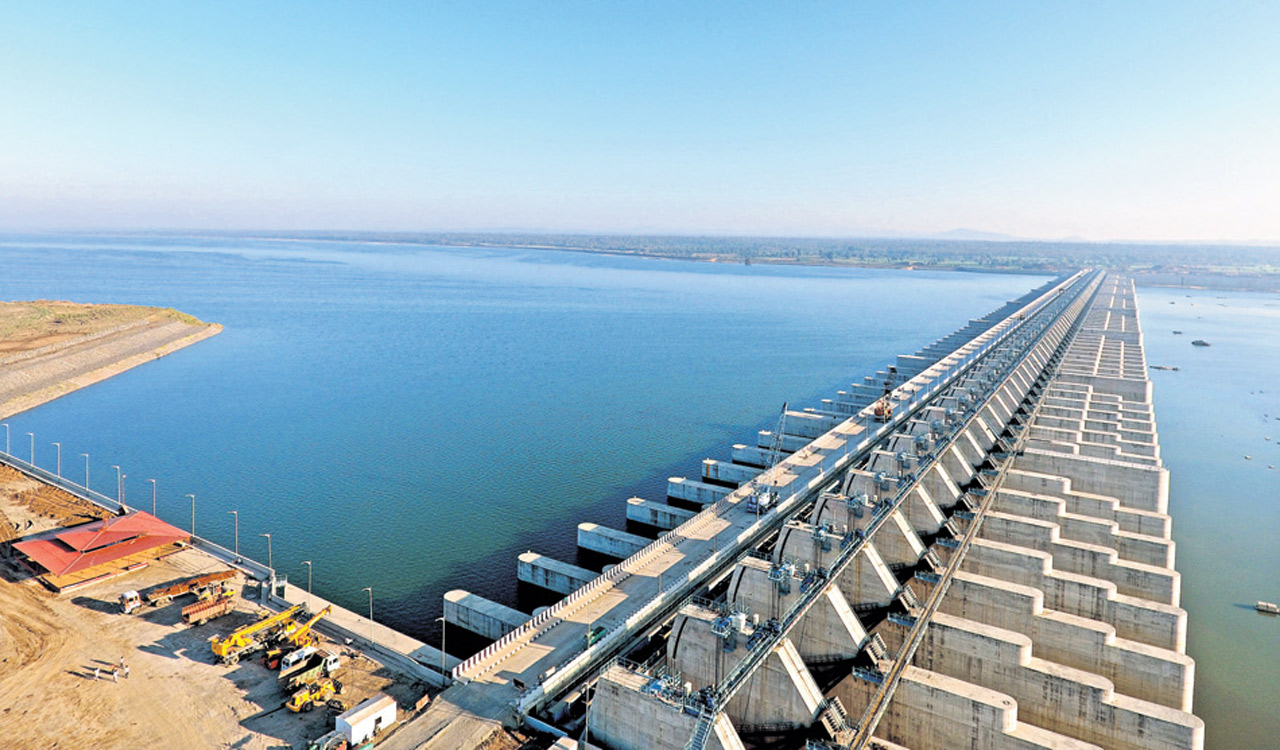
Hyderabad: Over the past two years, the Congress government has repeatedly argued that the Kaleshwaram Lift Irrigation Scheme (KLIS) is redundant and that Telangana’s record paddy output of 2.8 crore tonnes in 2025-26, achieved in its absence, proved the claim. However, data suggests otherwise, indicating that the bumper harvest was made possible by the groundwater reserves built during the previous BRS regime and that those reserves are now thinning.
A detailed analysis of successive editions of the National Compilation on Dynamic Ground Water Resources of India, published by the Central Ground Water Board (CGWB), affirmed that Telangana’s agricultural surge was directly linked to large-scale groundwater recharge created through the Kaleshwaram Lift Irrigation Scheme, Mission Kakatiya and Mission Bhagiratha during the BRS years.
CGWB contradicts Congress’ claims
The CGWB’s 2022 report explicitly attributed Telangana’s improving groundwater position to “government interventions like water conservation activities under Mission Kakatiya, improvement in surface water irrigation and drinking water supply under Mission Bhagiratha.”
Total annual groundwater recharge rose sharply from 16.63 bcm (billion cubic metres) in 2020 to 21.11 bcm, while the stage of groundwater extraction dropped from 53.32 per cent to 41.6 per cent.
The 2023 report recorded that recharge climbed from 21.27 bcm to 23.14 bcm, with the CGWB again directly crediting Mission Kakatiya, Mission Bhagiratha and expanded surface irrigation. Extractable groundwater resources reached 20.92 bcm, and extraction stress eased further to 38.65 per cent.
Irrigation experts stated that this period coincided with the full-scale expansion of the Kaleshwaram project under Chief Minister K Chandrashekhar Rao. Large inflows into reservoirs, tanks and irrigation channels lifted groundwater tables across several districts, particularly in north Telangana, where paddy cultivation expanded rapidly.
Decline under Congress
The situation began reversing after the change of government in December 2023. The CGWB’s 2024 report recorded a sharp fall in total annual recharge from 23.14 bcm to 20.40 bcm, attributing it “mainly to a decrease in recharge from other sources.” Extractable resources fell from 20.92 bcm to 18.44 bcm, extraction rose from 8.09 bcm to 8.47 bcm, and the extraction stage worsened from 38.65 per cent to 45.91 per cent.
Experts interpreted the phrase “other sources” as indirect recharge generated through large irrigation systems, tanks, canals and drinking water infrastructure, the very networks sustained by Kaleshwaram, Mission Kakatiya and Mission Bhagiratha.
The 2025 report showed a partial recovery, with recharge rising to 21.93 bcm due to heavy rains. However, this remained well below the 2023 peak. Extraction climbed further to 9.26 bcm, pushing the extraction stage to 46.69 per cent.
Agricultural experts argued that the Congress government was utilising groundwater reserves accumulated during years of heavy BRS-era recharge and not from any comparable irrigation intervention of its own. Despite nearly two years in office, the government has yet to restore operations at the damaged Medigadda barrage, a critical component of the Kaleshwaram project network.
Irrigation specialists warned that the current agricultural stability may not hold. Unless repairs to the Medigadda barrage are completed urgently and the Kaleshwaram system is fully restored before the next crop cycle, Telangana could face severe irrigation stress in 2026-27, particularly if monsoon conditions disappoint.
The groundwater data increasingly suggests that Telangana’s paddy expansion was not created overnight by the present government, but was the cumulative outcome of large-scale irrigation and water conservation infrastructure built over the previous decade.