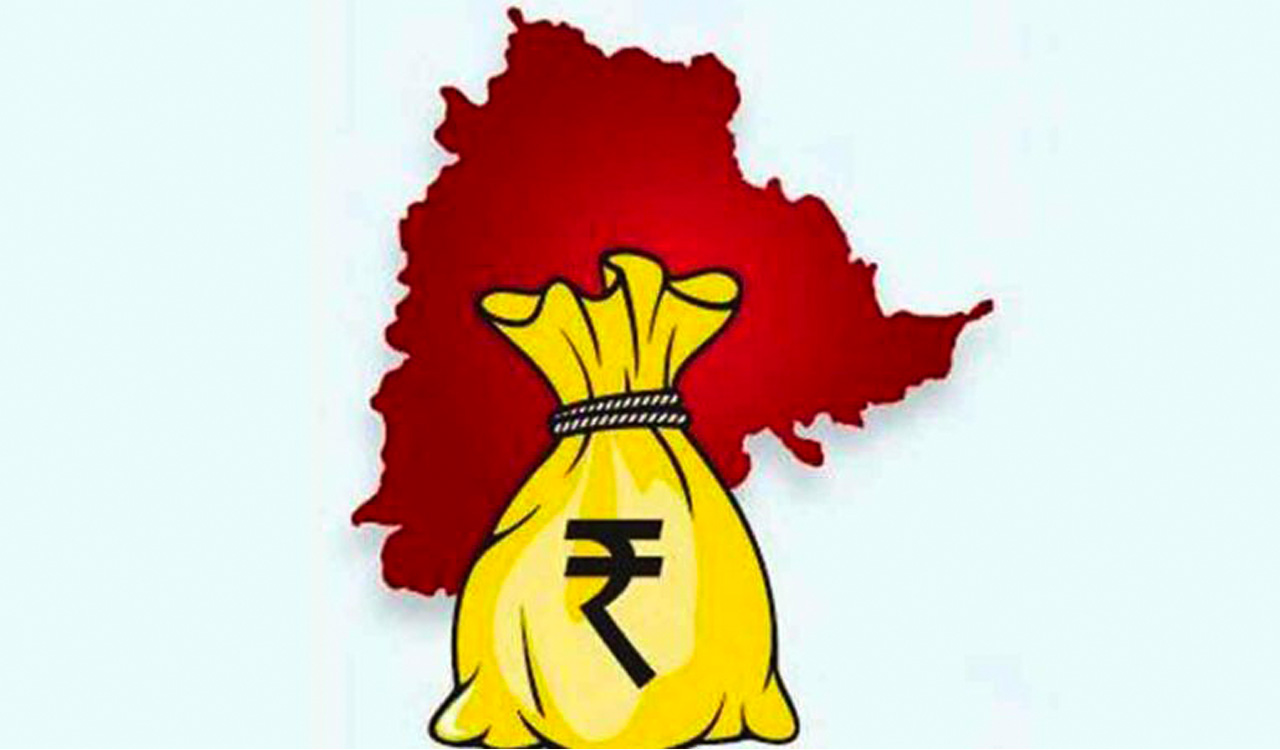
Telangana ended FY26 with a revenue deficit of Rs 9,235 crore and a fiscal deficit of Rs 77,762 crore, according to the preliminary CAG report. Revenue collections missed targets sharply, while borrowings and interest payments increased significantly, raising concerns over fiscal sustainability.
Published Date – 14 May 2026, 03:33 PM
Hyderabad: Telangana ended the financial year 2025-26 under severe fiscal stress, with the State slipping into a sharp revenue deficit of Rs 9,235 crore, while total revenue collections failed to cross the ambitious Rs 2 lakh crore mark.
The reversal was significant. The Revanth Reddy government had originally projected a revenue surplus of Rs 2,738 crore in the State budget, but closed the year with a substantial deficit, indicating growing pressure on public finances and increasing dependence on borrowings even for routine expenditure.
According to the preliminary Comptroller and Auditor General (CAG) report for 2025-26, the fiscal deficit surged to Rs 77,762 crore against the budget estimate of Rs 54,009 crore, marking an overshoot of nearly 44 per cent. The primary deficit, which excludes interest payments and reflects the government’s core fiscal position, stood at Rs 48,082 crore against the budgeted Rs 34,640 crore, an increase of nearly 39 per cent. Economists said the figures suggested that the State was spending far beyond its sustainable capacity.
Telangana recorded total revenue receipts of around Rs 1.81 lakh crore, achieving only about 79 per cent of the budget estimate of Rs 2.29 lakh crore. Though marginally better than the previous year’s achievement rate of 75.85 per cent, the State still faced a shortfall of over Rs 47,000 crore in total revenue receipts.
State tax revenue stood at Rs 1.52 lakh crore against the target of Rs 1.75 lakh crore. GST, sales tax and State excise collections remained the major contributors. However, non-tax revenue reached only Rs 18,986 crore, about 60 per cent of the budget estimate, pointing to the government’s weak performance in generating revenue beyond taxation.
Grants-in-aid and Central contributions emerged as another weak area, with the State receiving only Rs 10,423 crore, or 45.75 per cent of the budget estimate. This exposed Telangana’s inability to fully leverage Central transfers and external funding support.
Meanwhile, borrowings and other liabilities rose sharply to Rs 77,762 crore, far exceeding the budget projection of Rs 54,009 crore. The growing debt burden was reflected in rising interest payments, which increased to Rs 29,679 crore during 2025-26 from Rs 26,688 crore in the previous year.
Capital expenditure increased significantly to Rs 52,905 crore from Rs 35,286 crore in 2024-25. While the government projected this as infrastructure-driven growth, economists cautioned that debt-funded capital spending without corresponding revenue growth could create long-term repayment stress. They pointed out that, unlike the previous BRS regime, which linked capital expenditure to visible economic expansion, the Congress government had yet to showcase major growth-generating projects despite more than two years in office.
The report also raised concerns over transparency. The Accountant General noted that details relating to outstanding government guarantees and public account borrowings as on March 31, 2026, had not been furnished by the State government. Fiscal experts warned that the absence of such disclosures could conceal off-budget liabilities and additional financial risks.
Overall, the numbers pointed to a government that consistently overestimated revenues and underestimated expenditure during budget preparation. Telangana, which was once considered among the fiscally stronger States in the country, is increasingly moving towards a debt-driven financial model marked by rising liabilities and shrinking fiscal flexibility.